HiPPT
wrist-PPG encoder aligned to text at record, cross-recording and generative scopes
Activity counts measure attention, not model quality. Missing counts are unknown. Publication status follows the linked source; a listed venue alone does not confirm peer review.
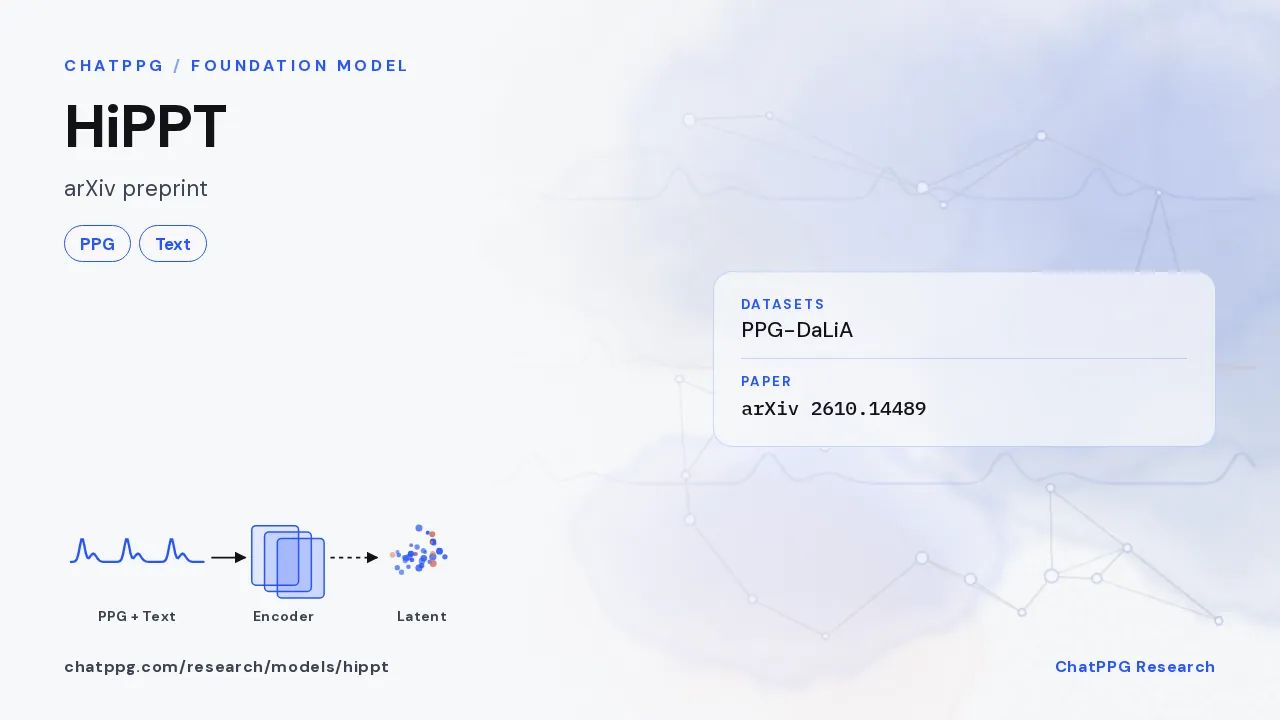
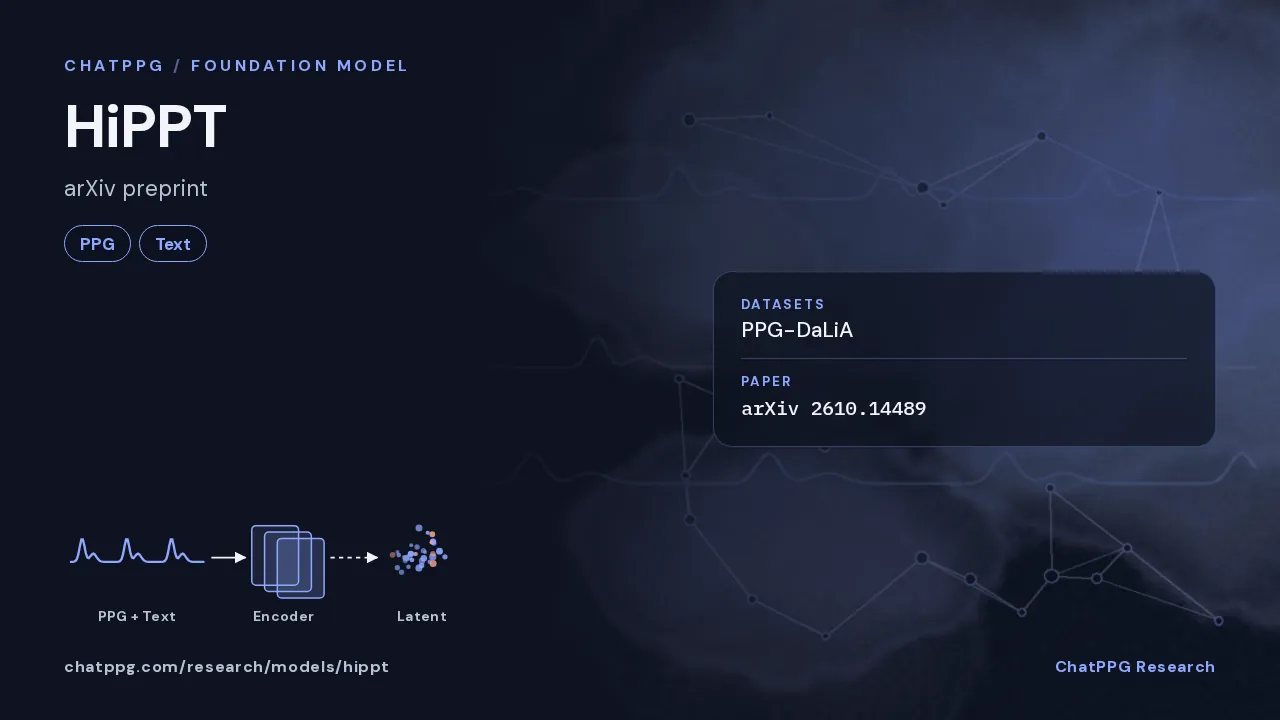
HiPPT trains a wrist PPG encoder by aligning recordings with text at different scopes. The authors built a corpus of more than 4 million wrist recordings from 202K users, each paired with descriptions of pulse shape and context. Individual recordings are aligned with their morphology, and groups of recordings that share the same context are aligned together.
- Published: arXiv preprint, 2026
- Pretraining: 4M+ wrist PPG recordings from 202K users
- Method: record-level morphology + cross-recording context text alignment
Abstract
Reusable wearable PPG representations should capture local pulse morphology and broader physiological regularities. Existing pretraining objectives, however, usually apply supervision at the recording or pair level, overlooking that different concepts become reliable over different scopes of waveform evidence. We propose HiPPT, a physiology-grounded framework that matches each supervision source to its appropriate evidence scope. We construct a PPG-Text corpus of over 4 million wrist-worn recordings from 202K users, pairing recordings with waveform-derived morphology and metadata-derived context descriptions. HiPPT combines record-level morphology alignment, which grounds individual recordings in pulse characteristics, with cross-recording context alignment, which aggregates recordings sharing the same metadata tuple to capture context-consistent regularities. Waveform-guided text modeling further recovers masked contextual concepts from PPG patch representations, providing fine-grained waveform-text supervision. Across six downstream tasks spanning blood pressure, vascular stiffness, physiological attributes, and cross-dataset heart-rate estimation, HiPPT achieves the best result on the primary linear-probing metrics. The aligned space also supports zero-shot profiling of age group, sex, and BMI category, individually and jointly, with performance improving as more recordings are aggregated. These results show that evidence-scope matching yields transferable and semantically accessible wearable PPG representations. Code and pretrained weights will be released.
Verbatim fromarXiv· arXiv metadata (abstracts are released under CC0)
Key results
How it works
Datasets linked in the hub; pretraining vs evaluation roles follow the paper.
- Pretraining data
- Proprietary OPPO smartwatch PPG: ~4M 1-min recordings at 250 Hz from ~202K users (HBPM-BG 1.3M/1,086 users + VS ~3M/200.5K users)
- Inputs
- PPG, Text
- Approach
- PPG FM · PPG text alignment · sensor language · wrist · OPPO · PubMedBERT
Devices· 2
Illustrations by form factor; product photos are added as licences clear.
Leaderboard rows· 1
All leaderboards| Task | Dataset | Metric | Value | Rank |
|---|---|---|---|---|
| Heart rate estimation | PPG-DaLiA | MAE (bpm) ↓ | 7.65 | #6 / 11 |
Datasets· 1
Papers· 1
Cite
@misc{hippt2026,
  title = {{HiPPT}},
  author = {Jiaqi Wang and Wei Chen and Xiaoyu Li and Lexian Xia and ShuaiLong Tang and Chenran Zhang and Donglin Xie and Guangpu Zhu and Yelei Li and Yi Zhou},
  year = {2026},
  howpublished = {arXiv preprint},
  eprint = {2610.14489},
  url = {https://arxiv.org/abs/2610.14489}
}History
Added to the ChatPPG research hub
More on ChatPPG
- PPG-DaLiA
PPG dataset for motion compensation / HR
- HiPPT: Physiology-Grounded Wearable PPG Representation Learning via Multi-Scope Text Alignment
HiPPT trains a wrist PPG encoder by aligning recordings with text at different scopes. The authors b
- Heart rate estimation leaderboard
Benchmark results for heart rate estimation
- Aether
compute-optimal physiological waveform FM family (20M–2.1B)
- AI-PPG age (PPG-VascularAge)
Foundation model