PaperarXiv:2610.33788
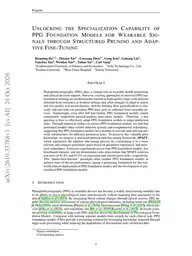
Unlocking the Specialization Capability of PPG Foundation Models for Wearable Signals through Structured Pruning and Adaptive Fine-Tuning (SPAFT)
arXiv 2610.33788v1 (cs.AI, 24 Oct 2026); ICLR 2027 submission (under review)
TL;DR
SPAFT adapts pretrained PPG foundation models in two stages: structural pruning (importance-guided filter deletion + SRR-guided block selection) removes redundant capacity, then selective filter fine-tuning with adaptive blockwise allocation updates only a compact subspace. The authors argue even fully fine-tuned PPG FMs often fail to beat general time-series models, and that pretrained PPG FMs carry exploitable sparsity.
- Form factor: wrist / ring / fingertip (downstream datasets)
Abstract
Photoplethysmography (PPG) plays a central role in wearable health monitoring and clinical decision support. However, existing approaches to universal PPG representation learning are predominantly trained on high-quality large-scale datasets obtained from oximeters in hospital settings and often struggle to adapt to sparse and low-quality real-world datasets, thereby limiting their generalization to clinically relevant tasks on prevalent PPG data such as collected from wearable devices. Surprisingly, even after full fine-tuning, PPG foundation models cannot consistently outperform general-purpose time-series models. Therefore, a key question is how to effectively adapt PPG foundation models to target prediction tasks. Through empirical studies on various PPG foundation models, we find that pretrained models often exhibit inherent sparsity and computational redundancy, suggesting that PPG foundation models have learned to activate task-relevant network substructures for different prediction tasks. To preserve this valuable prior knowledge, we propose a structured pruning-and-fine-tuning framework, SPAFT, which regularizes the adaptive fine-tuning process by constraining it to a more relevant and compact parameter space based on parameter importance and structural redundancy. Extensive experiments across four PPG foundation models, five benchmark datasets, and ten downstream tasks demonstrate that SPAFT achieves win rates of 82.8% and 87.5% on regression and classification tasks, respectively. This prune-then-finetune paradigm often enables PPG foundation models to achieve state-of-the-art performance, laying a promising foundation for the real-world clinical deployment of PPG foundation models and the development of personalized PPG foundation models.
Verbatim from arXiv (opens in a new tab) · arXiv metadata (abstracts are released under CC0)
Results on ChatPPG leaderboards · 2
All leaderboards| Leaderboard | Method | Result | Rank |
|---|---|---|---|
| uci-bp MAE (mmHg)Cuffless blood pressure estimation | Unlocking the Specialization Capability of PPG… | 8.345MAE (mmHg), lower is better | #3 of 3 |
| PPG-DaLiA MAE (BPM)Heart rate estimation | Unlocking the Specialization Capability of PPG… | 5.066MAE (BPM), lower is better | #11 of 19 |
2 rows are credited to this paper. Ranks apply within each leaderboard only, as reported by the source.
Tasks & signals
Tasks
Signals
Devices
Keywords
Datasets used
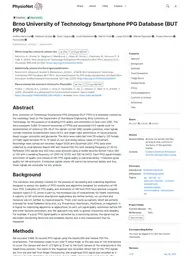 Brno University of Technology Smartphone PPG Database (BUT PPG)50 subjects · PPG · ECG
 PPG-DaLiAPPG dataset for motion compensation / HREvaluation15 subjects · PPG · ECG · IMU
 Stanford wrist PPG AF (DeepBeat)Torres-Soto & Ashley 2020, Synapse syn21985690PPG
 UCI Cuff-Less Blood Pressure Estimation (UCI 340; Kachuee 2015)EvaluationPPG · ECG · BP
How it works
Cite this paper
Unlocking the Specialization Capability of PPG Foundation Models for Wearable Signals through Structured Pruning and Adaptive Fine-Tuning (SPAFT). (2026). arXiv 2610.33788v1. https://arxiv.org/abs/2610.33788
@misc{spaftppgfmstruct2026unlocking,
  title         = {{Unlocking the Specialization Capability of PPG Foundation Models for Wearable Signals through Structured Pruning and Adaptive Fine-Tuning (SPAFT)}},
  year          = {2026},
  howpublished  = {arXiv 2610.33788v1},
  eprint        = {2610.33788},
  archivePrefix = {arXiv}
}Record updated
Added to the ChatPPG research hub