TL;DR
This scoping review covers deep learning methods for PPG data. It finds that deep learning generally beats handcrafted-feature approaches and is more flexible, but notes ongoing problems: few large high-quality datasets, little real-world validation, and concerns about interpretability, scalability and efficiency.
- Type: scoping review
- Gaps: datasets, real-world validation, interpretability, efficiency
Abstract
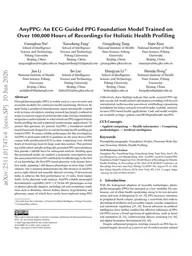
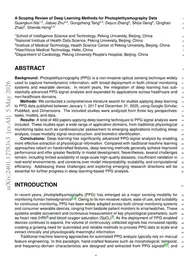
Background: Photoplethysmography (PPG) is a non-invasive optical sensing technique widely used to capture hemodynamic information, with broad deployment in both clinical monitoring systems and wearable devices. In recent years, the integration of deep learning has substantially advanced PPG signal analysis and expanded its applications across healthcare and non-healthcare domains. Methods: We conducted a comprehensive literature search for studies applying deep learning to PPG data published between January 1, 2017 and December 31, 2025, using Google Scholar, PubMed, and Dimensions. The included studies were analyzed from three key perspectives: tasks, models, and data. Results: A total of 460 papers applying deep learning techniques to PPG signal analysis were included. These studies span a wide range of application domains, from traditional physiological monitoring tasks such as cardiovascular assessment to emerging applications including sleep analysis, cross-modality signal reconstruction, and biometric identification. Conclusions: Deep learning has significantly advanced PPG signal analysis by enabling more effective extraction of physiological information. Compared with traditional machine learning approaches reliant on handcrafted features, deep learning methods generally achieve improved performance and offer greater flexibility in model development. Nevertheless, several challenges remain, including limited availability of large-scale high-quality datasets, insufficient validation in real-world environments, and concerns over model interpretability, scalability, and computational efficiency. Addressing these challenges and exploring emerging research directions will be essential for further progress in deep learning-based PPG analysis.
Verbatim from arXiv (opens in a new tab) · arXiv metadata (abstracts are released under CC0)
Results on ChatPPG leaderboards
All leaderboardsNo results from this paper on ChatPPG leaderboards yet. Browse the leaderboards.
Tasks & signals
Devices
Datasets used
 PPG-DaLiAPPG dataset for motion compensation / HR15 subjects · PPG · ECG · IMU
 PulseDB v2.0cleaned MIMIC-III + VitalDB cuffless-BP benchmark (MIMIC part ODbL; VitalDB part CC BY-NC-SA)5,361 subjects · PPG · ECG · BP
 VitalDBintraoperative multi-parameter vitals (PhysioNet mirror)6,388 subjects · PPG · ECG · BP
How it works
Cite this paper
Nie, G., Zhu, J., Tang, G., Zhang, D., Geng, S., Zhao, Q., & Hong, S. (2024). ppg-dl-scoping-review-nie-2024. arXiv preprint.
Nie, Guangkun, Jiabao Zhu, Gongzheng Tang, Deyun Zhang, Shijia Geng, Qinghao Zhao, and Shenda Hong. 2024. "ppg-dl-scoping-review-nie-2024." arXiv preprint.
Nie, G., Zhu, J., Tang, G., Zhang, D., Geng, S., Zhao, Q. and Hong, S. (2024) 'ppg-dl-scoping-review-nie-2024', arXiv preprint.
Nie, Guangkun, et al. "ppg-dl-scoping-review-nie-2024." arXiv preprint, 2024.
G. Nie et al., "ppg-dl-scoping-review-nie-2024," arXiv preprint, 2024.
@misc{nie2024ppgdlscopingreviewnie2024,
  title         = {{ppg-dl-scoping-review-nie-2024}},
  author        = {Nie, Guangkun and Zhu, Jiabao and Tang, Gongzheng and Zhang, Deyun and Geng, Shijia and Zhao, Qinghao and Hong, Shenda},
  year          = {2024},
  howpublished  = {arXiv preprint}
}Record updated