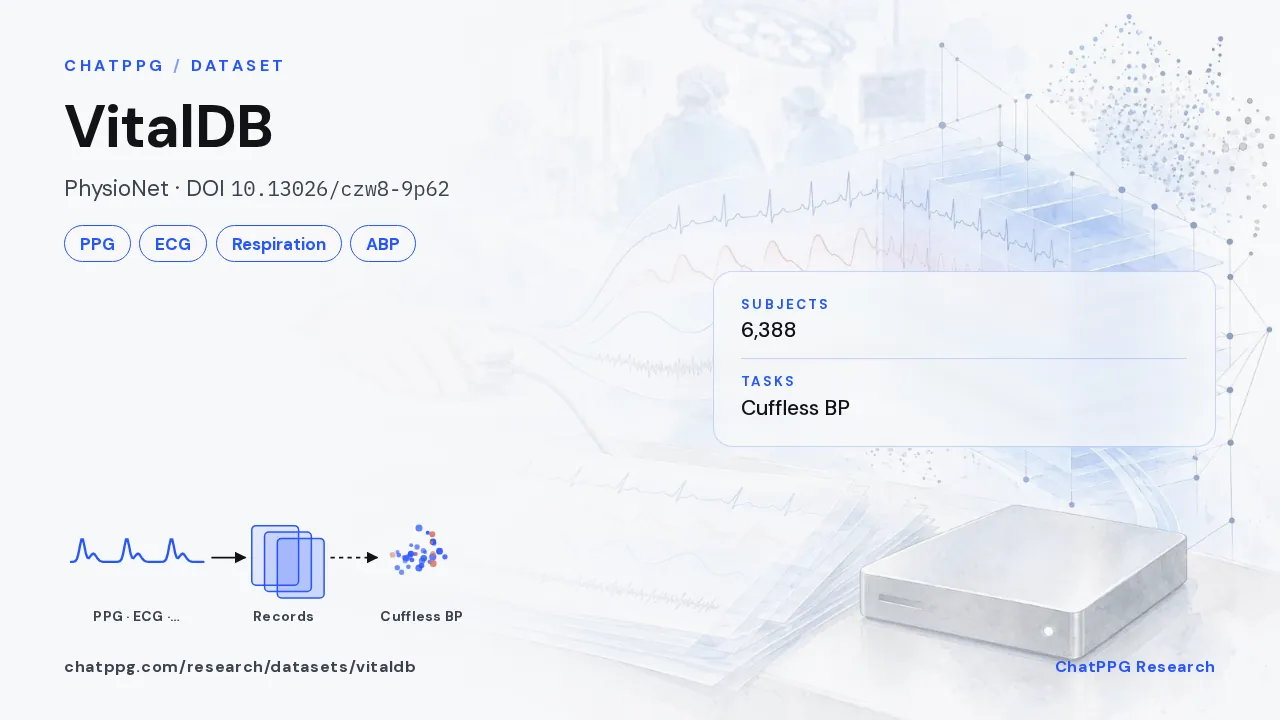
VitalDB is a high-fidelity, multi-parameter vital signs database of surgical patients from Seoul National University Hospital. It is described in "VitalDB, a high-fidelity multi-parameter vital signs database in surgical patients" by Hyung-Chul Lee and colleagues in Scientific Data 9:279 (2022), and the dataset is on PhysioNet as version 1.0.0 from Hyung-Chul Lee and Chul-Woo Jung.
Anaesthesia teams watch many devices at once during surgery, and interpreting the changes and correlations in those signals is hard even for experienced anaesthesiologists. The authors had already built the Vital Recorder program, which captures time-synchronized high-resolution data from patient monitors, anaesthesia machines, brain monitors, infusion pumps and other devices. VitalDB is the public release of that data. The authors describe it as the first public biosignal dataset focused specifically on perioperative care with both high-resolution waveforms and numeric data.
The dataset covers 6,388 cases with 486,451 waveform and numeric data tracks of 196 intraoperative monitoring parameters, along with perioperative clinical information and laboratory results. Waveforms are recorded at 62.5 to 500 Hz and numeric data at a resolution of 1 to 7 seconds, depending on the device, and each case file contains an average of 2.8 million data points. Cases get random identifiers, with a separate subject identifier so that reoperations can be linked. Data collection was approved by the Seoul National University Hospital institutional review board and registered at clinicaltrials.gov (NCT02914444).
For PPG research, VitalDB matters because it pairs the pulse oximeter PPG waveform with invasive arterial blood pressure and ECG in thousands of surgical cases. That makes it a core source for cuffless blood pressure work. PulseDB, for example, is built from VitalDB and MIMIC-III, and many PPG foundation model papers use VitalDB subsets.
On PhysioNet the full release is 95.4 GB and open access under the Creative Commons Attribution 4.0 International license, stored as .vital files plus CSV clinical tables. The database was first released in 2018 at vitaldb.net, and the paper notes it can also be accessed through application programming interfaces and a Python library.
Cases
6,388 surgical cases, Seoul National University Hospital
Sampling
waveforms 62.5 to 500 Hz; numerics every 1 to 7 seconds
PhysioNet size
95.4 GB; DOI 10.13026/czw8-9p62
License on PhysioNet
CC BY 4.0
Paper
Lee et al., Scientific Data 9:279 (2022), doi 10.1038/s41597-022-01411-5
Tracks
486,451 waveform and numeric tracks of 196 intraoperative parameters
In modern anesthesia, multiple medical devices are used simultaneously to comprehensively monitor real-time vital signs to optimize patient care and improve surgical outcomes. However, interpreting the dynamic changes of time-series biosignals and their correlations is a difficult task even for experienced anesthesiologists. Recent advanced machine learning technologies have shown promising results in biosignal analysis, however, research and development in this area is relatively slow due to the lack of biosignal datasets for machine learning. The VitalDB (Vital Signs DataBase) is an open dataset created specifically to facilitate machine learning studies related to monitoring vital signs in surgical patients. This dataset contains high-resolution multi-parameter data from 6,388 cases, including 486,451 waveform and numeric data tracks of 196 intraoperative monitoring parameters, 73 perioperative clinical parameters, and 34 time-series laboratory result parameters. All data is stored in the public cloud after anonymization. The dataset can be freely accessed and analysed using application programming interfaces and Python library. The VitalDB public dataset is expected to be a valuable resource for biosignal research and development.
Verbatim fromPhysioNet· Licence: Creative Commons Attribution 4.0 International Public License
VitalDB: overview
VitalDB is an open database of high-resolution vital signs from 6,388 non-cardiac surgery cases at Seoul National University Hospital (August 2016 to June 2017). Each case can include up to 12 waveform tracks (PPG, ECG, arterial pressure and more, at 62.5 to 500 Hz) and 184 numeric tracks, plus 74 perioperative clinical parameters and 34 laboratory parameters. The PhysioNet release is CC BY 4.0, and the vitaldb Python package loads any case by ID.
Run on 16 Oct 2026: returns a (1154210, 2) array for case 1.
Caveats
Single centre and, per the authors, a single race (Asian): validate on another cohort before claiming generalisation.
Track sets differ by case because different equipment was used; check that the tracks you need (e.g. SNUADC/PLETH and SNUADC/ART) exist before batching.
Data are deliberately not pre-processed, so expect artefacts from line flushes, transducer zeroing and electrocautery.
Surgical patients are anaesthetised and often on vasoactive drugs, so BP dynamics differ from ambulatory users.
PulseDB's VitalDB-derived folder carries a different licence (CC BY-NC-SA 4.0) from the CC BY 4.0 PhysioNet release.
VitalDB is an open dataset of intraoperative vital signs from 6,388 surgical cases at Seoul National University Hospital, with high-resolution waveforms, numeric tracks and perioperative clinical data, released for machine learning research.
How do I download VitalDB in Python?
Install the vitaldb package and call vitaldb.load_case(caseid, ['SNUADC/ART', 'SNUADC/PLETH'], 1/100) to get arterial pressure and PPG at 100 Hz. The full files are also on PhysioNet (95.4 GB).
What is the VitalDB PPG sampling rate?
Waveform tracks are recorded at 62.5 to 500 Hz depending on the device; you choose the output interval when loading (e.g. 1/100 s for 100 Hz).
Is VitalDB free for commercial use?
The PhysioNet release is CC BY 4.0, which allows commercial use with attribution.
How many patients are in VitalDB?
6,388 cases, selected from 7,051 eligible cases after excluding local anaesthesia, incomplete recordings and missing essential tracks.
How do I download VitalDB?
The full 95.4 GB release is open access on PhysioNet at https://physionet.org/content/vitaldb/1.0.0/ under CC BY 4.0. The paper also describes API and Python library access through vitaldb.net.
VitalDB vs MIMIC-III waveforms?
VitalDB covers surgical patients during anaesthesia with waveforms up to 500 Hz; the MIMIC-III matched subset covers ICU patients at Beth Israel Deaconess with 125 Hz waveforms and requires credentialed access for the clinical data.
What are VitalDB benchmark results?
VitalDB has no single official benchmark. It is a source dataset for tasks such as cuffless blood pressure estimation, and benchmarks such as PulseDB are built partly from it.
Cite this dataset
This citation is the paper recorded with this dataset. Check it against the publisher before submitting.
Lee, H.-C., Park, Y., Bin Yoon, S., Yang, S. M., Park, D., & Jung, C.-W. (2022). VitalDB, a high-fidelity multi-parameter vital signs database in surgical patients. Scientific Data, 9(1). https://doi.org/10.1038/s41597-022-01411-5
Lee, Hyung-Chul, Yoonsang Park, Soo Bin Yoon, Seong Mi Yang, Dongnyeok Park, and Chul-Woo Jung. 2022. "VitalDB, a high-fidelity multi-parameter vital signs database in surgical patients." Scientific Data 9 (1). https://doi.org/10.1038/s41597-022-01411-5.
Lee, H.-C., Park, Y., Bin Yoon, S., Yang, S. M., Park, D. and Jung, C.-W. (2022) 'VitalDB, a high-fidelity multi-parameter vital signs database in surgical patients', Scientific Data, 9(1). doi: 10.1038/s41597-022-01411-5.
Lee, Hyung-Chul, et al. "VitalDB, a high-fidelity multi-parameter vital signs database in surgical patients." Scientific Data, vol. 9, no. 1, 2022. https://doi.org/10.1038/s41597-022-01411-5.
H.-C. Lee, Y. Park, S. Bin Yoon, S. M. Yang, D. Park, and C.-W. Jung, "VitalDB, a high-fidelity multi-parameter vital signs database in surgical patients," Scientific Data, vol. 9, no. 1, 2022, doi: 10.1038/s41597-022-01411-5.
@article{lee2022vitaldb,
  title         = {{VitalDB, a high-fidelity multi-parameter vital signs database in surgical patients}},
  author        = {Lee, Hyung-Chul and Park, Yoonsang and Bin Yoon, Soo and Yang, Seong Mi and Park, Dongnyeok and Jung, Chul-Woo},
  year          = {2022},
  journal       = {Scientific Data},
  volume        = {9},
  number        = {1},
  publisher     = {Springer Science and Business Media LLC},
  doi           = {10.1038/s41597-022-01411-5}
}
Cite the ChatPPG record
Cite the dated snapshot 2026-10 for a fixed, reproducible version. Please also cite the original publications listed above.
APA
ChatPPG. (2026). VitalDB: dataset record (Version 2026-10) [Data set]. ChatPPG Research Hub. https://chatppg.com/research/datasets/vitaldb
BibTeX
@misc{chatppg_dataset_vitaldb,
  author       = {{ChatPPG}},
  title        = {{VitalDB: dataset record}},
  year         = {2026},
  month        = nov,
  version      = {2026-10},
  howpublished = {\url{https://chatppg.com/research/datasets/vitaldb}},
  note         = {ChatPPG Research Hub, Snapshot 2026-10, https://chatppg.com/research/snapshots/2026-10}
}
CITATION.cff
cff-version: 1.2.0
message: "If you use this resource, please cite it as below."
type: dataset
title: "VitalDB: dataset record"
authors:
  - name: "ChatPPG"
url: "https://chatppg.com/research/datasets/vitaldb"
repository-artifact: "https://chatppg.com/research/snapshots/2026-10"
version: "2026-10"
date-released: "2026-11-25"
History
Record updated
Newsletter
Get new PPG datasets, papers and models
Get alerts when new models are benchmarked on VitalDB, plus the weekly digest.
New datasets, papers and models
Practical guides from the hub
Unsubscribe anytime
The waveform is an illustration of a PPG pulse, not a recording.