Cuffless Blood Pressure Validation: The ESH Tests Explained
The ESH 2023 framework introduced six validation tests for cuffless BP devices. Learn what passing static, position, treatment, awake/asleep, exercise, and recalibration tests means — and what 2026 studies reveal about real-world accuracy.
Reviewed by Sameer Sontakey, Co-founder and Chief AI & Algorithms Officer at Sensor Bio. ChatPPG is independent and device-neutral; it is not a Sensor Bio product.
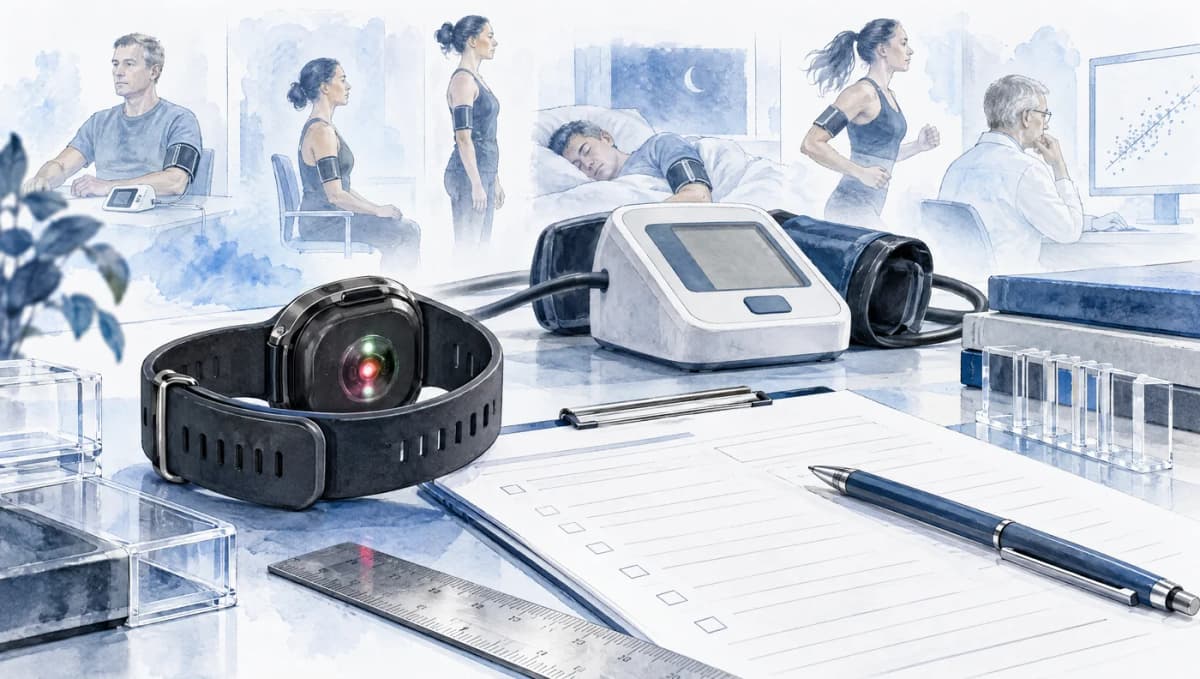
When a company claims its cuffless blood pressure device passed validation, what does that actually mean? The European Society of Hypertension published specific recommendations in 2023 that define how to validate cuffless blood pressure monitors through six distinct tests (Stergiou et al., 2023). Not every device needs to pass all six tests. Which tests apply depends on whether the device requires individual calibration, whether it measures automatically, and whether it works in multiple body positions.
Understanding these validation tests matters because passing one test is not the same as full clinical validation. This guide explains what each ESH test measures, why the framework requires different tests for different devices, and what the 2026 validation studies show about cuffless blood pressure performance in practice.
Why Cuff Validation Protocols Don't Work for Cuffless Devices
Traditional cuff-based blood pressure monitors follow ISO 81060-2 validation protocols. Those protocols test accuracy at rest in controlled settings: participants sit quietly for five minutes, a trained operator measures three readings, and the device passes if mean differences stay within 5 mmHg with standard deviations within 8 mmHg. That standard works for devices that measure the same way every time in the same position.
Cuffless devices face different challenges. They measure continuously or on demand throughout the day. They track blood pressure during sleep, during exercise, when your arm is raised or lowered, and across days or weeks without recalibration. A device accurate during seated rest might fail completely during position changes or after blood pressure drops with treatment. The ESH framework tests these scenarios separately because cuffless accuracy varies across contexts.
The Six ESH Validation Tests
The 2023 ESH recommendations define six tests, each evaluating a distinct aspect of cuffless blood pressure accuracy (Stergiou et al., 2023). Not every device must complete all six.
Static Test: Absolute Blood Pressure Accuracy
The static test measures whether the device can determine absolute blood pressure values accurately. It compares the cuffless device against a reference measurement (invasive arterial line or validated cuff) under resting, controlled conditions. This is the baseline accuracy test — similar to traditional cuff validation but adapted for cuffless technology.
Devices that require individual cuff calibration may perform well on the static test after calibration. Devices claiming calibration-free operation face a much harder challenge: accurately estimating absolute BP values without knowing the individual's arterial properties.
Device Position Test: Hydrostatic Pressure Robustness
Blood pressure at your wrist changes by roughly 7 mmHg for every 10 centimeters of arm elevation or depression relative to the heart. The device position test checks whether the cuffless monitor can compensate for these hydrostatic pressure changes when the measurement site moves above or below heart level.
Wrist-worn devices that measure in multiple positions (standing with arm down, arm raised, lying on your side) must pass this test. Devices designed only for specific positions (such as seated with arm at heart level) don't need to validate position robustness if they clearly instruct users to maintain that position.
The position test is where many wearables struggle. Accelerometers can estimate arm angle but cannot precisely measure the vertical distance between the sensor and your heart. That imprecision limits compensation accuracy.
Treatment Test: Blood Pressure Decrease Accuracy
The treatment test evaluates whether the device accurately tracks blood pressure reductions after antihypertensive therapy. Patients start treatment, their systolic and diastolic pressures drop, and the cuffless device should reflect those drops with the same magnitude the reference cuff measures.
This test matters for medication management. A device that underestimates BP drops might lead clinicians to escalate treatment unnecessarily. A device that overestimates drops might miss inadequate treatment response.
Only devices intended for monitoring patients on antihypertensive medication must pass the treatment test. Wellness devices marketed solely for healthy populations may skip this validation.
Awake/Asleep Test: Blood Pressure Change Accuracy
Blood pressure normally drops 10-20% during sleep (nocturnal dipping). The awake/asleep test checks whether the cuffless device accurately captures this physiological decrease by comparing sleep-time and wake-time measurements against ambulatory blood pressure monitoring (ABPM).
Nocturnal blood pressure patterns carry prognostic value: reduced or absent nocturnal dipping predicts cardiovascular risk. Devices used for 24-hour monitoring or overnight tracking must validate their ability to detect awake-asleep transitions and measure the magnitude of BP changes across the sleep-wake cycle. For background on how PPG tracks nocturnal physiology, see our nocturnal blood pressure dipping guide.
Exercise Test: Blood Pressure Increase Accuracy
The exercise test evaluates whether the device accurately tracks blood pressure increases during physical activity. Exercise raises both systolic and diastolic pressure; the device should reflect those increases with similar magnitude to a reference measurement taken during or immediately after exercise.
Exercise introduces dual challenges: physiological changes (increased cardiac output, altered vascular tone) and motion artifacts that corrupt PPG signals. Devices marketed for fitness or activity tracking must pass this test. Devices limited to resting or sleep measurement don't need exercise validation.
Recalibration Test: Stability Over Time
Many cuffless devices require periodic recalibration with a cuff to maintain accuracy. The recalibration test determines how long the device remains accurate before recalibration becomes necessary — whether days, weeks, or months.
The test measures whether accuracy degrades over time as individual vascular properties change due to hydration, medication effects, aging, or disease progression. Devices with short recalibration intervals (every few days) impose higher user burden. Devices maintaining accuracy for weeks or months without recalibration offer better practical utility.
Which Tests Apply to Which Devices
The ESH framework does not require every device to pass all six tests. Required tests depend on three device characteristics:
Individual calibration: Devices requiring an initial cuff calibration for each user must pass the static, recalibration, and any scenario tests relevant to their intended use (position, treatment, awake/asleep, or exercise depending on claims).
Automatic vs. user-initiated measurement: Devices that measure automatically at scheduled intervals or continuously must pass tests for all scenarios where automatic measurement occurs. User-initiated devices (you press a button to measure) need only validate scenarios the instructions recommend.
Multi-position capability: Devices measuring in multiple body positions (standing, sitting, lying down, arm raised or lowered) must pass the position test. Devices with position-restricted instructions don't need position validation if they clearly specify when and how to measure.
This tiered framework recognizes that a device designed for seated resting measurements faces different validation requirements than a 24-hour wearable tracking sleep, exercise, and daily activity.
What the 2026 Validation Studies Show
Several research groups published cuffless blood pressure validation studies using the ESH framework in 2026. The results illustrate both the promise and current limitations of cuffless technology.
Qiu et al.: All-Scenario Finger PPG Validation
Qiu and colleagues at Sun Yat-sen University conducted the most comprehensive ESH-compliant validation published in 2026 (Qiu et al., 2026). The study enrolled 1,173 participants across two phases. Phase 1 validated a finger-worn PPG device against invasive arterial BP, office BP, and 24-hour ABPM across seven ESH scenarios: invasive, static, awake/asleep, device position, treatment, exercise, and recalibration.
The device fulfilled all ESH criteria with mean differences ≤5 mmHg and standard deviations ≤8 mmHg for both systolic and diastolic BP across all seven tests. Phase 2 enrolled 405 hypertensive patients and found that PPG-derived mean BP and time-in-target-range metrics correlated with endothelial injury and arterial stiffness biomarkers — associations not seen with conventional ABPM metrics.
Key limitations: This is a single-device study from the device manufacturer's research collaborators. The device is finger-worn, not a wrist watch. Finger PPG typically provides higher signal quality than wrist sensors, so these results may not generalize to wrist-worn devices.
Lee et al.: Ring-Based Awake/Asleep Validation
Lee and colleagues validated a ring-type cuffless BP monitor (CART BP Pro) specifically for detecting awake-asleep BP variations (Lee et al., 2026). They enrolled 84 participants, selected 35 meeting ESH distribution criteria, and calibrated the device at least one day before the validation session.
For awake-asleep BP changes, the device showed mean differences of -1.74 ± 6.47 mmHg for systolic and 0.08 ± 5.84 mmHg for diastolic pressure. Limits of agreement ranged from -14.42 to 10.94 mmHg (SBP) and -11.37 to 11.53 mmHg (DBP). Nocturnal dipping classification showed moderate agreement (weighted kappa 0.58).
The authors concluded the device addressed only the awake/asleep test and cannot yet replace 24-hour ABPM. A conflict of interest disclosure notes the senior author received fees from the device manufacturer (Sky Labs).
Hove et al.: Nocturnal Dipping with Protocol Deviations
Hove and colleagues tested a PPG cuffless device worn on the upper arm against oscillometric cuff ABPM for nocturnal dipping (Hove et al., 2026). They enrolled 50 participants aged 18-80 and measured awake-asleep BP changes. Mean differences were 1.6 [-8.0, 11.2] mmHg for systolic and 1.2 [-6.7, 9.1] mmHg for diastolic. Correlation coefficients were 0.75 (SBP) and 0.74 (DBP).
The authors noted methodological deviations from the ESH awake/asleep test protocol: they used only cuffless values that were simultaneous with reference cuff measurements rather than averaging all cuffless readings across awake and asleep periods. The cohort also overrepresented participants with normal or low BP. The authors concluded full ESH-compliant validation is required before clinical use.
Several co-authors work for Aidee Health AS, the device manufacturer — an industry affiliation that warrants noting when interpreting results.
Proenca et al.: Six-Week Stability Tracking
Proenca and colleagues investigated long-term stability and BP change tracking with a wrist-worn cuffless device over six weeks (Proenca et al., 2026). They enrolled 30 hypertensive patients who completed four visits. The study compared BP change measurements (∆BP) from the cuffless device against a Microlife WatchBP Home A cuff device.
Mean differences were 0.2 ± 12.8 mmHg for systolic change and -0.1 ± 7.4 mmHg for diastolic change. The device showed no temporal drift over six weeks, and concordance for detecting significant BP changes was 83% (SBP) and 86% (DBP).
The authors framed this as a feasibility study and noted that oscillometric reference variability limits definitive conclusions. This study primarily informs the recalibration test — whether accuracy remains stable across weeks — rather than absolute BP measurement accuracy.
Why Machine Learning Papers Still Fall Short
Not all cuffless BP research follows the ESH framework. Many papers use machine learning models trained on large datasets to estimate BP from PPG waveforms without formal validation protocols. A 2026 analysis by Fritzsche and Senner examined what determines ML-based BP estimation performance (Fritzsche et al., 2026).
The authors compared models trained on MIMIC III (intensive care data with potential synchronization issues) and VitalDB (surgical data with verified synchronization). Models trained on VitalDB — where PPG and arterial BP signals were confirmed synchronized — performed substantially better than those trained on MIMIC III, where synchronization could not be guaranteed.
Subject-specific calibration improved accuracy, but with diminishing returns beyond three calibration measurements. Even with calibration, models reached clinically acceptable accuracy for diastolic BP while systolic BP remained challenging when using PPG alone.
The key finding: dataset integrity and calibration likely matter more than neural network architecture. This suggests that incremental model complexity improvements won't solve cuffless BP accuracy problems. The issue is signal information content and calibration stability, not algorithmic sophistication.
The AHA 2026 Scientific Statement: Proceed With Caution
The American Heart Association published a scientific statement on cuffless blood pressure devices in 2026, concluding that devices currently on the market have not been adequately vetted for accuracy and efficacy (Cohen et al., 2026). The statement notes that validation standards only recently became available and do not fully assess performance during typical use.
Some FDA-cleared devices are already used clinically, and patients often self-monitor with cuffless devices without informing their clinicians. The AHA panel concluded that currently available cuffless BP devices may be inappropriate for clinical decision-making until more rigorous validation evidence accumulates.
This caution reflects the gap between passing individual ESH tests and demonstrating real-world clinical utility. A device might pass the static test in a research lab but still produce unreliable readings during daily life when users don't follow calibration schedules, wear the device improperly, or measure during activities not covered by validation testing.
How to Read a Cuffless Blood Pressure Claim: A Checklist
When evaluating cuffless BP device claims, check:
Which ESH tests were completed? Passing one test (often the static test) is not full validation. Multi-scenario devices should validate all applicable tests.
What was the reference standard? Invasive arterial BP is the gold standard. Oscillometric cuff BP is acceptable but introduces reference measurement variability. Office BP measured by untrained operators is the weakest reference.
How many participants, and what population? Studies with fewer than 50-85 participants may not capture individual variability. Studies in young healthy adults don't validate performance in older or hypertensive populations.
Who funded the study? Manufacturer-sponsored studies or those with author conflicts of interest warrant closer scrutiny. Independent validation provides stronger evidence.
What are the calibration requirements? Devices requiring calibration every few days offer limited practical advantage over conventional ABPM. Calibration-free devices must demonstrate accuracy without individual calibration.
Was the study peer-reviewed? Preprints, conference abstracts, and company white papers have not undergone peer review. Published journal articles provide more reliable evidence.
YMYL Caveats
Blood pressure measurement is high-stakes health information. Do not change blood pressure medications based on readings from a wearable device. Passing one ESH test does not constitute full clinical validation. Most published cuffless BP studies are single-device evaluations, some industry-sponsored, some with small sample sizes or populations skewed toward normal blood pressure.
Devices requiring calibration need periodic cuff measurements to maintain accuracy — the calibration schedule matters as much as validation performance. For clinical decisions about hypertension diagnosis or treatment, confirm readings with a validated upper-arm cuff device and consult a healthcare provider. For guidance on comparing ambulatory blood pressure monitors and smartwatches, see our detailed comparison guide.
Consumer wearables marketed for wellness tracking rather than medical use may not have completed any ESH validation tests. Check the device's regulatory status and published validation data before relying on its BP readings.
Frequently Asked Questions
What does it mean when a cuffless blood pressure device "passes ESH validation"?
It means the device completed one or more of the six ESH validation tests (static, device position, treatment, awake/asleep, exercise, recalibration) and met the accuracy criteria for those specific tests. Passing one test does not equal full validation. Check which tests were completed and whether they match the device's intended use. A device for 24-hour monitoring should validate static, awake/asleep, position (if multi-position), and recalibration tests at minimum.
Are cuffless blood pressure watches accurate enough to replace a cuff?
Not yet for most clinical applications. The AHA's 2026 scientific statement concluded that currently available cuffless devices have not been adequately validated for clinical decision-making. Devices requiring periodic cuff calibration offer some utility for trend tracking but cannot fully replace conventional measurement. Blood pressure watches vary widely in validation quality — check for published ESH-compliant studies before trusting a device's accuracy claims.
What is the difference between the static test and the awake/asleep test?
The static test measures absolute blood pressure accuracy under resting, controlled conditions — can the device correctly report that your BP is 135/85 mmHg when you're seated at rest? The awake/asleep test measures blood pressure change accuracy across the sleep-wake transition — can the device correctly detect that your BP dropped 15 mmHg from daytime to nighttime? A device might pass one test but fail the other.
Do all cuffless blood pressure devices need to pass all six ESH tests?
No. Required tests depend on the device's design and intended use. Devices requiring individual calibration must pass static, recalibration, and scenario tests matching their claims. Devices measuring only at rest in one position don't need exercise or position validation. Devices for 24-hour monitoring must validate awake/asleep and automatic measurement scenarios. The ESH framework tailors validation requirements to match device capabilities and marketing claims.
How long does cuffless blood pressure calibration last?
It varies by device, which is what the recalibration test determines. Some devices require recalibration every few days, others claim weeks to months of stability. The Proenca et al. (2026) study found no accuracy drift over six weeks in one wrist-worn device, but that's a single-device finding. Calibration stability depends on how much an individual's vascular properties change — factors like hydration, medication adjustments, weight changes, and disease progression all affect the PPG-to-BP relationship. For related measurement techniques, see our guide on pulse transit time BP estimation.
What is the most validated cuffless blood pressure device as of 2026?
The Qiu et al. (2026) study provided the most comprehensive ESH validation published by mid-2026, testing all seven recommended scenarios in over 1,100 participants. However, it was a single-device study of a finger-worn PPG device, not a wrist watch. Independent replication and validation in diverse populations are needed. As of late 2026, no wrist-worn consumer device has published full multi-scenario ESH validation in peer-reviewed literature with the sample sizes and population diversity the framework recommends.
References
-
Stergiou GS, Avolio AP, Palatini P, et al. European Society of Hypertension recommendations for the validation of cuffless blood pressure measuring devices. J Hypertens. 2023;41(12):2074-2087. doi:10.1097/HJH.0000000000003483
-
Qiu Y, Zhou Z, Zhang J, He J, et al. Clinical Validation of Photoplethysmography-Based Finger Cuffless Blood Pressure Monitoring Following European Society of Hypertension Recommendations. J Am Heart Assoc. 2026;15(15):e050501. doi:10.1161/JAHA.126.050501
-
Lee SM, Kwon H, Cho B, Park JH, Na SH, Lee SP, Lee HY. Validation of ring-type cuffless BP monitoring device for detecting awake-asleep BP variations compared to ambulatory BP monitoring device. Hypertens Res. 2026;49(10):2817-2825. doi:10.1038/s41440-026-02759-6
-
Hove C, Seeberg TM, Botker-Rasmussen KG, Westgaard E, Heimark S, Waldum-Grevbo B, Larstorp ACK. Nocturnal Blood Pressure Dipping in Adults: A Comparison Between Cuffless and Ambulatory Blood Pressure Monitoring. Am J Hypertens. 2026 (online 2026-09-21). doi:10.1093/ajh/hpag115
-
Proenca M, Rigon PA, Bonnier G, Ferrario D, Zahnd J, Lemay M, Wuerzner G. Long-term stability and blood pressure change tracking with a cuffless wearable device in hypertensive patients. Blood Press. 2026;35(1):2707794. doi:10.1080/08037051.2026.2707794
-
Fritzsche C, Senner V. The role of dataset integrity, calibration and signal quality in neural network-based blood pressure estimation. Sci Rep. 2026;16:25524. doi:10.1038/s41598-026-66882-7
-
Cohen JB, Byfield RL, Hardy ST, et al. Cuffless Devices for the Measurement of Blood Pressure: A Scientific Statement From the American Heart Association. Hypertension. 2026;83(3):e00254. doi:10.1161/HYP.0000000000000254
Frequently Asked Questions
- What does it mean when a cuffless blood pressure device passes ESH validation?
- It means the device completed one or more of the six ESH validation tests (static, device position, treatment, awake/asleep, exercise, recalibration) and met accuracy criteria for those specific tests. Passing one test does not equal full validation. Check which tests were completed and whether they match the device's intended use.
- Are cuffless blood pressure watches accurate enough to replace a cuff?
- Not yet for most clinical applications. The AHA's 2026 scientific statement concluded that currently available cuffless devices have not been adequately validated for clinical decision-making. Devices requiring periodic cuff calibration offer some utility for trend tracking but cannot fully replace conventional measurement.
- What is the difference between the static test and the awake/asleep test?
- The static test measures absolute blood pressure accuracy under resting, controlled conditions. The awake/asleep test measures blood pressure change accuracy across the sleep-wake transition. A device might pass one test but fail the other.
- Do all cuffless blood pressure devices need to pass all six ESH tests?
- No. Required tests depend on the device's design and intended use. Devices requiring individual calibration must pass static, recalibration, and scenario tests matching their claims. The ESH framework tailors validation requirements to match device capabilities and marketing claims.
- How long does cuffless blood pressure calibration last?
- It varies by device, which is what the recalibration test determines. Some devices require recalibration every few days, others claim weeks to months. Calibration stability depends on how much an individual's vascular properties change due to hydration, medication adjustments, weight changes, and disease progression.
- What is the most validated cuffless blood pressure device as of 2026?
- The Qiu et al. (2026) study provided the most comprehensive ESH validation published by mid-2026, testing all seven recommended scenarios in over 1,100 participants. However, it was a single-device study of a finger-worn PPG device. As of late 2026, no wrist-worn consumer device has published full multi-scenario ESH validation in peer-reviewed literature.
Related articles
White-Coat vs Masked Hypertension: Where Wearables Help and Where ABPM Still Wins
White-coat and masked hypertension are opposite out-of-office blood pressure phenotypes. This guide explains the difference, the risks of each pattern, and where cuffless wearables can help compared with ambulatory blood pressure monitoring.
Masked Hypertension and Wearable Detection: Why Clinic Blood Pressure Can Miss Risk
Masked hypertension is easy to miss because clinic blood pressure can look normal while out-of-office readings stay high. This guide explains where wearables may help with screening and support, and why diagnosis still depends on validated cuff-based out-of-office measurement.
Ambulatory Blood Pressure Monitor vs Smartwatch: Accuracy, Use Cases, and Why They Are Not the Same
ABPM and smartwatch blood-pressure features are often discussed together, but they solve different problems. This guide compares clinical accuracy, use cases, and why ambulatory blood pressure monitoring still outperforms cuffless wearables for diagnosis.
Is Camera Blood Pressure Accurate?
Camera-based blood pressure estimation is promising in research, but it is not yet a dependable replacement for cuff-based blood pressure in routine telehealth or clinical care.
PPG AC DC Ratio Explained
The ratio of the AC (pulsatile) to DC (non-pulsatile) components of the photoplethysmographic signal is the fundamental measurement upon which pulse o...