Activity counts measure attention, not model quality. Missing counts are unknown. Publication status follows the linked source; a listed venue alone does not confirm peer review.
PPG-LM is a family of PPG-language models that learn from both signal-derived physiological labels and the clinical context in electronic health records. The authors argue that task-specific heads in earlier PPG models and the medical knowledge in LLMs each miss part of the picture, and PPG-LM combines the two.
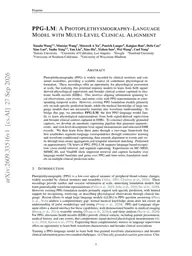
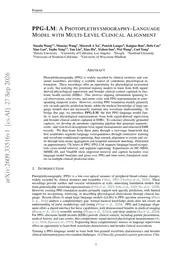
Photoplethysmography (PPG) is widely recorded by clinical monitors and consumer wearables, providing a scalable source of continuous physiological information. These recordings offer an opportunity for physiological assessment at scale, but realizing this potential requires models to learn from both signal-derived physiological supervision and broader clinical context captured in electronic health records (EHRs). This involves aligning information spanning local observations, care events, and entire visits with PPG representations at corresponding temporal scales. However, existing PPG foundation models primarily rely on task-specific prediction heads, while the medical knowledge of large language models does not necessarily translate into waveform understanding. To bridge this gap, we introduce PPG-LM, the first PPG-language model family to learn physiological representations from both signal-derived supervision and broader clinical context captured in EHRs. To construct clinically grounded captions, we develop an automatic captioning pipeline that generates segment-, event-, and visit-level descriptions from signal measurements and structured EHR records. We then learn from these pairs through a two-stage framework that first establishes segment-language correspondence through contrastive learning and waveform-conditioned captioning, then extends alignment to events and visits through time-aware aggregation and temporal statement matching. Pretrained on approximately 73k hours of PPG, PPG-LM supports language-based recognition, cross-modal retrieval, and segment captioning. Experiments on MC-MED, MIMIC-III, and VitalDB show improved retrieval and caption factuality over language-model baselines and gains over PPG and time-series foundation models on multiple clinical prediction tasks.
Verbatim fromarXiv· arXiv metadata (abstracts are released under CC0)
How it works
Datasets linked in the hub; pretraining vs evaluation roles follow the paper.
Architecture
Shared PPG Transformer + causal text tower (CoCa-style)
Cite the publication recorded for this model. Check it against the publisher before submitting.
Wang, X., Wang, M., Xu, M. A., Langer, P., Han, K., Cao, D., Luo, X., Yang, Y., Liu, Y., Hu, X., Sun, Y., Wang, W., et al. (2026). PPG-LM: A Photoplethysmography–Language Model with Multi-Level Clinical Alignment. arXiv preprint. https://arxiv.org/abs/2609.33516
Wang, Xiaoda, Minxiao Wang, Maxwell A Xu, Patrick Langer, Kaiqiao Han, Defu Cao, and Xiao Luo, et al. 2026. "PPG-LM: A Photoplethysmography–Language Model with Multi-Level Clinical Alignment." arXiv preprint. https://arxiv.org/abs/2609.33516.
Wang, X., Wang, M., Xu, M. A., Langer, P., Han, K., Cao, D. and Luo, X. et al. (2026) 'PPG-LM: A Photoplethysmography–Language Model with Multi-Level Clinical Alignment', arXiv preprint. Available at: https://arxiv.org/abs/2609.33516
Wang, Xiaoda, et al. "PPG-LM: A Photoplethysmography–Language Model with Multi-Level Clinical Alignment." arXiv preprint, 2026. https://arxiv.org/abs/2609.33516.
X. Wang et al., "PPG-LM: A Photoplethysmography–Language Model with Multi-Level Clinical Alignment," arXiv preprint, 2026, [Online]. Available: https://arxiv.org/abs/2609.33516.
@misc{wang2026ppglm,
  title         = {{PPG-LM: A Photoplethysmography–Language Model with Multi-Level Clinical Alignment}},
  author        = {Wang, Xiaoda and Wang, Minxiao and Xu, Maxwell A. and Langer, Patrick and Han, Kaiqiao and Cao, Defu and Luo, Xiao and Yang, Yuzhe and Liu, Yan and Hu, Xiao and Sun, Yizhou and Wang, Wei and others},
  year          = {2026},
  howpublished  = {arXiv preprint},
  eprint        = {2609.33516},
  archivePrefix = {arXiv}
}
History
Added to the ChatPPG research hub
Newsletter
Get new PPG datasets, papers and models
Get alerts when PPG-LM is benchmarked on new datasets, plus the weekly digest.
New datasets, papers and models
Practical guides from the hub
Unsubscribe anytime
The waveform is an illustration of a PPG pulse, not a recording.