Foundation model

OpenSLA

Sensor-Language-Action model (UCLA, Yuzhe Yang lab)

Year
2026
Form factor
Clinical
Xu, Yuekai et al., "Sensor-Language-Action Models", arXiv:2610.08244, CC BY-NC-ND 4.0
PreprintFirst posted: Oct 6, 2026Added to atlas: Oct 8, 2026Source

Activity counts measure attention, not model quality. Missing counts are unknown. Publication status follows the linked source; a listed venue alone does not confirm peer review.

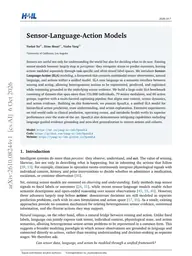
Existing sensor models however largely stop at perception: they recognize states or predict outcomes, leaving actions modeled separately through task-specific and often closed label spaces. The authors introduce Sensor-Language-Action (SLA) modeling, a framework that connects multimodal sensor observations, natural language, and actions within a unified model. SLA uses language as a semantic interface between sensing and acting, allowing heterogeneous actions to be represented, predicted, and explained while remaining grounded in the underlying sensor evidence. Building on this framework, the authors present OpenSLA, a unified SLA model for hierarchical action prediction, state understanding, and action explanation.

Published
arXiv preprint, 2026
Signals
PPG, ECG, BP, Resp, EEG, Glucose, EHR, Text, vitals
Cohort
116,000 individuals
Form factor
Clinical
License
MIT; Qwen3.5-2B base model terms apply to the LLM
Year
2026
Architecture

Qwen3.5-2B + LoRA; frozen OSF-derived DINO 1D-ViT waveform encoder; hierarchical sensor memory (OpenSLA-H) or flat prefix (OpenSLA-B)

Pretraining data

Sensor-language-action training on MC-MED, MIMIC-III, MOVER, VitalDB, MetaboNet, PEDAP (115,740 individuals across 7 datasets incl. MIMIC-IV external); waveform encoder from OSF DINO pretraining

At a glance
Type
Foundation model
Form factor
Clinical
Parameters
Not reported
Architecture
Qwen3.5-2B + LoRA; frozen OSF-derived DINO 1D-ViT waveform encoder; hierarchical sensor memory (OpenSLA-H) or flat prefix (OpenSLA-B)
Venue
arXiv 2026-10-06
Year
2026
DOI
Not reported
Licence
MIT; Qwen3.5-2B base model terms apply to the LLM
Caveats
Not reported
Added
Oct 8, 2026
Updated
Oct 17, 2026

Abstract

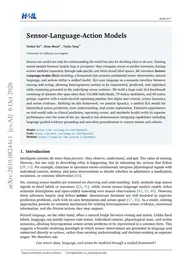
Sensors are useful not only for understanding the world but also for deciding what to do next. Existing sensor models however largely stop at perception: they recognize states or predict outcomes, leaving actions modeled separately through task-specific and often closed label spaces. We introduce Sensor-Language-Action (SLA) modeling, a framework that connects multimodal sensor observations, natural language, and actions within a unified model. SLA uses language as a semantic interface between sensing and acting, allowing heterogeneous actions to be represented, predicted, and explained while remaining grounded in the underlying sensor evidence. We build a large-scale SLA benchmark consisting of datasets that span more than 116,000 individuals, 79 sensor modalities, and 60 action groups, together with a multi-faceted captioning pipeline that aligns user context, sensor dynamics, and action evidence. Building on this framework, we present OpenSLA, a unified SLA model for hierarchical action prediction, state understanding, and action explanation. Extensive experiments on real-world tasks in clinical prediction, operating rooms, and metabolic health verify its superior performance over the state-of-the-art. OpenSLA also demonstrates intriguing capabilities including language-guided evidence grounding and zero-shot generalization to unseen actions and cohorts.

Verbatim fromarXiv· arXiv metadata (abstracts are released under CC0)

How it works

How OpenSLA works: Input signals → Foundation model → Downstream tasksInput signals: PPG (Photoplethysmogram); ECG (Electrocardiogram); ABP (Arterial pressure); Respiration (Breathing effort). Datasets: VitalDB, MIMIC-IV Waveform Database (PhysioNet preview). Foundation model: OpenSLA (Transformer · Language-aligned). Downstream tasks: Glucose.Input signalsPPG: PhotoplethysmogramPPGPhotoplethysmogramECG: ElectrocardiogramECGElectrocardiogramABP: Arterial pressureABPArterial pressureRespiration: Breathing effortRespirationBreathing effortDatasets: VitalDB, MIMIC-IV Waveform Database (PhysioNet preview)DatasetsVitalDB, MIMIC-IV Waveform Database…Foundation model×NOpenSLATransformer · Language-alignedDownstream tasksGlucoseGlucose

Datasets linked in the hub; pretraining vs evaluation roles follow the paper.

Pretraining data
Sensor-language-action training on MC-MED, MIMIC-III, MOVER, VitalDB, MetaboNet, PEDAP (115,740 individuals across 7 datasets incl. MIMIC-IV external); waveform encoder from OSF DINO pretraining
Architecture
Qwen3.5-2B + LoRA; frozen OSF-derived DINO 1D-ViT waveform encoder; hierarchical sensor memory (OpenSLA-H) or flat prefix (OpenSLA-B)
Inputs
PPG, ECG, BP, Resp, EEG, Glucose, EHR, Text, vitals
Approach
sensor language · sensor language action · LLM · clinical · CGM · MIT

Datasets used· 2

Papers· 1

Authors· 3

Cite this model

Cite the publication recorded for this model. Check it against the publisher before submitting.

Xu, Y., Shuai, Z., & Yang, Y. (2026). Sensor-Language-Action Models (OpenSLA). arXiv. https://arxiv.org/abs/2610.08244
Xu, Yuekai, Zitao Shuai, and Yuzhe Yang. 2026. "Sensor-Language-Action Models (OpenSLA)." arXiv. https://arxiv.org/abs/2610.08244.
Xu, Y., Shuai, Z. and Yang, Y. (2026) 'Sensor-Language-Action Models (OpenSLA)', arXiv. Available at: https://arxiv.org/abs/2610.08244
Xu, Yuekai, et al. "Sensor-Language-Action Models (OpenSLA)." arXiv, 2026. https://arxiv.org/abs/2610.08244.
Y. Xu, Z. Shuai, and Y. Yang, "Sensor-Language-Action Models (OpenSLA)," arXiv, 2026, [Online]. Available: https://arxiv.org/abs/2610.08244.
@misc{xu2026sensorlanguageaction,
  title         = {{Sensor-Language-Action Models (OpenSLA)}},
  author        = {Xu, Yuekai and Shuai, Zitao and Yang, Yuzhe},
  year          = {2026},
  eprint        = {2610.08244},
  archivePrefix = {arXiv}
}

Source metadata: 2026

Record updated Oct 17, 2026

History

  1. Record updated

  2. Added to the ChatPPG research hub