PulseOx-FM
overnight pulse-oximetry foundation model (Human Phenotype Project)
Activity counts measure attention, not model quality. Missing counts are unknown. Publication status follows the linked source; a listed venue alone does not confirm peer review.
PulseOx-FM is a self-supervised foundation model trained on 6,995,558 pulse oximetry segments from 42,282 overnight sleep recordings of 10,704 people in the Human Phenotype Project. It predicted chronological age better than existing feature extraction methods and held up in an external cohort. Its representations predicted 64 phenotypes across cardiometabolic and neuropsychiatric domains and flagged two-year hypertension risk in people with normal blood pressure.
- Published: OpenRxiv, 2026
- Pretraining: 6,995,558 segments from 42,282 overnight recordings
- Cohort: 10,704 participants (Human Phenotype Project)
- Result: predicts 64 phenotypes and 2-year hypertension incidence
- License: CC BY 4.0
Abstract
While Photoplethysmography (PPG) is established as a noninvasive optical tool for monitoring heart rate and oxygen saturation, its high-resolution blood flow waveforms contain rich physiological data that extend far beyond conventional vital signs.
We introduce PulseOx-FM, a foundation model, trained using self-supervised learning on 6,995,558 segments of pulse oximetry signals collected during 42,282 overnight sleep monitoring recordings of 10,704 participants in the Human Phenotype Project (HPP).
Using chronological age as a global health benchmark, PulseOx-FM significantly outperformed existing open-source and proprietary feature extraction methods while demonstrating robust generalization in an external out-of-distribution cohort. PulseOx-FM representations predicted 64 phenotypic targets spanning cardiometabolic, and neuropsychiatric domains beyond demographic baselines, and prospectively identified two-year hypertension incidence in normotensive individuals. Nightly embeddings further tracked next-day glycemic, dietary and activity-based state within individuals, dissociating this signal from sleep architecture alone. This next-day glycemic signal was predominantly a direct physiological effect, not explained by next-day dietary intake.
These findings suggest that PulseOx-FM provides a generalizable framework for encoding physiological patterns from sleep, offering a non-invasive tool for global health risk stratification and precision medicine.
Verbatim fromthe publisher's DOI record· Publisher licence: http://creativecommons.org/licenses/by/4.0/
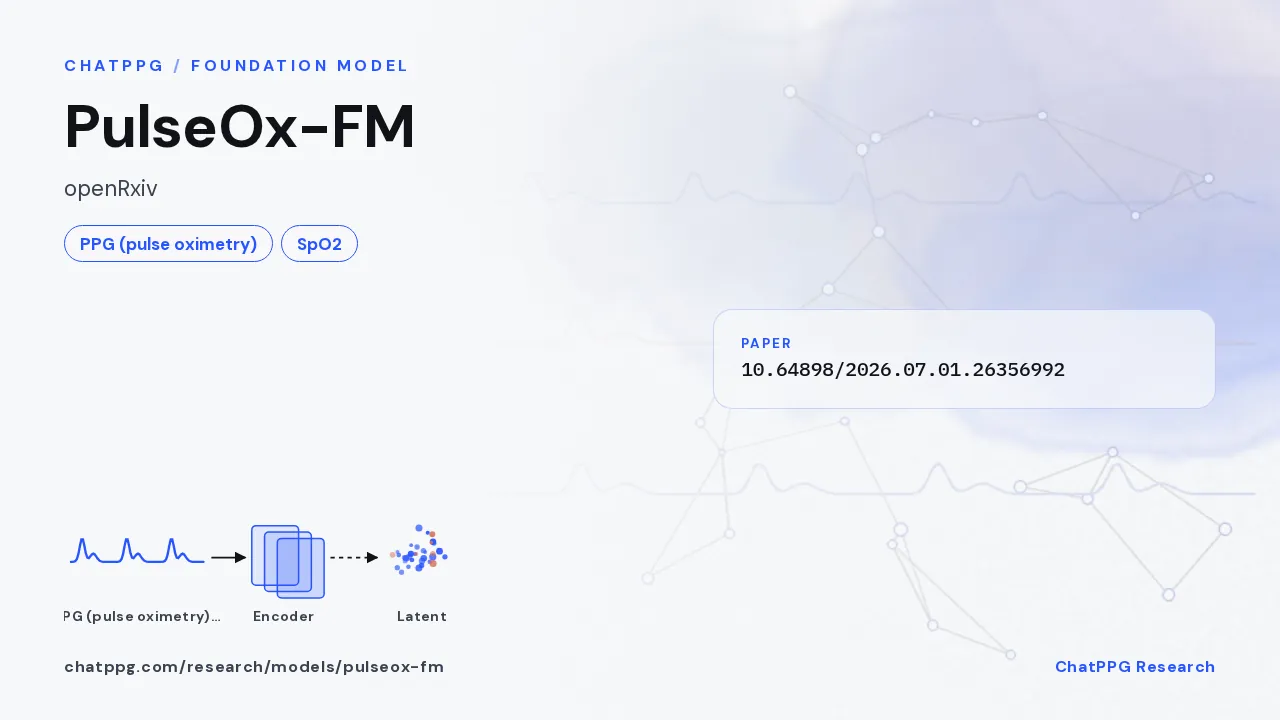
How it works
- Pretraining data
- 6,995,558 segments from 42,282 overnight recordings, 10,704 HPP participants (proprietary cohort)
- Inputs
- PPG, SpO₂
- Approach
- foundation model · pulse oximetry · sleep · self supervised
Datasets
Papers· 1
Cite
@article{pulseoxfm2026,
  title = {{PulseOx-FM}},
  author = {Sarah Kohn and Guy Lutsker and Alon Diament and Smadar Shilo and Adam Gabet and Gil Sasson and Gili Wolf and Adva Wolf and Anastasia Godneva and Adina Weinberger and Hagai Rossman and Eran Segal},
  year = {2026},
  journal = {openRxiv},
  doi = {10.64898/2026.07.01.26356992}
}History
Added to the ChatPPG research hub
More on ChatPPG
- A foundation model of wearable pulse oximetry reveals physiological signatures of health and cardiometabolic risk (PulseOx-FM)
PulseOx-FM is a self-supervised model trained on 6,995,558 pulse oximetry segments from 42,282 overn
- OSF (Open Sleep Foundation Models)
Foundation model
- SensorLM
Foundation model