PaperarXiv:2610.08244
Sensor-Language-Action Models (OpenSLA)

arXiv preprint
 (opens in a new tab)
Xu, Yuekai et al., "Sensor-Language-Action Models", arXiv:2610.08244, CC BY-NC-ND 4.0
TL;DR
OpenSLA links sensor data, language and actions in one model, using language as the bridge between sensing and acting. It predicts actions at several levels, describes states and explains its predictions while staying grounded in the sensor data.
- Type: sensor-language-action model
- Tasks: action prediction, state understanding, action explanation
Abstract
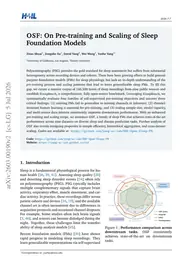
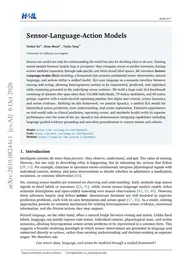
Sensors are useful not only for understanding the world but also for deciding what to do next. Existing sensor models however largely stop at perception: they recognize states or predict outcomes, leaving actions modeled separately through task-specific and often closed label spaces. We introduce Sensor-Language-Action (SLA) modeling, a framework that connects multimodal sensor observations, natural language, and actions within a unified model. SLA uses language as a semantic interface between sensing and acting, allowing heterogeneous actions to be represented, predicted, and explained while remaining grounded in the underlying sensor evidence. We build a large-scale SLA benchmark consisting of datasets that span more than 116,000 individuals, 79 sensor modalities, and 60 action groups, together with a multi-faceted captioning pipeline that aligns user context, sensor dynamics, and action evidence. Building on this framework, we present OpenSLA, a unified SLA model for hierarchical action prediction, state understanding, and action explanation. Extensive experiments on real-world tasks in clinical prediction, operating rooms, and metabolic health verify its superior performance over the state-of-the-art. OpenSLA also demonstrates intriguing capabilities including language-guided evidence grounding and zero-shot generalization to unseen actions and cohorts.
Verbatim from arXiv (opens in a new tab) · arXiv metadata (abstracts are released under CC0)
Results on ChatPPG leaderboards
All leaderboardsNo results from this paper on ChatPPG leaderboards yet. Browse the leaderboards.
Tasks & signals
Tasks
Signals
Keywords
Datasets used
Models
How it works
- Cohort
- 116,000 individuals
Cite this paper
Xu, Y., Shuai, Z., & Yang, Y. (2026). Sensor-Language-Action Models (OpenSLA). arXiv preprint. https://arxiv.org/abs/2610.08244
Xu, Yuekai, Zitao Shuai, and Yuzhe Yang. 2026. "Sensor-Language-Action Models (OpenSLA)." arXiv preprint. https://arxiv.org/abs/2610.08244.
Xu, Y., Shuai, Z. and Yang, Y. (2026) 'Sensor-Language-Action Models (OpenSLA)', arXiv preprint. Available at: https://arxiv.org/abs/2610.08244
Xu, Yuekai, et al. "Sensor-Language-Action Models (OpenSLA)." arXiv preprint, 2026. https://arxiv.org/abs/2610.08244.
Y. Xu, Z. Shuai, and Y. Yang, "Sensor-Language-Action Models (OpenSLA)," arXiv preprint, 2026, [Online]. Available: https://arxiv.org/abs/2610.08244.
@misc{xu2026sensorlanguageaction,
  title         = {{Sensor-Language-Action Models (OpenSLA)}},
  author        = {Xu, Yuekai and Shuai, Zitao and Yang, Yuzhe},
  year          = {2026},
  howpublished  = {arXiv preprint},
  eprint        = {2610.08244},
  archivePrefix = {arXiv}
}Record updated
Added to the ChatPPG research hub