PaperarXiv:2602.04725
Benchmarking and Enhancing PPG-Based Cuffless Blood Pressure Estimation Methods
arXiv preprint (cs.LG, eess.SP)
 (opens in a new tab)
Mathew, Neville et al., "Benchmarking and Enhancing PPG-Based Cuffless Blood Pressure Estimation Methods", arXiv:2602.04725, CC BY-SA 4.0
TL;DR
Cuffless blood pressure screening based on easily acquired photoplethysmography (PPG) signals offers a practical pathway toward scalable cardiovascular health assessment. Despite rapid progress, existing PPG-based blood pressure estimation models have not consistently achieved the established clinical numerical limits such as AAMI/ISO 81060-2, and prior evaluations often lack the rigorous experimental controls necessary for valid clinical assessment. Moreover, the publicly available datasets commonly used are heterogeneous and lack physiologically controlled conditions for fair benchmarking.
- Form factor: lab
Abstract
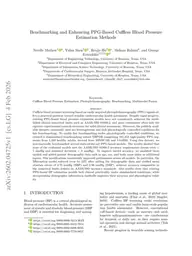
Cuffless blood pressure screening based on easily acquired photoplethysmography (PPG) signals offers a practical pathway toward scalable cardiovascular health assessment. Despite rapid progress, existing PPG-based blood pressure estimation models have not consistently achieved the established clinical numerical limits such as AAMI/ISO 81060-2, and prior evaluations often lack the rigorous experimental controls necessary for valid clinical assessment. Moreover, the publicly available datasets commonly used are heterogeneous and lack physiologically controlled conditions for fair benchmarking. To enable fair benchmarking under physiologically controlled conditions, we created a standardized benchmarking subset NBPDB comprising 101,453 high-quality PPG segments from 1,103 healthy adults, derived from MIMIC-III and VitalDB. Using this dataset, we systematically benchmarked several state-of-the-art PPG-based models. The results showed that none of the evaluated models met the AAMI/ISO 81060-2 accuracy requirements (mean error < 5 mmHg and standard deviation < 8 mmHg). To improve model accuracy, we modified these models and added patient demographic data such as age, sex, and body mass index as additional inputs. Our modifications consistently improved performance across all models. In particular, the MInception model reduced error by 23% after adding the demographic data and yielded mean absolute errors of 4.75 mmHg (SBP) and 2.90 mmHg (DBP), achieves accuracy comparable to the numerical limits defined by AAMI/ISO accuracy standards. Our results show that existing PPG-based BP estimation models lack clinical practicality under standardized conditions, while incorporating demographic information markedly improves their accuracy and physiological validity.
Verbatim from arXiv (opens in a new tab) · arXiv metadata (abstracts are released under CC0)
Results on ChatPPG leaderboards
All leaderboardsNo results from this paper on ChatPPG leaderboards yet. Browse the leaderboards.
Tasks & signals
Tasks
Signals
Keywords
How it works
Cite this paper
APA
Mathew, N., Shen, Y., Hu, R., Rahimi, M., & Zouridakis, G. (2026). Benchmarking and Enhancing PPG-Based Cuffless Blood Pressure Estimation Methods. arXiv preprint. https://doi.org/10.48550/arXiv.2602.04725
BibTeX
@misc{mathew2026benchmarking,
  title         = {{Benchmarking and Enhancing PPG-Based Cuffless Blood Pressure Estimation Methods}},
  author        = {Mathew, Neville and Shen, Yidan and Hu, Renjie and Rahimi, Maham and Zouridakis, George},
  year          = {2026},
  howpublished  = {arXiv preprint},
  doi           = {10.48550/arXiv.2602.04725},
  eprint        = {2602.04725},
  archivePrefix = {arXiv}
}
Built from the hub record. Check it against the publisher before submitting.
Added to the ChatPPG research hub