PaperarXiv:2502.19949
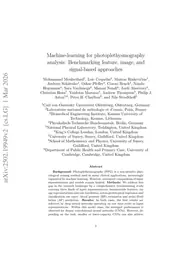
Machine-learning for photoplethysmography analysis: Benchmarking feature, image, and signal-based approaches
Biomedical Signal Processing and Control (July 2026); arXiv 2502.19949
Open codeOpen weightsLicence: CC BY 4.0; code: no licence stated
TL;DR
Like-for-like benchmark of three input representations — interpretable features, images (scalograms etc.), raw time series — with identical splits: BP regression on the VitalDB subset of PulseDB (10-s, 125 Hz; Calib and patient-disjoint CalibFree protocols) and AF classification on DeepBeat. Models include XResNet1d50/101, Inception1d, LeNet1d, AlexNet1d, MiniRocket, PPNet, iTransformer, TimesNet, TCN+MLP, XResNet1d50+GNLL; bootstrap significance vs the best model. Result: raw-waveform deep CNNs best for both tasks; smaller CNNs competitive on some tasks.
- Form factor: any
Abstract
Photoplethysmography (PPG) is a widely used non-invasive physiological sensing technique, suitable for various clinical applications. Such clinical applications are increasingly supported by machine learning methods, raising the question of the most appropriate input representation and model choice. Comprehensive comparisons, in particular across different input representations, are scarce. We address this gap in the research landscape by a comprehensive benchmarking study covering three kinds of input representations, interpretable features, image representations and raw waveforms, across prototypical regression and classification use cases: blood pressure and atrial fibrillation prediction. In both cases, the best results are achieved by deep neural networks operating on raw time series as input representations. Within this model class, best results are achieved by modern convolutional neural networks (CNNs). but depending on the task setup, shallow CNNs are often also very competitive. We envision that these results will be insightful for researchers to guide their choice on machine learning tasks for PPG data, even beyond the use cases presented in this work.
Verbatim from arXiv (opens in a new tab) · arXiv metadata (abstracts are released under CC0)
Results on ChatPPG leaderboards
All leaderboardsNo results from this paper on ChatPPG leaderboards yet. Browse the leaderboards.
Tasks & signals
Tasks
Signals
Keywords
Datasets

How it works
Cite this paper
APA
Moulaeifard, M., Coquelin, L., Rinkevičius, M., Sološenko, A., Pfeffer, O., Bench, C., Hegemann, N., Vardanega, S., Nandi, M., Alastruey, J., Heiss, C., Marozas, V., Thompson, A., Aston, P. J., Charlton, P. H., & Strodthoff, N. (2026). Machine-learning for photoplethysmography analysis: Benchmarking feature, image, and signal-based approaches. Biomedical Signal Processing and Control. https://doi.org/10.1016/j.bspc.2026.109831
BibTeX
@article{moulaeifard2026machinelearning,
  title         = {{Machine-learning for photoplethysmography analysis: Benchmarking feature, image, and signal-based approaches}},
  author        = {Moulaeifard, Mohammad and Coquelin, Loic and Rinkevičius, Mantas and Sološenko, Andrius and Pfeffer, Oskar and Bench, Ciaran and Hegemann, Nando and Vardanega, Sara and Nandi, Manasi and Alastruey, Jordi and Heiss, Christian and Marozas, Vaidotas and Thompson, Andrew and Aston, Philip J. and Charlton, Peter H. and Strodthoff, Nils},
  year          = {2026},
  journal       = {Biomedical Signal Processing and Control},
  doi           = {10.1016/j.bspc.2026.109831},
  eprint        = {2502.19949},
  archivePrefix = {arXiv}
}
Built from the hub record. Check it against the publisher before submitting.
Added to the ChatPPG research hub