Paperdoi:10.5281/zenodo.24307490
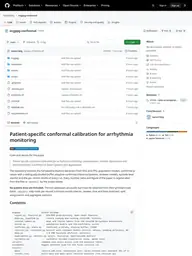
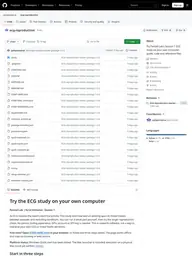
How well does an open ECG foundation model travel? (Pertzel Lab, Season 1: reproduction code and scientific records)
Zenodo software record 10.5281/zenodo.24307490 (2026-11-18)
TL;DR
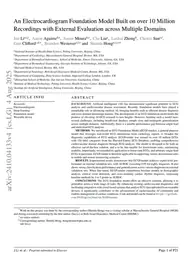
Zenodo software record with reproduction code and a dated evidence record for a study of how the open ECG foundation model ECGFounder transfers across PTB-XL 1.0.3, VitalDB 1.0.0 and VitalDB Arrhythmia 1.0.0. It states that the original PTB-XL comparison stayed outside its stated tolerance and that a second-machine reproduction was only partly reproduced, and it keeps failed findings and corrections. No per-record predictions are released.
Abstract
Reproduction code and supporting scientific evidence for “How well does an open ECG foundation model travel?”
This record combines the ecg-reproduction v1.0.0 code package with a scientific-evidence companion containing dated decision excerpts, aggregate results, seven publication figures and selected technical reviews. An index connects the evidence to the paper, and a manifest records file hashes and identifies any excerpts or projections.
The original PTB-XL comparison remained outside its stated tolerance, and the second-machine reproduction was only partly reproduced. Failed findings, corrections and limitations are retained. This archive does not represent a new experiment or a complete reconstruction of every result.
The new evidence companion excludes private planning, raw conversations, individual traces and per-record predictions. Its dated records do not establish public preregistration. The nine reference data files are available separately through the existing GitHub release:https://github.com/jackpertzel-ai/ecg-reproduction/releases/tag/v1.0.0
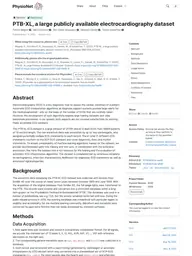
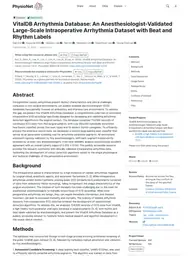
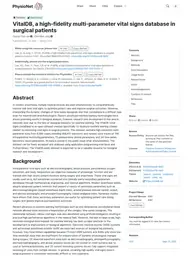
The work uses ECGFounder and derives results from PTB-XL 1.0.3, PhysioNet’s VitalDB 1.0.0 and VitalDB Arrhythmia Database 1.0.0. Dataset identifiers:https://doi.org/10.13026/kfzx-aw45https://doi.org/10.13026/czw8-9p62https://doi.org/10.13026/axd6-wm13
Lab code and original documentation use the MIT licence. Derived scientific records and figures retain CC BY 4.0 attribution. Full credits and notices are included in the packages.
Results compare model outputs with reference labels; they do not establish clinical usefulness or any individual’s health.
Verbatim from DataCite (opens in a new tab) · Licence: https://creativecommons.org/licenses/by/4.0/legalcode
Results on ChatPPG leaderboards · 1
All leaderboards| Leaderboard | Method | Result | Rank |
|---|---|---|---|
| external-single-lead AUROCAtrial fibrillation detection | ECGFoundervia model ECGFounder | 0.957AUROC, higher is better | #1 of 1 |
No row is credited to the paper itself; 1 more belong to models it introduces or evaluates. Ranks apply within each leaderboard only, as reported by the source.
Tasks & signals
Tasks
Signals
Keywords
Datasets used
Models
How it works
Cite this paper
How well does an open ECG foundation model travel? (Pertzel Lab, Season 1: reproduction code and scientific records). (2026). Zenodo software record 10.5281/zenodo.24307490. https://doi.org/10.5281/zenodo.24307490
@article{pertzelopenecgfm2026well,
  title         = {{How well does an open ECG foundation model travel? (Pertzel Lab, Season 1: reproduction code and scientific records)}},
  year          = {2026},
  journal       = {Zenodo software record 10.5281/zenodo.24307490},
  doi           = {10.5281/zenodo.24307490}
}Added to the ChatPPG research hub