PaperarXiv:2605.09579
Biosignal Fingerprinting: A Cross-Modal PPG-ECG Foundation Model
arXiv preprint
Key results
All results- M2AE biosignal fingerprintsResults, hypertension detection (source, opens in a new tab)
0.877
AUROC ↑
Hypertension · MIMIC-III (ECG+PPG)
frozen encoder
Results as reported by the authors; not independently reproduced. A SOTA star marks the best value among results reported under the same evaluation protocol; ties go to the earlier publication.
TL;DR
This paper introduces biosignal fingerprints, compact embeddings from M2AE, a multimodal masked autoencoder trained on more than 3.4 million paired ECG and PPG signals. Used frozen across 7 tasks, they matched or beat specialist foundation models, with AUROC of 0.974 for five-class cardiovascular disease and 0.877 for hypertension.
- Pretraining: 3.4M+ paired ECG and PPG signals
- Evaluation: 7 downstream tasks (frozen)
- Result: AUROC 0.974 (5-class CVD), 0.877 (hypertension)
Abstract
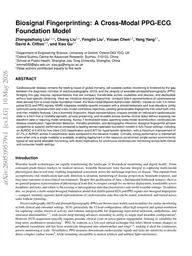
Cardiovascular disease remains the leading cause of global mortality, yet scalable cardiac monitoring is hindered by the gap between diagnostic-rich ECG and ubiquitous wearable PPG. Bridging this gap requires representations that are compact, transferable across modalities and devices, and deployable without task-specific retraining. Here we introduce biosignal fingerprints: compact latent representations of cardiovascular state derived from a cross-modal foundation model, the Multi-modal Masked Autoencoder (M2AE), trained on over 3.4 million paired ECG and PPG signals. M2AE integrates modality-specific encoders with a shared bottleneck and dual decoders, jointly optimized using reconstruction and cross-modal contrastive objectives, yielding generalizable fingerprints that retain intra- and inter-modality features. Like a biometric fingerprint, these representations uniquely encode an individual's cardiovascular state in a modality-agnostic, privacy-preserving form reusable across clinical tasks without exposing raw waveform data or requiring model retraining. Across 7 downstream tasks, spanning cross-modal reconstruction, cardiovascular disease classification, hypertension detection, mortality prediction, and demographic inference, biosignal fingerprints achieve competitive or superior performance compared to leading domain-specialist foundation models in frozen settings, including an AUROC of 0.974 for five-class CVD classification and 0.877 for hypertension detection, with a maximum improvement of 27.7% in AUROC across 5 classification tasks. Critically, strong performance is maintained with only a single modality, enabling deployment in resource-constrained, single-sensor environments typical of real-world wearable monitoring, with direct implications for continuous cardiovascular monitoring across clinical and consumer health settings.
Verbatim from arXiv (opens in a new tab) · arXiv metadata (abstracts are released under CC0)
Results on ChatPPG leaderboards
All leaderboardsNo results from this paper on ChatPPG leaderboards yet. Browse the leaderboards.
Tasks & signals
Signals
Keywords
Datasets used
- CODE-15%: large annotated 12-lead ECG dataset (Telehealth Network of Minas Gerais)ECG
 PTB-XL21,799 clinical 12-lead ECGs (PhysioNet)18,869 subjects · ECG
 PulseDB v2.0cleaned MIMIC-III + VitalDB cuffless-BP benchmark (MIMIC part ODbL; VitalDB part CC BY-NC-SA)5,361 subjects · PPG · ECG · BP
 VitalDBintraoperative multi-parameter vitals (PhysioNet mirror)Pretraining6,388 subjects · PPG · ECG · BP
Models
How it works
Cite this paper
Liu, Z., Liu, C., Liu, F., Chen, Y., Yang, Y., Clifton, D. A., & Gu, X. (2026). Biosignal Fingerprinting: A Cross-Modal PPG-ECG Foundation Model. arXiv preprint. https://doi.org/10.48550/arXiv.2605.09579
Liu, Zhangdaihong, Chang Liu, Fenglin Liu, Yixuan Chen, Yang Yang, David A. Clifton, and Xiao Gu. 2026. "Biosignal Fingerprinting: A Cross-Modal PPG-ECG Foundation Model." arXiv preprint. https://doi.org/10.48550/arXiv.2605.09579.
Liu, Z., Liu, C., Liu, F., Chen, Y., Yang, Y., Clifton, D. A. and Gu, X. (2026) 'Biosignal Fingerprinting: A Cross-Modal PPG-ECG Foundation Model', arXiv preprint. doi: 10.48550/arXiv.2605.09579.
Liu, Zhangdaihong, et al. "Biosignal Fingerprinting: A Cross-Modal PPG-ECG Foundation Model." arXiv preprint, 2026. https://doi.org/10.48550/arXiv.2605.09579.
Z. Liu et al., "Biosignal Fingerprinting: A Cross-Modal PPG-ECG Foundation Model," arXiv preprint, 2026, doi: 10.48550/arXiv.2605.09579.
@misc{liu2026biosignal,
  title         = {{Biosignal Fingerprinting: A Cross-Modal PPG-ECG Foundation Model}},
  author        = {Liu, Zhangdaihong and Liu, Chang and Liu, Fenglin and Chen, Yixuan and Yang, Yang and Clifton, David A. and Gu, Xiao},
  year          = {2026},
  howpublished  = {arXiv preprint},
  doi           = {10.48550/arXiv.2605.09579},
  eprint        = {2605.09579},
  archivePrefix = {arXiv}
}Added to the ChatPPG research hub