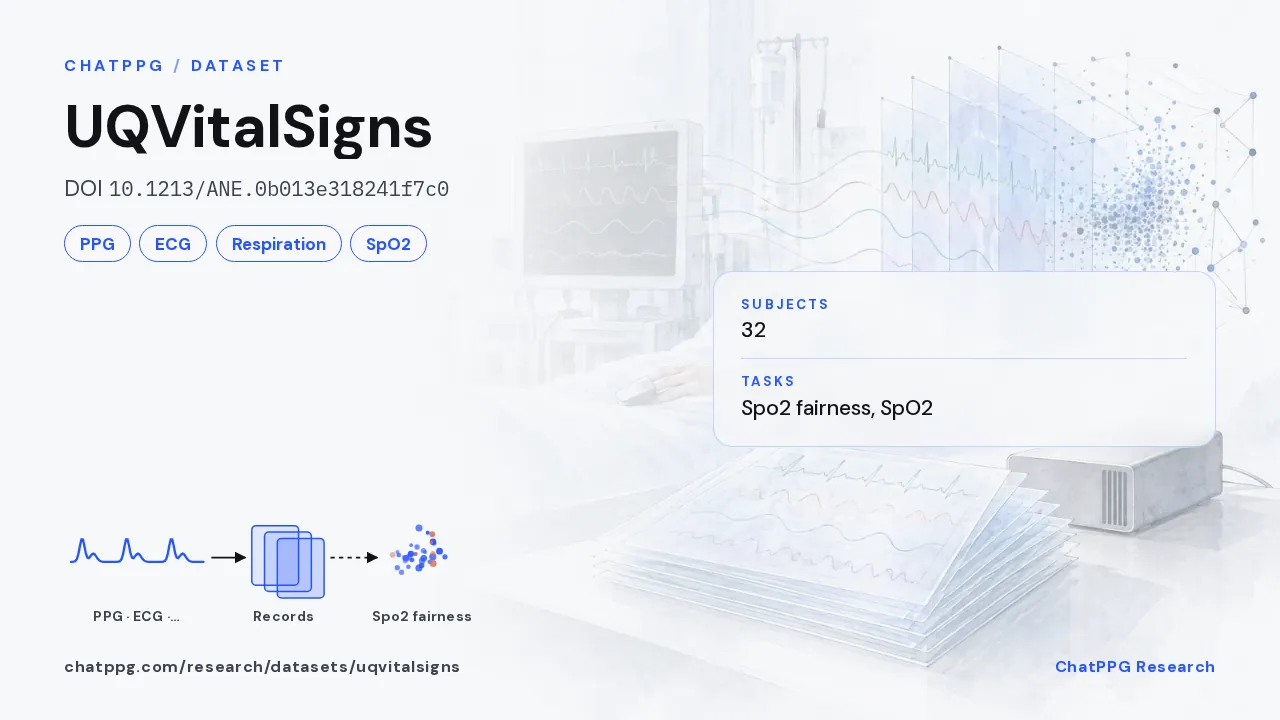
The University of Queensland Vital Signs Dataset is a collection of high-resolution patient monitoring data from 32 surgical cases at the Royal Adelaide Hospital. It is described in "University of Queensland vital signs dataset: development of an accessible repository of anesthesia patient monitoring data for research" by Liu, Gorges and Jenkins in Anesthesia and Analgesia 114(3):584-589 (2012).
The authors built it because detailed, multi-parameter monitoring data from patients under anaesthesia was hard to get. Existing databases such as PhysioBank and MIMIC II came mostly from intensive care, but patients in the operating room are different. Their cardiovascular and respiratory variables change more often and more sharply, and anaesthesia-specific information such as end-tidal agent monitoring is missing from ICU data. Patient simulators were another option, but they are less realistic during transitions and do not simulate artifacts such as noise, sensor disconnections and interference.
Data was captured from Philips IntelliVue MP70 and MP30 patient monitors and Datex-Ohmeda Aestiva/5 anaesthesia machines, then time synchronized and interpolated into 10 millisecond resolution samples. The 32 cases include 25 general anaesthetics, 3 spinal anaesthetics and 4 sedations, lasting from 13 minutes to 5 hours with a median of 105 minutes. Most cases include the electrocardiograph, pulse oximeter, capnograph, non-invasive blood pressure, airway flow and pressure, and a few add Y-piece spirometry, EEG or arterial blood pressure.
The data comes in four forms: CSV files with full numerical and waveform data, CSV numerical parameters at 1-second intervals, image plots of all waveforms at a range of resolutions, and overview plots of numerical data for each case. The full download is a ZIP of about 1.1 GB that needs about 5.5 GB once uncompressed, and you can also browse or download individual cases online.
For PPG work, the value is the pulse oximeter waveform recorded alongside ECG and respiratory signals during real anaesthesia, with all the artifacts and fast changes that come with it. It is an older, smaller alternative to VitalDB for the same setting.
The dataset is under CC BY-NC 3.0. The site adds that using the data while developing commercial products is allowed, as long as the data itself is not distributed with the product.
Duration
13 minutes to 5 hours, median 105 minutes
Resolution
10 ms samples; trend data at 1 second
Monitors
Philips IntelliVue MP70 and MP30, Datex-Ohmeda Aestiva/5
Paper
Liu, Gorges, Jenkins, Anesth Analg 114(3):584-589 (2012), doi 10.1213/ANE.0b013e318241f7c0
Cases
32 (25 general anaesthetics, 3 spinal, 4 sedations) at Royal Adelaide Hospital
Download
about 1.1 GB ZIP, about 5.5 GB uncompressed; CC BY-NC 3.0
BACKGROUND: Data recorded from the devices used to monitor a patient's vital signs are often used in the development of displays, alarms, and information systems, but high-resolution, multiple-parameter datasets of anesthesia monitoring data from patients during anesthesia are often difficult to obtain. Existing databases have typically been collected from patients in intensive care units. However, the physical state of intensive care patients is dissimilar to those undergoing surgery, more frequent and marked changes to cardiovascular and respiratory variables are seen in operating room patients, and additional and highly relevant information to anesthesia (e.g., end-tidal agent monitoring, etc.) is omitted from these intensive care databases. We collected a set of high-quality, high-resolution, multiple-parameter monitoring data suitable for anesthesia monitoring research. METHODS: Vital signs data were recorded from patients undergoing anesthesia at the Royal Adelaide Hospital. Software was developed to capture, time synchronize, and interpolate vital signs data from Philips IntelliVue MP70 and MP30 patient monitors and Datex-Ohmeda Aestiva/5 anesthesia machines into 10 millisecond resolution samples. The recorded data were saved in a variety of accessible file formats. RESULTS: Monitoring data were recorded from 32 cases (25 general anesthetics, 3 spinal anesthetics, 4 sedations) ranging in duration from 13 minutes to 5 hours (median 105 min). Most cases included data from the electrocardiograph, pulse oximeter, capnograph, noninvasive arterial blood pressure monitor, airway flow, and pressure monitor and, in a few cases, the Y-piece spirometer, electroencephalogram monitor, and arterial blood pressure monitor. Recorded data were processed and saved into 4 file formats: (1) comma-separated values text files with full numerical and waveform data, (2) numerical parameters recorded in comma-separated values files at 1-second intervals, (3) graphical plots of all waveform data in a range of resolutions as Portable Network Graphics image files, and (4) graphical overview plots of numerical data for entire cases as Portable Network Graphics and Scalable Vector Graphics files. The complete dataset is freely available online via doi:102.100.100/6914 and has been listed in the Australian National Data Service Collections Registry. DISCUSSION: The present dataset provides clinical anesthesia monitoring data from entire surgical cases where patients underwent anesthesia, includes a wide range of vital signs variables that are commonly monitored during surgery, and is published in accessible, user-friendly file formats. The text and image file formats let researchers without engineering or computer science backgrounds easily access the data using standard spreadsheet and image browsing software. In future work, monitoring data should be collected from a wider range and larger number of cases, and software tools are needed to support searching and navigating the database.
What is the University of Queensland Vital Signs Dataset?
It is a set of 32 surgical cases from the Royal Adelaide Hospital with high-resolution monitoring data, including pulse oximeter, ECG, capnography and blood pressure, at 10 ms resolution.
How do I download the UQ Vital Signs Dataset?
Download the about 1.1 GB ZIP from https://outbox.eait.uq.edu.au/uqdliu3/uqvitalsignsdataset/download.html or browse cases online. It is under CC BY-NC 3.0.
UQ Vital Signs vs VitalDB?
Both cover patients under anaesthesia. UQ has 32 cases from 2012; VitalDB has 6,388 cases with waveforms up to 500 Hz.
Is there a benchmark for the UQ Vital Signs Dataset?
No standard benchmark is defined. The paper presents it as a resource for monitoring displays, alarms and decision support research.
Cite this dataset
This citation is the paper recorded with this dataset. Check it against the publisher before submitting.
Liu, D., Görges, M., & Jenkins, S. A. (2012). University of Queensland Vital Signs Dataset: Development of an Accessible Repository of Anesthesia Patient Monitoring Data for Research. Anesthesia & Analgesia, 114(3), 584–589. https://doi.org/10.1213/ane.0b013e318241f7c0
Liu, David, Matthias Görges, and Simon A. Jenkins. 2012. "University of Queensland Vital Signs Dataset: Development of an Accessible Repository of Anesthesia Patient Monitoring Data for Research." Anesthesia & Analgesia 114 (3): 584–589. https://doi.org/10.1213/ane.0b013e318241f7c0.
Liu, D., Görges, M. and Jenkins, S. A. (2012) 'University of Queensland Vital Signs Dataset: Development of an Accessible Repository of Anesthesia Patient Monitoring Data for Research', Anesthesia & Analgesia, 114(3), pp. 584–589. doi: 10.1213/ane.0b013e318241f7c0.
Liu, David, et al. "University of Queensland Vital Signs Dataset: Development of an Accessible Repository of Anesthesia Patient Monitoring Data for Research." Anesthesia & Analgesia, vol. 114, no. 3, 2012, pp. 584–589. https://doi.org/10.1213/ane.0b013e318241f7c0.
D. Liu, M. Görges, and S. A. Jenkins, "University of Queensland Vital Signs Dataset: Development of an Accessible Repository of Anesthesia Patient Monitoring Data for Research," Anesthesia & Analgesia, vol. 114, no. 3, pp. 584–589, 2012, doi: 10.1213/ane.0b013e318241f7c0.
@article{liu2012university,
  title         = {{University of Queensland Vital Signs Dataset: Development of an Accessible Repository of Anesthesia Patient Monitoring Data for Research}},
  author        = {Liu, David and Görges, Matthias and Jenkins, Simon A.},
  year          = {2012},
  journal       = {Anesthesia \& Analgesia},
  volume        = {114},
  number        = {3},
  pages         = {584--589},
  publisher     = {Ovid Technologies (Wolters Kluwer Health)},
  doi           = {10.1213/ane.0b013e318241f7c0}
}
Cite the ChatPPG record
Cite the dated snapshot 2026-10 for a fixed, reproducible version. Please also cite the original publications listed above.
APA
ChatPPG. (2026). UQVitalSigns: dataset record (Version 2026-10) [Data set]. ChatPPG Research Hub. https://chatppg.com/research/datasets/uqvitalsigns
BibTeX
@misc{chatppg_dataset_uqvitalsigns,
  author       = {{ChatPPG}},
  title        = {{UQVitalSigns: dataset record}},
  year         = {2026},
  month        = nov,
  version      = {2026-10},
  howpublished = {\url{https://chatppg.com/research/datasets/uqvitalsigns}},
  note         = {ChatPPG Research Hub, Snapshot 2026-10, https://chatppg.com/research/snapshots/2026-10}
}
CITATION.cff
cff-version: 1.2.0
message: "If you use this resource, please cite it as below."
type: dataset
title: "UQVitalSigns: dataset record"
authors:
  - name: "ChatPPG"
url: "https://chatppg.com/research/datasets/uqvitalsigns"
repository-artifact: "https://chatppg.com/research/snapshots/2026-10"
version: "2026-10"
date-released: "2026-11-13"
History
Record updated
Newsletter
Get new PPG datasets, papers and models
Get alerts when new models are benchmarked on UQVitalSigns, plus the weekly digest.
New datasets, papers and models
Practical guides from the hub
Unsubscribe anytime
The waveform is an illustration of a PPG pulse, not a recording.