PaperarXiv:2410.20542
PaPaGei: Open Foundation Models for Optical Physiological Signals



arXiv preprint
 (opens in a new tab)
Pillai, Arvind et al., "PaPaGei: Open Foundation Models for Optical Physiological Signals", arXiv:2410.20542, CC BY-NC-ND 4.0
Key results4 SOTA
All results0.79
AUROC ↑
ICU admission · VitalDB
PaPaGei-S
linear probe on frozen embeddings
Best comparison: BYOL 0.78
0.77
AUROC ↑
Hypertension · PPG-BP
PaPaGei-S
linear probe on frozen embeddings
Best comparison: TF-C 0.76
0.70
AUROC ↑
Sleep-disordered breathing · SDB (Garde et al.)
PaPaGei-S
linear probe on frozen embeddings
Best comparison: SimCLR 0.61
12.97events/h
MAE (events/h) ↓
Apnea-hypopnea index · MESA
PaPaGei-S
linear probe on frozen embeddings
Best comparison: PaPaGei-P 13.85
Results as reported by the authors; not independently reproduced. A SOTA star marks the best value among results reported under the same evaluation protocol; ties go to the earlier publication.
Embed this badge (4 badges for READMEs and project pages)
 Markdown
[](https://chatppg.com/research/models/papagei-s#key-results)HTML<a href="https://chatppg.com/research/models/papagei-s#key-results"><img src="https://chatppg.com/research/badges/papagei-s--icu-admission-vitaldb-auroc.svg" alt="SOTA on ChatPPG: ICU admission · VitalDB" height="20"></a> Markdown
[](https://chatppg.com/research/models/papagei-s#key-results)HTML<a href="https://chatppg.com/research/models/papagei-s#key-results"><img src="https://chatppg.com/research/badges/papagei-s--hypertension-ppgbp-guilin-auroc.svg" alt="SOTA on ChatPPG: Hypertension · PPG-BP" height="20"></a> Markdown
[](https://chatppg.com/research/models/papagei-s#key-results)HTML<a href="https://chatppg.com/research/models/papagei-s#key-results"><img src="https://chatppg.com/research/badges/papagei-s--sleep-apnea-sdb-garde-auroc.svg" alt="SOTA on ChatPPG: Sleep-disordered breathing · SDB (Garde et al.)" height="20"></a> Markdown
[](https://chatppg.com/research/models/papagei-s#key-results)HTML<a href="https://chatppg.com/research/models/papagei-s#key-results"><img src="https://chatppg.com/research/badges/papagei-s--sleep-apnea-ahi-mesa-mae-events-per-hour.svg" alt="SOTA on ChatPPG: Apnea-hypopnea index · MESA" height="20"></a>
TL;DR
PaPaGei is an open foundation model for PPG, pretrained on more than 57,000 hours (20 million segments) of public PPG data. Its training uses knowledge of how PPG waveform shape varies between people. It improved classification by 6.3% and regression by 2.9% across at least 14 tasks.
- Pretraining: 57,000+ hours, 20M PPG segments (public data)
- Weights: open
- Result: +6.3% classification, +2.9% regression on 14+ tasks
Abstract
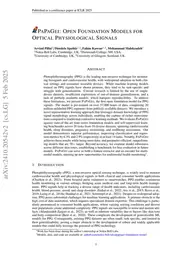
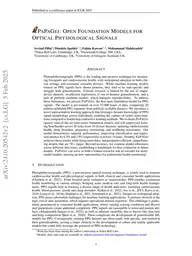
Photoplethysmography (PPG) is the leading non-invasive technique for monitoring biosignals and cardiovascular health, with widespread adoption in both clinical settings and consumer wearable devices. While machine learning models trained on PPG signals have shown promise, they tend to be task-specific and struggle with generalization. Current research is limited by the use of single-device datasets, insufficient exploration of out-of-domain generalization, and a lack of publicly available models, which hampers reproducibility. To address these limitations, we present PaPaGei, the first open foundation model for PPG signals. The model is pre-trained on over 57,000 hours of data, comprising 20 million unlabeled PPG segments from publicly available datasets. We introduce a novel representation learning approach that leverages domain knowledge of PPG signal morphology across individuals, enabling the capture of richer representations compared to traditional contrastive learning methods. We evaluate PaPaGei against state-of-the-art time-series foundation models and self-supervised learning benchmarks across 20 tasks from 10 diverse datasets, spanning cardiovascular health, sleep disorders, pregnancy monitoring, and wellbeing assessment. Our model demonstrates superior performance, improving classification and regression metrics by 6.3% and 2.9% respectively in at least 14 tasks. Notably, PaPaGei achieves these results while being more data- and parameter-efficient, outperforming models that are 70x larger. Beyond accuracy, we examine model robustness across different skin tones, establishing a benchmark for bias evaluation in future models. PaPaGei can serve as both a feature extractor and an encoder for multimodal models, opening up new opportunities for multimodal health monitoring.
Verbatim from arXiv (opens in a new tab) · arXiv metadata (abstracts are released under CC0)
Results on ChatPPG leaderboards · 2
All leaderboards| Leaderboard | Method | Result | Rank |
|---|---|---|---|
| PPG-DaLiA MAE (BPM)Heart rate estimation | PaPaGei-Svia model PaPaGei-S | 15.22MAE (BPM), lower is better | #19 of 19 |
| WESAD AUROCMental workload assessment | PaPaGei-Svia model PaPaGei-S | 0.8043AUROC, higher is better | #7 of 7 |
No row is credited to the paper itself; 2 more belong to models it introduces or evaluates. Ranks apply within each leaderboard only, as reported by the source.
Tasks & signals
Tasks
Signals
Keywords
Datasets used
- MESA SleepNSRR polysomnography + wrist actigraphy (Multi-Ethnic Study of Atherosclerosis)PretrainingEvaluation2,237 subjects · PPG · ECG · IMU
- nuMoM2bNSRR pregnancy sleep-disordered-breathing substudyEvaluation3,702 subjects · PPG · PSG
 PulseDB v2.0cleaned MIMIC-III + VitalDB cuffless-BP benchmark (MIMIC part ODbL; VitalDB part CC BY-NC-SA)5,361 subjects · PPG · ECG · BP
 VitalDBintraoperative multi-parameter vitals (PhysioNet mirror)6,388 subjects · PPG · ECG · BP
 VitalVideosface video + contact PPG + BP/SpO2 (Europe-1, Africa-1, Worldwide)Evaluation850 subjects · PPG
Models
How it works
Cite this paper
Pillai, A., Spathis, D., Kawsar, F., & Malekzadeh, M. (2024). PaPaGei: Open Foundation Models for Optical Physiological Signals. arXiv preprint. https://arxiv.org/abs/2410.20542
Pillai, Arvind, Dimitris Spathis, Fahim Kawsar, and Mohammad Malekzadeh. 2024. "PaPaGei: Open Foundation Models for Optical Physiological Signals." arXiv preprint. https://arxiv.org/abs/2410.20542.
Pillai, A., Spathis, D., Kawsar, F. and Malekzadeh, M. (2024) 'PaPaGei: Open Foundation Models for Optical Physiological Signals', arXiv preprint. Available at: https://arxiv.org/abs/2410.20542
Pillai, Arvind, et al. "PaPaGei: Open Foundation Models for Optical Physiological Signals." arXiv preprint, 2024. https://arxiv.org/abs/2410.20542.
A. Pillai, D. Spathis, F. Kawsar, and M. Malekzadeh, "PaPaGei: Open Foundation Models for Optical Physiological Signals," arXiv preprint, 2024, [Online]. Available: https://arxiv.org/abs/2410.20542.
@misc{pillai2024papagei,
  title         = {{PaPaGei: Open Foundation Models for Optical Physiological Signals}},
  author        = {Pillai, Arvind and Spathis, Dimitris and Kawsar, Fahim and Malekzadeh, Mohammad},
  year          = {2024},
  howpublished  = {arXiv preprint},
  eprint        = {2410.20542},
  archivePrefix = {arXiv}
}Record updated