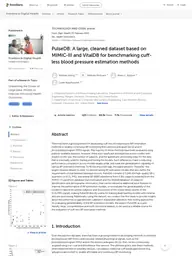
PulseDB is a large, cleaned dataset for benchmarking cuffless blood pressure estimation, built from the MIMIC-III Waveform Database Matched Subset and VitalDB. It is described in "PulseDB: A large, cleaned dataset based on MIMIC-III and VitalDB for benchmarking cuff-less blood pressure estimation methods" by Weinan Wang, Pedram Mohseni, Kevin L. Kilgore and Laleh Najafizadeh in Frontiers in Digital Health 4:1090854 (published February 2023).
The authors noticed that cuffless blood pressure papers were hard to compare. Most used public data, but studies differed in dataset size, number of subjects and preprocessing, which made comparisons unfair and hid how well models generalized. PulseDB fixes the data side with one large, consistently processed set and standardized testing protocols.
It contains 5,245,454 high-quality 10-second segments of ECG, PPG and arterial blood pressure waveforms from 5,361 subjects. For each MIMIC or VitalDB record, one consecutive clip is taken, cut into 10-second segments, and segments of bad quality are removed. Alongside the signals come subject identifiers and demographic information, which can be used as extra input features or to test generalization to unseen subjects, and the positions of characteristic points of the ECG and PPG signals. The paper also reports what the authors call the first study of the performance gap between calibration-based and calibration-free testing.
The GitHub repository (pulselabteam/PulseDB) explains how to download the Segment and Info files from Box or Google Drive and run Generate_Subsets.m to build the training, calibration-based and calibration-free testing subsets, with Python loading examples. Supplementary subsets derived from VitalDB are also on Kaggle.
Licensing is split by source. The files derived from MIMIC-III are under the Open Database License, while the VitalDB-derived files and the Info files are under CC BY-NC-SA 4.0, so commercial use of the full dataset is not allowed without other permission.
PulseDB is one of the standard datasets for cuffless blood pressure work, and it appears as a downstream dataset in foundation model papers such as SiamQuality and AnyPPG. Its calibration-free split is the harder and more realistic test.
Segments
5,245,454 10-second ECG, PPG and ABP segments
License
MIMIC part ODbL; VitalDB and Info parts CC BY-NC-SA 4.0
Paper
Wang, Mohseni, Kilgore, Najafizadeh, Frontiers in Digital Health 4:1090854, doi 10.3389/fdgth.2022.1090854
Includes demographics and ECG/PPG characteristic point positions
Subsets
training, calibration-based and calibration-free testing via Generate_Subsets.m
There has been a growing interest in developing cuff-less blood pressure (BP) estimation methods to enable continuous BP monitoring from electrocardiogram (ECG) and/or photoplethysmogram (PPG) signals. The majority of these methods have been evaluated using publicly-available datasets, however, there exist significant discrepancies across studies with respect to the size, the number of subjects, and the applied pre-processing steps for the data that is eventually used for training and testing the models. Such differences make conducting performance comparison across models largely unfair, and mask the generalization capability of various BP estimation methods. To fill this important gap, this paper presents “PulseDB,” the largest cleaned dataset to date, for benchmarking BP estimation models that also fulfills the requirements of standardized testing protocols. PulseDB contains 1) 5,245,454 high-quality 10-s segments of ECG, PPG, and arterial BP (ABP) waveforms from 5,361 subjects retrieved from the MIMIC-III waveform database matched subset and the VitalDB database; 2) subjects’ identification and demographic information, that can be utilized as additional input features to improve the performance of BP estimation models, or to evaluate the generalizability of the models to data from unseen subjects; and 3) positions of the characteristic points of the ECG/PPG signals, making PulseDB directly usable for training deep learning models with minimal data pre-processing. Additionally, using this dataset, we conduct the first study to provide insights about the performance gap between calibration-based and calibration-free testing approaches for evaluating generalizability of the BP estimation models. We expect PulseDB, as a user-friendly, large, comprehensive and multi-functional dataset, to be used as a reliable source for the evaluation of cuff-less BP estimation methods.
Verbatim fromthe publisher's DOI record· Publisher licence: https://creativecommons.org/licenses/by/4.0/
PulseDB v2.0: overview
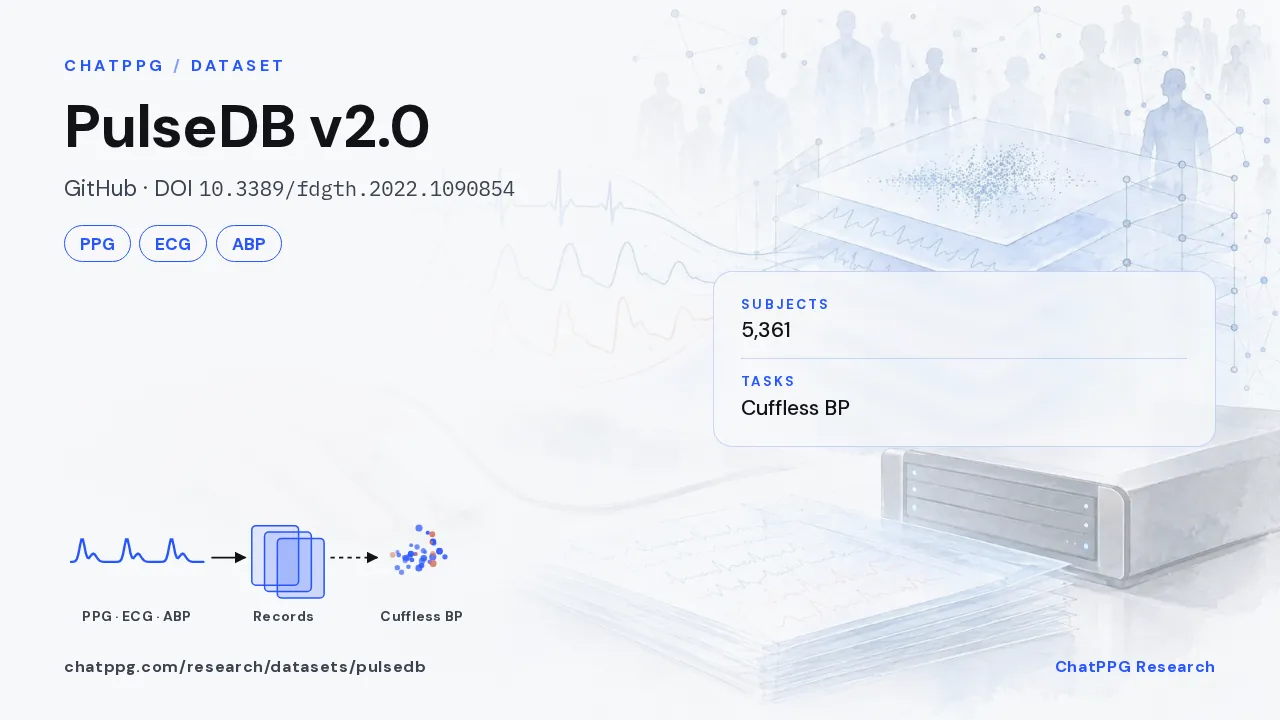
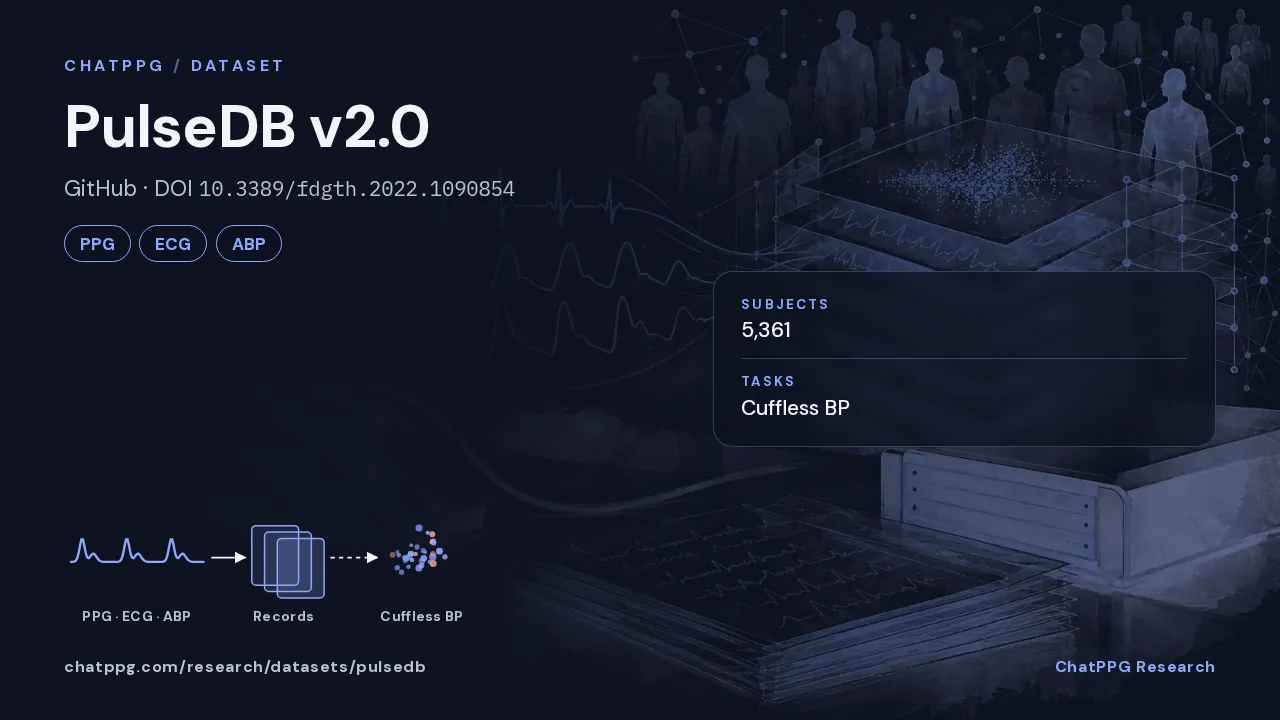
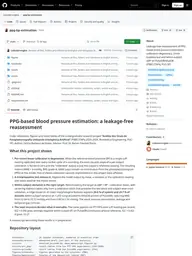
PulseDB is the largest cleaned benchmark for cuffless blood pressure estimation: 5,245,454 ten-second segments of ECG, PPG and arterial blood pressure (ABP) from 5,361 subjects, built from the MIMIC-III Waveform Matched Subset and VitalDB (Wang et al., Frontiers in Digital Health, 2023). It ships subject demographics, ECG/PPG characteristic points and a script that generates fixed training, calibration-based and calibration-free test subsets.
What's inside
Subjects
5,361 (MIMIC-III matched subset + VitalDB)
Segments
5,245,454 × 10 s
Signals
ECG, PPG, ABP (raw and filtered fields)
Sampling rate
125 Hz
Labels
SBP / DBP per segment; age, gender; height and weight (VitalDB subjects only)
Extras
ECG/PPG characteristic-point positions; v2.0 adds absolute timestamps T and non-normalised raw/filtered records
Download the Segment and Info files from the Box, Google Drive or OneDrive links in the README (Box splits them into 16 PulseDB_MIMIC and 10 PulseDB_Vital zip parts; SHA-1 checksums are listed).
Unzip part .001 of each with 7-Zip.
Run Generate_Subsets.m in MATLAB to create the training, calibration-based and calibration-free test subsets.
Optional: the VitalDB-derived supplementary subsets are also on Kaggle.
Licence: Split by folder: PulseDB_MIMIC under ODbL 1.0 (contents DbCL 1.0); PulseDB_Vital, Info and Subset files under CC BY-NC-SA 4.0
What it allows: The MIMIC part allows commercial use with attribution and share-alike for derived databases. The VitalDB part is non-commercial and share-alike.
from mat73 import loadmat   # PulseDB uses MAT v7.3
import numpy as np

data = loadmat("PulseDB/Subset_Files/Train_Subset.mat")["Subset"]
signals = data["Signals"]          # 10 s ECG, PPG, ABP segments
sbp = data["SBP"]                  # systolic BP label per segment
age = data["Age"]
gender = (np.array(data["Gender"]).squeeze() == "M").astype(float)
# Height/Weight are NaN for MIMIC subjects (recorded only in VitalDB)
Adapted from the loader in the PulseDB README. Not run here: the subset files are generated locally from multi-GB downloads.
Caveats
Height and weight are NaN for MIMIC-derived subjects; only VitalDB recorded them.
The default subsets use normalised ECG_F and PPG_F fields. To train on non-normalised signals, edit Generate_Subsets.m to read the v2.0 fields (ECG_Record_F, PPG_Record_F).
PulseDB keeps one consecutive clip per record and removes poor-quality segments, so it is cleaner than the bedside data a deployed model will see.
MIMIC-derived datasets (UCI cuffless BP, MIMIC-III-Ext-PPG, MIMIC PERform) can contain the same patients; do not use one as an independent test set for another.
The VitalDB folder is CC BY-NC-SA 4.0, so commercial models should not be trained on it.
PulseDB v2.0 has 5,361 subject files containing 5,245,454 ten-second ECG, PPG and ABP segments. On Box it is split into 16 PulseDB_MIMIC and 10 PulseDB_Vital zip parts.
How do I download PulseDB?
Follow the GitHub README (pulselabteam/PulseDB): download the Segment and Info files from Box, Google Drive or OneDrive, unzip, then run Generate_Subsets.m to build the training and test subsets.
What is the sampling rate of PulseDB?
125 Hz. Each segment is 10 seconds long.
Can PulseDB be used commercially?
Only the MIMIC folder (ODbL 1.0). The VitalDB folder and the Info and Subset files are CC BY-NC-SA 4.0, which is non-commercial.
What is the difference between PulseDB v1.0 and v2.0?
v2.0 regenerates all 5,361 files with the v1.0 fields plus absolute timestamps and non-normalised raw and filtered ECG and PPG records. Shared fields match v1.0.
What is PulseDB?
PulseDB is a cleaned benchmark for cuffless blood pressure estimation with 5,245,454 ten-second ECG, PPG and ABP segments from 5,361 subjects in MIMIC-III and VitalDB.
PulseDB vs VitalDB?
VitalDB is the raw surgical database with 6,388 cases. PulseDB takes cleaned 10-second segments from VitalDB and MIMIC-III and adds standard training and testing subsets for blood pressure.
What are PulseDB benchmark results?
The paper's main benchmark finding is the performance gap between calibration-based and calibration-free testing, and its subsets let later papers report blood pressure error under both.
Cite this dataset
This citation is the paper recorded with this dataset. Check it against the publisher before submitting.
Wang, W., Mohseni, P., Kilgore, K. L., & Najafizadeh, L. (2023). PulseDB: A large, cleaned dataset based on MIMIC-III and VitalDB for benchmarking cuff-less blood pressure estimation methods. Frontiers in Digital Health, 4. https://doi.org/10.3389/fdgth.2022.1090854
Wang, Weinan, Pedram Mohseni, Kevin L. Kilgore, and Laleh Najafizadeh. 2023. "PulseDB: A large, cleaned dataset based on MIMIC-III and VitalDB for benchmarking cuff-less blood pressure estimation methods." Frontiers in Digital Health 4. https://doi.org/10.3389/fdgth.2022.1090854.
Wang, W., Mohseni, P., Kilgore, K. L. and Najafizadeh, L. (2023) 'PulseDB: A large, cleaned dataset based on MIMIC-III and VitalDB for benchmarking cuff-less blood pressure estimation methods', Frontiers in Digital Health, 4. doi: 10.3389/fdgth.2022.1090854.
Wang, Weinan, et al. "PulseDB: A large, cleaned dataset based on MIMIC-III and VitalDB for benchmarking cuff-less blood pressure estimation methods." Frontiers in Digital Health, vol. 4, 2023. https://doi.org/10.3389/fdgth.2022.1090854.
W. Wang, P. Mohseni, K. L. Kilgore, and L. Najafizadeh, "PulseDB: A large, cleaned dataset based on MIMIC-III and VitalDB for benchmarking cuff-less blood pressure estimation methods," Frontiers in Digital Health, vol. 4, 2023, doi: 10.3389/fdgth.2022.1090854.
@article{wang2023pulsedb,
  title         = {{PulseDB: A large, cleaned dataset based on MIMIC-III and VitalDB for benchmarking cuff-less blood pressure estimation methods}},
  author        = {Wang, Weinan and Mohseni, Pedram and Kilgore, Kevin L. and Najafizadeh, Laleh},
  year          = {2023},
  journal       = {Frontiers in Digital Health},
  volume        = {4},
  publisher     = {Frontiers Media SA},
  doi           = {10.3389/fdgth.2022.1090854}
}
Cite the ChatPPG record
Cite the dated snapshot 2026-10 for a fixed, reproducible version. Please also cite the original publications listed above.
APA
ChatPPG. (2026). PulseDB v2.0: dataset record (Version 2026-10) [Data set]. ChatPPG Research Hub. https://chatppg.com/research/datasets/pulsedb
BibTeX
@misc{chatppg_dataset_pulsedb,
  author       = {{ChatPPG}},
  title        = {{PulseDB v2.0: dataset record}},
  year         = {2026},
  month        = nov,
  version      = {2026-10},
  howpublished = {\url{https://chatppg.com/research/datasets/pulsedb}},
  note         = {ChatPPG Research Hub, Snapshot 2026-10, https://chatppg.com/research/snapshots/2026-10}
}
CITATION.cff
cff-version: 1.2.0
message: "If you use this resource, please cite it as below."
type: dataset
title: "PulseDB v2.0: dataset record"
authors:
  - name: "ChatPPG"
url: "https://chatppg.com/research/datasets/pulsedb"
repository-artifact: "https://chatppg.com/research/snapshots/2026-10"
version: "2026-10"
date-released: "2026-11-25"
History
Record updated
Newsletter
Get new PPG datasets, papers and models
Get alerts when new models are benchmarked on PulseDB v2.0, plus the weekly digest.
New datasets, papers and models
Practical guides from the hub
Unsubscribe anytime
The waveform is an illustration of a PPG pulse, not a recording.