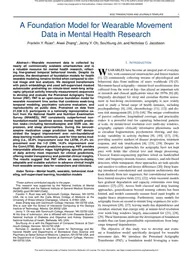
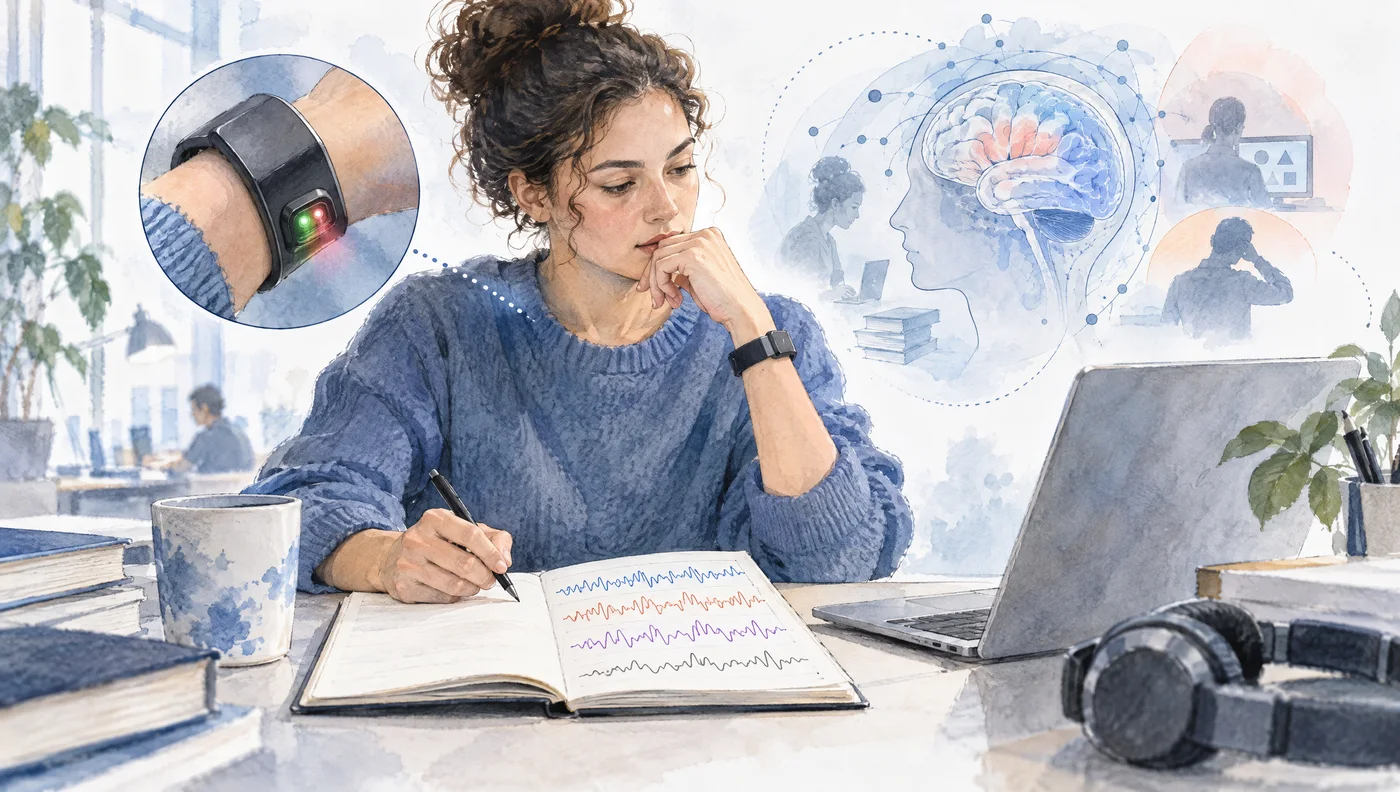
PAT (Pretrained Actigraphy Transformer) is an open-source foundation model for wearable movement data in mental health research. It uses transformers with patch embeddings, pretrained as a masked autoencoder on week-long minute-level actigraphy from 21,538 NHANES participants. PAT beat non-foundation baselines on predicting benzodiazepine and SSRI use, depression and sleep problems, including a 55.6% gain over an LSTM for benzodiazepine use.
Personal Health Agent is Google's open multi-agent framework for personal health questions over consumer wearable and medical context. An orchestrator coordinates data-science, domain-expert, and health-coach LLM sub-agents with iterative reflection. Apache-2.0 code is available; the paper runs used Gemini. Published in Nature 2026 (DOI 10.1038/s41586-026-11161-8).
PG-LRF generates ECG from PPG with a physiology-guided latent rectified flow. An electro-hemodynamic simulator supplies morphology and forward PPG consistency so the generator respects cardiac phase and pulse-arrival delay while needing only PPG at inference.
PhysioOmni is a foundation model for multimodal physiological signals that still works when some modalities are missing. It trains a decoupled tokenizer and pretrains with masked-signal objectives that separate shared and modality-specific features, then fine-tunes with prototype alignment so it adapts to whatever combination of signals a dataset has.
PPG-Distill is a knowledge-distillation framework that compresses PPG foundation teachers such as GPT-PPG-19m and PaPaGei into roughly 1M-parameter students for edge devices. It adds morphology and rhythm distillation on top of prediction and feature KD so heart-rate and atrial-fibrillation performance stay close to the teacher at a fraction of the cost.
PPG-LM is a family of PPG-language models that learn from both signal-derived physiological labels and the clinical context in electronic health records. The authors argue that task-specific heads in earlier PPG models and the medical knowledge in LLMs each miss part of the picture, and PPG-LM combines the two.
ProtoMM is a self-supervised method that uses a shared dictionary of prototypes to place different sensor modalities in one embedding space. The authors used it to build a pulse-motion foundation model that beat contrastive-only and earlier multimodal methods, and the prototypes also help interpret the learned features.
Foundation dataset + PPG–text QA benchmark (not a new PPG encoder). Aggregates 16 public PPG sources into ~1.08M 10 s / 125 Hz segments and ~2.48M closed-ended QA pairs across 12 tasks; baselines couple pretrained PPG encoders (PaPaGei / Pulse-PPG) to LoRA-adapted LLMs.
RAE-PPG trains one Transformer PPG encoder in stages on 10 s, 30 s and 240 s inputs, adding targets for features that need longer recordings at each step. Features learned early stay recoverable from the longer-input representations, and learning earlier stages first made later features easier to learn.
RL-PPG tests self-supervised PPG representations for detecting intense emotions in daily life. The representations transferred very well to activity recognition, with almost five times the baseline performance in leave-one-subject-out tests, but did not beat simple baselines for emotion detection under the same protocol. Using a person's own data during fine-tuning mattered more than population-level pretraining.
This multi-task cascaded model uses remote PPG supervision to guide joint heart-rate and SpO2 estimation from face video, as described in IEEE Access 2026 (DOI 10.1109/ACCESS.2026.3735373, CC BY-NC-ND 4.0). Public abstract text and official code were not reachable when this entry was prepared, so datasets and numeric results are omitted here.
Samsung's Masked Multiscale Reconstruction (MMR) is a self-supervised pretraining method for PPG that learns from several time-frequency scales, from fine waveform shape to overall rhythm. Trained on large-scale wearable PPG, it matched or beat open-source PPG foundation models, time-series foundation models and other self-supervised baselines on 17 of 19 health tasks.
Google's SensorFM is a wearable health foundation model pretrained on more than one trillion minutes of unlabelled sensor data from five million participants. Scaling model size and data together steadily improved results across 35 health prediction tasks covering cardiovascular, metabolic, sleep and mental health, lifestyle and demographics.
Sensori is a self-supervised foundation model that learns health representations from 24 hours of raw wrist accelerometer data. It was built and tested on four population cohorts from the UK, China and the United States, totalling 122,640 people and 683,617 person-days of free-living data. Added to standard clinical covariates, it improved disease classification for 52 of 102 conditions.
Google sensor-language model aligning wearable streams with hierarchical natural-language captions; open code path under Google-Health consumer-health-research.
SIGMA-PPG is a generative PPG foundation model that uses a reinforcement-learning teacher to choose difficult masks based on statistical priors, plus vector quantization so that similar waveforms map to the same codes. Pretrained on more than 120,000 hours of PPG, it beat five state-of-the-art baselines on average across 12 downstream tasks. Code is on GitHub and the checkpoint is on Hugging Face.
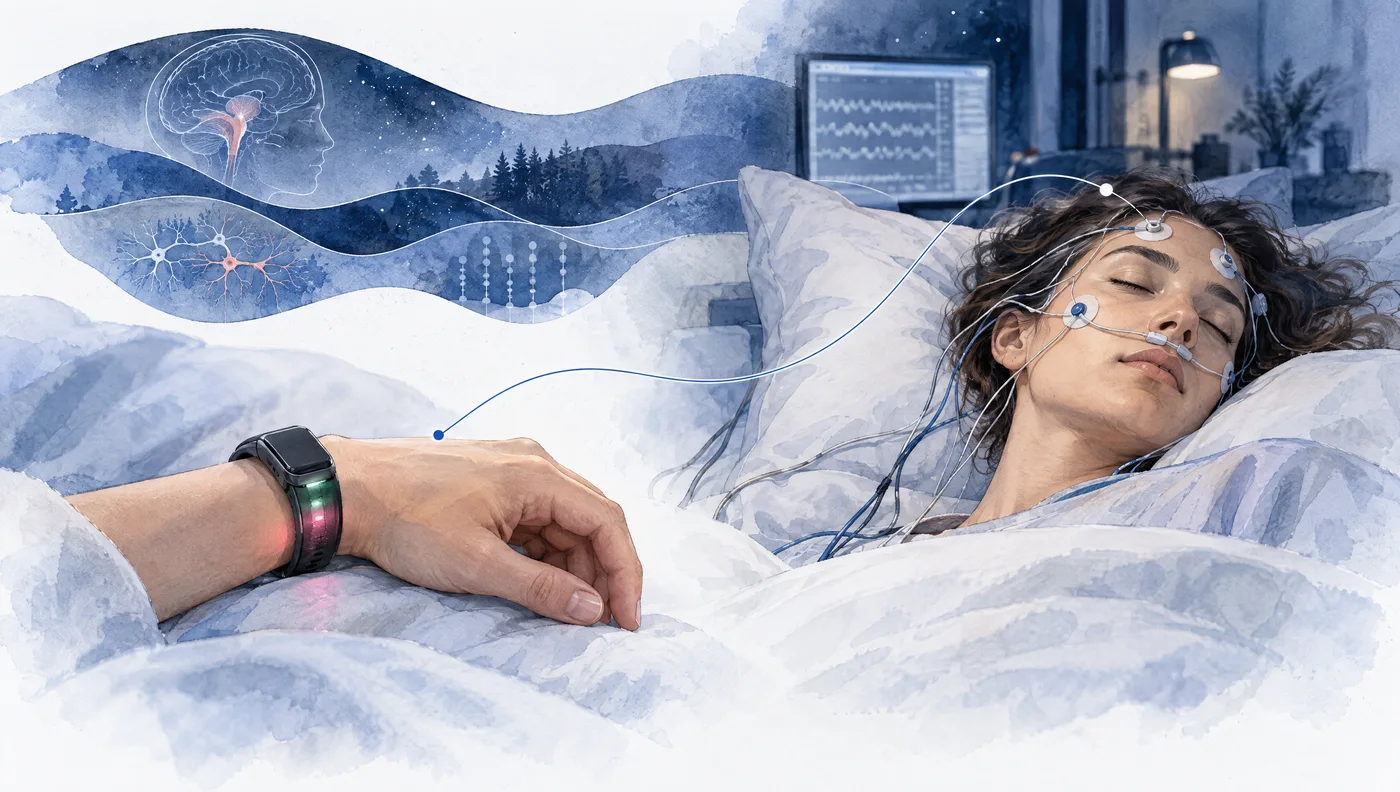
SleepFM-2 is a sleep foundation model built on 282,511 polysomnography recordings from 26 cohorts, 235,865 of them used for pretraining. It improves on SleepFM for disease prediction and sleep scoring, adds arousal, limb movement and respiratory event detection, and transfers to wearables. Combined with age, sex and BMI, it met a prespecified criterion for 188 later EHR phenotypes in two held-out cohorts.
SleepLM is a family of sleep-language foundation models that connect sleep signals with natural language. The authors built a sleep-text dataset of more than 100K hours from over 10,000 people with a multilevel captioning pipeline, and trained with contrastive alignment, caption generation and signal reconstruction. It beat previous methods on zero-shot and few-shot tasks, retrieval and sleep captioning.
SleepMaMi is a polysomnography sleep foundation model with a micro-encoder over 30-second multimodal epochs and a bidirectional Mamba macro-encoder over full-night embeddings trained with demographic-guided contrastive learning. It reports strong linear-probe sleep-staging results on SHHS and CFS. Code and checkpoints are linked from the ICML 2026 / arXiv 2602.07628 release.
SLIP is an open-source framework for language-aligned sensor representations that work across different sensor setups. It reuses a pretrained decoder-only language model through cross-attention and uses a flexible patch embedder, so it handles new sensor configurations, sampling rates and lengths without retraining. Across 11 datasets it reached 77.14% average linear-probe accuracy, 3.56 points above SensorLM.
SOTER is a generative foundation model for wearable physiological time series. It combines a backbone that models links between channels, a mixture-of-experts layer that routes by fixed spectral bands, and a neural controlled differential equation decoder that predicts and imputes at any timestamp. It had the best zero-shot forecasting error on most of six datasets and the lowest imputation error on all six at 75% missing data.
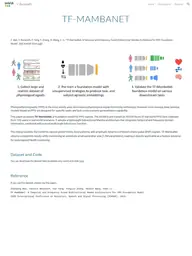
StepFM is a foundation model built only on step-counter data for broad health prediction. Its pretraining captures temporal and behavioural patterns from large-scale step sequences, and it transfers to more than 20 health risk prediction tasks across different devices, regions and diseases.
SynHAR creates synthetic IMU data from personalized biomechanical models and human body surface models to improve activity recognition. It was used both mixed with real data and for pretraining before transfer to public benchmarks, with three HAR models. Synthetic data raised macro-F1 by 8% on average when real data was limited, and pretraining with synthetic plus real data beat real data alone by 5.2% on average.
Text2IMU generates synthetic accelerometer and gyroscope data from text descriptions of activities. A motion synthesis model turns prompts into 3D movement, which body surface models of different shapes perform while virtual IMUs record. Without measured data from the target domain, it reached 79.2% average activity recognition accuracy across three public datasets for correctly generated activities, about double the baseline synthetic data.
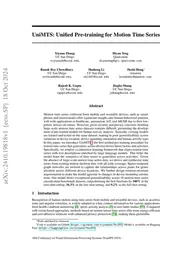
UniMTS is a pretraining method for motion time series from phones and smartwatches that generalizes across device position, orientation and activity type. Tested on 18 motion classification benchmarks, it beat the best baselines by 340% in zero-shot, 16.3% in few-shot and 9.2% in full-shot settings.
Families describe the main role reported in each record. Signals may describe training data, rather than required inference inputs. Dates use the first arXiv posting when known, otherwise the catalog paper date. Missing information stays unconfirmed. Saves stay in this browser.
Complete source records (JSON and CSV) are free for members. Sign in to download. Every record is readable on this site, and llms.txt describes the hub for AI tools.
For a citable version that never changes, use the 2026-10 snapshot.
Cite or reuse this
CC BY 4.0ChatPPG compiled this data. You can copy, adapt and republish it, including in articles, slides, papers and AI tools, as long as you credit ChatPPG and link to this page. Please also cite the original studies for any number you use.
Attribution
Source: ChatPPG, ChatPPG Research Hub: wearable and PPG benchmark leaderboards, datasets and models, https://chatppg.com/research (CC BY 4.0)
HTML link
Source: <a href="https://chatppg.com/research">ChatPPG, ChatPPG Research Hub: wearable and PPG benchmark leaderboards, datasets and models</a> (<a href="https://creativecommons.org/licenses/by/4.0/" rel="license">CC BY 4.0</a>)
Cite the dated snapshot 2026-10 for a fixed, reproducible version. Please also cite the original publications listed above.
APA
ChatPPG. (2026). ChatPPG Research Hub: wearable and PPG benchmark leaderboards, datasets and models (Version 2026-10) [Data set]. ChatPPG Research Hub. https://chatppg.com/research
BibTeX
@misc{chatppg_research_hub,
  author       = {{ChatPPG}},
  title        = {{ChatPPG Research Hub: wearable and PPG benchmark leaderboards, datasets and models}},
  year         = {2026},
  month        = oct,
  version      = {2026-10},
  howpublished = {\url{https://chatppg.com/research}},
  note         = {ChatPPG Research Hub, Snapshot 2026-10, https://chatppg.com/research/snapshots/2026-10}
}
CITATION.cff
cff-version: 1.2.0
message: "If you use this resource, please cite it as below."
type: dataset
title: "ChatPPG Research Hub: wearable and PPG benchmark leaderboards, datasets and models"
authors:
  - name: "ChatPPG"
url: "https://chatppg.com/research"
repository-artifact: "https://chatppg.com/research/snapshots/2026-10"
version: "2026-10"
date-released: "2026-10-17"
Stay in the loop
Get new PPG datasets, papers and models
The ChatPPG newsletter covers what's new in the research atlas, plus practical guides. Unsubscribe anytime.