Cite this model
PAT (Pretrained Actigraphy Transformer). (2026). IEEE JBHI 2026.
@article{patactigraphytra2026pretrained,
  title         = {{PAT (Pretrained Actigraphy Transformer)}},
  year          = {2026},
  journal       = {IEEE JBHI 2026}
}
Activity counts measure attention, not model quality. Missing counts are unknown. Publication status follows the linked source; a listed venue alone does not confirm peer review.
PAT (Pretrained Actigraphy Transformer) is an open-source foundation model for wearable movement data in mental health research. It uses transformers with patch embeddings, pretrained as a masked autoencoder on week-long minute-level actigraphy from 21,538 NHANES participants. PAT beat non-foundation baselines on predicting benzodiazepine and SSRI use, depression and sleep problems, including a 55.6% gain over an LSTM for benzodiazepine use.
transformer with patch embeddings, MAE pretraining
0.767
AUROC ↑
Mental health from wearables · NHANES actigraphy
benzodiazepine use (binary) · pretrained masked autoencoder, fine-tuned; AUC averaged over training-set sizes (500, 1,000, 2,500, full)
0.767
AUROC ↑
Mental health from wearables · NHANES actigraphy
benzodiazepine use (binary) · pretrained masked autoencoder, fine-tuned; AUC averaged over training-set sizes (500, 1,000, 2,500, full)
Results as reported by the authors; not independently reproduced. A SOTA star marks the best value among results reported under the same evaluation protocol; ties go to the earlier publication.
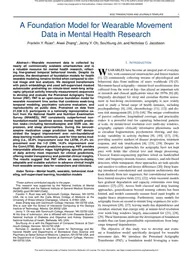
Wearable movement data is collected by nearly all commercially available smartwatches and is a valuable resource for mental health research, reflecting fine-grained temporal behavioral trends. Despite its promise, the development of foundation models for health wearable modeling remains limited when compared to clinical image and text analysis. We designed transformers with patch embeddings and used self-supervised masked autoencoder pretraining on minute-level week-long actigraphy (physical activity intensity measurement) sequences to develop and evaluate the Pretrained Actigraphy Transformer (PAT). PAT is an open-source foundation model for wearable movement time series that combines week-long temporal modeling, psychiatric outcome evaluation, and reproducibility on public data. Pretrained on data from 21,538 U.S. participants in a nationally representative cohort from the National Health and Nutrition Examination Survey (NHANES), PAT consistently outperformed non-foundation-model baselines across mental health prediction tasks-including benzodiazepine and SSRI use, depression, and sleep abnormalities. During the benzodiazepine medication usage prediction task, PAT demonstrated the largest improvement over non-foundational deep learning models commonly used for time-series modeling (i.e., 55.6% improvement over the LSTM, 21.4% improvement over the 1-D CNN, 14.8% improvement over the ConvLSTM). Beyond predictive accuracy, PAT provides interpretable attention maps highlighting specific periods of daily activity most important for clinical predictions, offering model transparency and potential clinical insights. The results suggest that PAT offers an easy-to-deploy, adaptable and scalable solution to advance clinical insight from wearable sensor data for researchers and clinicians.
Verbatim fromGitHub· Description from the repository README; licence: CC-BY-4.0

PAT (Pretrained Actigraphy Transformer). (2026). IEEE JBHI 2026.
@article{patactigraphytra2026pretrained,
title = {{PAT (Pretrained Actigraphy Transformer)}},
year = {2026},
journal = {IEEE JBHI 2026}
}Record updated
Added to the ChatPPG research hub
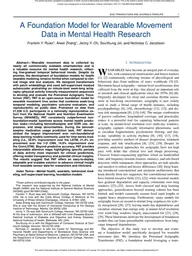 A Foundation Model for Wearable Movement Data in Mental Health Research (PAT)Paper on this modelIEEE J Biomed Health Inform · 2026
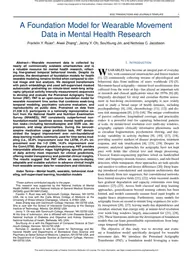 PAT: Pretrained Actigraphy TransformerPaper on this modelIEEE Journal of Biomedical and Health Info · 2026
 Lapras: Latent Reasoning for Time Series Language ModelsShared author: Nicholas C. JacobsonarXiv 2610.11111 · 2026