Activity counts measure attention, not model quality. Missing counts are unknown. Publication status follows the linked source; a listed venue alone does not confirm peer review.
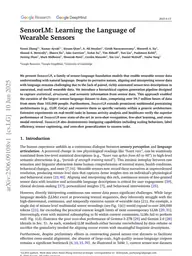
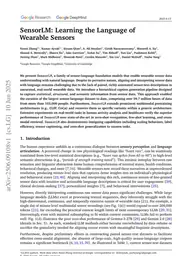
SensorLM is a family of sensor-language foundation models from Google DeepMind and Google Research, described in "SensorLM: Learning the Language of Wearable Sensors" by Yuwei Zhang, Kumar Ayush, Siyuan Qiao and colleagues, with Yuzhe Yang as the final author (arXiv 2506.09108, 2025). The goal is to let people query and describe wearable sensor data in natural language.
The main obstacle is that real-world wearable data almost never comes with text. To get paired data, the authors built a hierarchical caption generation pipeline that captures statistical, structural and semantic information from the sensor data. With this pipeline they curated what they describe as the largest sensor-language dataset to date, with over 59.7 million hours of data from more than 103,000 people.
On the modeling side, SensorLM generalizes two well-known multimodal pretraining recipes, CLIP and CoCa, so that both appear as specific variants inside one architecture. The paper evaluates it on real-world tasks in human activity analysis and healthcare and reports better results than the state of the art in zero-shot recognition, few-shot learning and cross-modal retrieval between sensor data and text. The authors also report scaling behavior, label efficiency, sensor captioning and zero-shot generalization to unseen tasks.
SensorLM sits in the same line of Google work as LSM and LSM-2, which learn representations of sensor data without language. It works on minute-level wearable data, not raw PPG waveforms. The arXiv record does not link code or weights, so it is mainly a reference design for anyone building language interfaces over wearable data. For a PPG-specific language dataset that is public, PulseLM pairs over 1 million PPG segments with question-answer pairs.
Signals
PPG, IMU, SpO₂, Temp, HR
Data
over 59.7 million hours from more than 103,000 people
Year
2025
Paper
SensorLM: Learning the Language of Wearable Sensors (Zhang, Ayush, Qiao et al.), arXiv 2506.09108, 2025
Captions
hierarchical pipeline covering statistical, structural and semantic information
Architecture
generic design that recovers CLIP and CoCa as variants
Results
zero-shot recognition, few-shot learning and cross-modal retrieval above prior state of the art
We present SensorLM, a family of sensor-language foundation models that enable wearable sensor data understanding with natural language. Despite its pervasive nature, aligning and interpreting sensor data with language remains challenging due to the lack of paired, richly annotated sensor-text descriptions in uncurated, real-world wearable data. We introduce a hierarchical caption generation pipeline designed to capture statistical, structural, and semantic information from sensor data. This approach enabled the curation of the largest sensor-language dataset to date, comprising over 59.7 million hours of data from more than 103,000 people. Furthermore, SensorLM extends prominent multimodal pretraining architectures (e.g., CLIP, CoCa) and recovers them as specific variants within a generic architecture. Extensive experiments on real-world tasks in human activity analysis and healthcare verify the superior performance of SensorLM over state-of-the-art in zero-shot recognition, few-shot learning, and cross-modal retrieval. SensorLM also demonstrates intriguing capabilities including scaling behaviors, label efficiency, sensor captioning, and zero-shot generalization to unseen tasks.
Verbatim fromarXiv· arXiv metadata (abstracts are released under CC0)
SensorLM is a family of Google sensor-language foundation models that align wearable sensor data with natural language, trained on over 59.7 million hours of data from more than 103,000 people.
Can I download SensorLM?
No weights or data are linked from the arXiv record (2506.09108).
SensorLM vs LSM?
LSM learns sensor representations by masked reconstruction without text. SensorLM pairs sensor data with generated captions and trains CLIP and CoCa style models, which enables zero-shot recognition and sensor-text retrieval.
What are SensorLM's benchmark results?
The paper reports that SensorLM beats the prior state of the art in zero-shot recognition, few-shot learning and cross-modal retrieval on human activity and healthcare tasks.
Cite this model
Cite the publication recorded for this model. Check it against the publisher before submitting.
Zhang, Y., Ayush, K., Qiao, S., Heydari, A. A., Narayanswamy, G., Xu, M. A., Metwally, A. A., Xu, S., Garrison, J., Xu, X., Althoff, T., Liu, Y., Kohli, P., Zhan, J., Malhotra, M., Patel, S., Mascolo, C., Liu, X., McDuff, D., & Yang, Y. (2025). SensorLM: Learning the Language of Wearable Sensors. NeurIPS 2025. https://doi.org/10.48550/ARXIV.2506.09108
Zhang, Yuwei, Kumar Ayush, Siyuan Qiao, A. Ali Heydari, Girish Narayanswamy, Maxwell A. Xu, and Ahmed A. Metwally, et al. 2025. "SensorLM: Learning the Language of Wearable Sensors." NeurIPS 2025. https://doi.org/10.48550/ARXIV.2506.09108.
Zhang, Y., Ayush, K., Qiao, S., Heydari, A. A., Narayanswamy, G., Xu, M. A. and Metwally, A. A. et al. (2025) 'SensorLM: Learning the Language of Wearable Sensors', NeurIPS 2025. doi: 10.48550/ARXIV.2506.09108.
Zhang, Yuwei, et al. "SensorLM: Learning the Language of Wearable Sensors." NeurIPS 2025, 2025. https://doi.org/10.48550/ARXIV.2506.09108.
Y. Zhang et al., "SensorLM: Learning the Language of Wearable Sensors," NeurIPS 2025, 2025, doi: 10.48550/ARXIV.2506.09108.
@misc{zhang2025sensorlm,
  title         = {{SensorLM: Learning the Language of Wearable Sensors}},
  author        = {Zhang, Yuwei and Ayush, Kumar and Qiao, Siyuan and Heydari, A. Ali and Narayanswamy, Girish and Xu, Maxwell A. and Metwally, Ahmed A. and Xu, Shawn and Garrison, Jake and Xu, Xuhai and Althoff, Tim and Liu, Yun and Kohli, Pushmeet and Zhan, Jiening and Malhotra, Mark and Patel, Shwetak and Mascolo, Cecilia and Liu, Xin and McDuff, Daniel and Yang, Yuzhe},
  year          = {2025},
  howpublished  = {NeurIPS 2025},
  publisher     = {arXiv},
  doi           = {10.48550/ARXIV.2506.09108},
  eprint        = {2506.09108},
  archivePrefix = {arXiv}
}
History
Record updated
Added to the ChatPPG research hub
Newsletter
Get new PPG datasets, papers and models
Get alerts when SensorLM is benchmarked on new datasets, plus the weekly digest.
New datasets, papers and models
Practical guides from the hub
Unsubscribe anytime
The waveform is an illustration of a PPG pulse, not a recording.