Foundation model

SleepFM-2

From “Learning transferable human physiology from two million hours of sleep with SleepFM-2”
Year
2026
Form factor
PSG pretrain wearable transfer
Thapa, Rahul et al., "Learning transferable human physiology from two million hours of sleep with SleepFM-2", arXiv:2609.06849, CC BY 4.0
PreprintFirst posted: Sep 6, 2026Added to atlas: Sep 26, 2026Source

Activity counts measure attention, not model quality. Missing counts are unknown. Publication status follows the linked source; a listed venue alone does not confirm peer review.

SleepFM-2 is a sleep foundation model built on 282,511 polysomnography recordings from 26 cohorts, 235,865 of them used for pretraining. It improves on SleepFM for disease prediction and sleep scoring, adds arousal, limb movement and respiratory event detection, and transfers to wearables. Combined with age, sex and BMI, it met a prespecified criterion for 188 later EHR phenotypes in two held-out cohorts.

Published
arXiv preprint, 2026
Signals
PPG, ECG, IMU, Resp, EEG, EMG, EOG
Result
predictive for 188 EHR phenotypes in held-out cohorts
Year
2026
Data

282,511 PSG recordings from 26 cohorts (235,865 for pretraining)

At a glance
Type
Foundation model
Parameters
Not reported
Architecture
LLaMA-style shared encoder, 1 s tokens
Venue
arXiv preprint
Year
2026
DOI
Not reported
Code
Not reported
Weights
Not released
Licence
Not reported
Caveats
Not reported
Datasets
Not reported
Added
Sep 26, 2026
Updated
Sep 26, 2026

Abstract

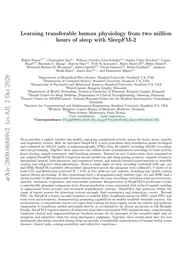
Sleep provides a nightly window into health by capturing coordinated activity across the brain, heart, muscles and respiratory system. We introduce SleepFM-2, a sleep foundation model developed and evaluated on 282,511 polysomnography recordings from 26 cohorts, including 235,865 used for pretraining. These data span more than two million hours of multimodal physiology. Compared with SleepFM, SleepFM-2 improves disease prediction and sleep scoring, supports arousal, limb movement and respiratory event detection, and transfers to wearable sensing and subjective sleep phenotypes. A model combining its PSG representation with age, sex and BMI met a prespecified discrimination and significance criterion for 188 subsequently recorded EHR phenotypes in two held-out cohorts, including one health system unseen during pretraining. SleepFM-2 also outperformed a 480-feature baseline derived from the same recordings. Its disease scores revealed a reproducible principal component associated with reduced sigma-band spatial coupling and increased hypnodensity entropy. The frozen encoder performed within the observed range of expert scorers for sleep events and transferred to wakeful EEG, headband and in-ear EEG, wrist PPG and wrist accelerometry. It improved sleep staging across six accelerometry cohorts and achieved disease-prediction performance in UK Biobank similar to models pretrained directly on accelerometry. Finally, SleepFM-2 captured aspects of subjective sleep not recovered by conventional PSG summaries, particularly reports of the recorded night. These results show that multimodal sleep physiology can provide a transferable representation of human health across diseases, clinical tasks, sensors and subjective experience.
Verbatim fromarXiv· arXiv metadata (abstracts are released under CC0)

How it works

How SleepFM-2 works: Input signals → Foundation model → Downstream tasksInput signals: PPG (Photoplethysmogram); ECG (Electrocardiogram); IMU (Accelerometer, 3-axis); Respiration (Breathing effort). Foundation model: SleepFM-2 (Language-aligned). Downstream tasks: Sleep staging.Input signalsPPG: PhotoplethysmogramPPGPhotoplethysmogramECG: ElectrocardiogramECGElectrocardiogramIMU: Accelerometer, 3-axisxyzIMUAccelerometer, 3-axisRespiration: Breathing effortRespirationBreathing effortFoundation modelSleepFM-2Language-alignedDownstream tasksSleep stagingSleep staging
Architecture
LLaMA-style shared encoder, 1 s tokens
Inputs
PPG, ECG, IMU, Resp, EEG, EMG, EOG
Approach
sleep · PSG · Stanford · transfer

Datasets used

No public datasets linked yet.

Papers· 2

Authors· 12

Cite this model

Cite the publication recorded for this model. Check it against the publisher before submitting.

Learning transferable human physiology from two million hours of sleep with SleepFM-2. (2026). arXiv preprint. https://doi.org/10.48550/arXiv.2609.06849
@misc{sleepfm22026learning,
  title         = {{Learning transferable human physiology from two million hours of sleep with SleepFM-2}},
  year          = {2026},
  howpublished  = {arXiv preprint},
  doi           = {10.48550/arXiv.2609.06849},
  eprint        = {2609.06849},
  archivePrefix = {arXiv}
}

History

  1. Added to the ChatPPG research hub