SPOTR
single-token compress-reconstruct SSL for EEG/iEEG/ECG/PPG (IJCAI-ECAI 2026)
Activity counts measure attention, not model quality. Missing counts are unknown. Publication status follows the linked source; a listed venue alone does not confirm peer review.
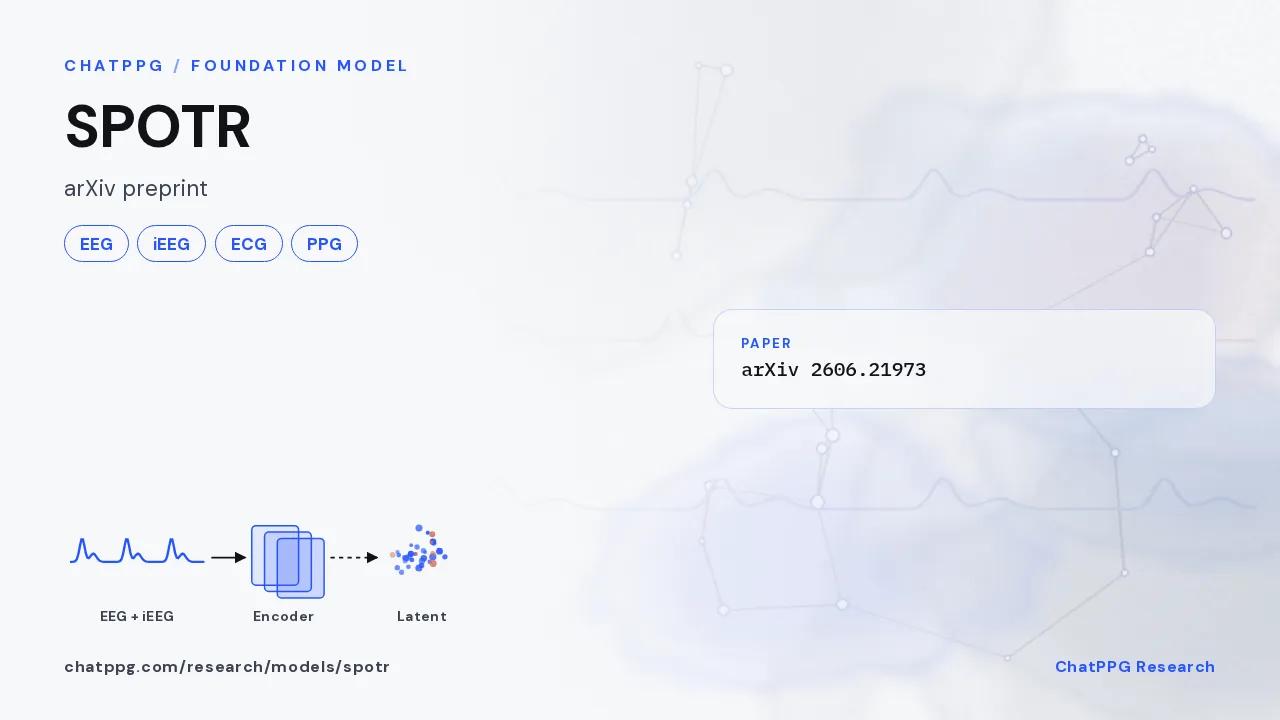
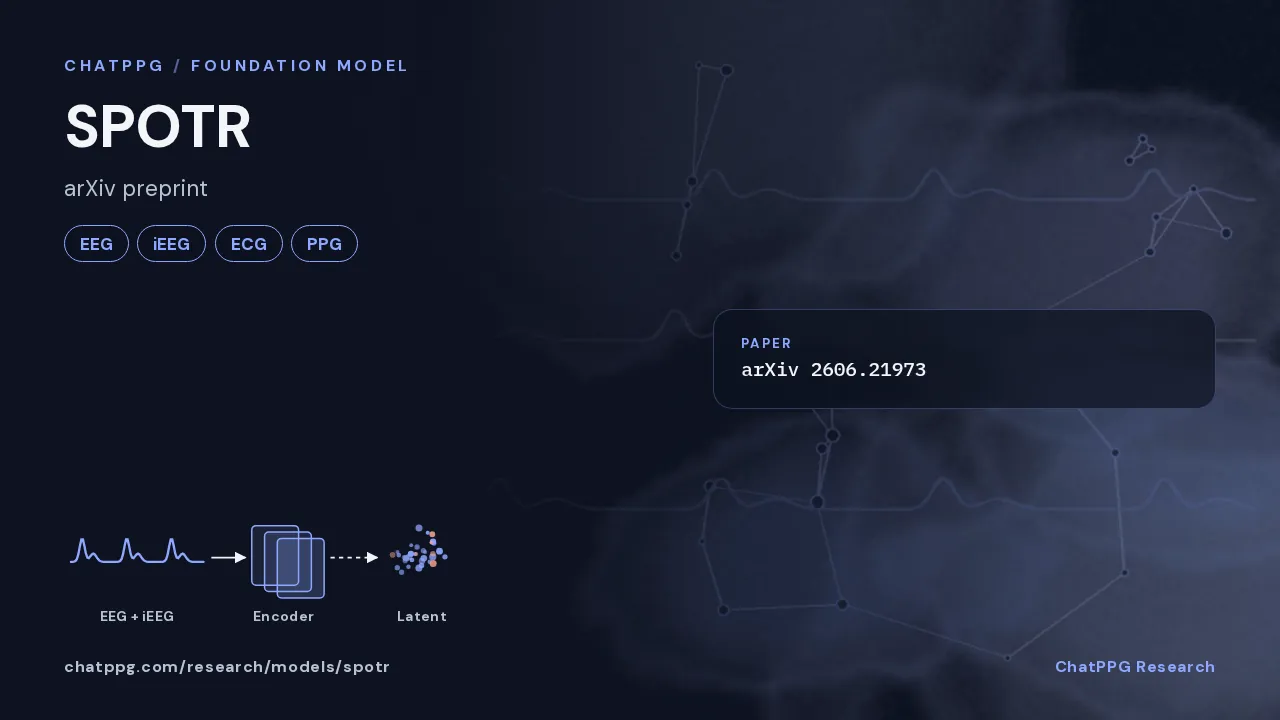
SPOTR is a pretraining method for physiological signals that compresses each recording into a single global token and reconstructs from it, with a compaction module to save compute. Pretrained on 20 datasets of EEG, iEEG, ECG and PPG, it beat the strongest baseline in linear probing by 18.49%, 21.71%, 17.86% and 4.64% AUC respectively. It also ran with about 78% lower latency and 52% less GPU memory than a general time-series foundation model.
- Published: arXiv preprint, 2026
- Pretraining: 20 datasets (EEG, iEEG, ECG, PPG)
- Method: single-token bottleneck compress-reconstruct
- Result: +4.64% AUC on PPG, +17.86% on ECG (linear probe)
- Efficiency: ~78% lower latency, 52% lower peak GPU memory
- Type
- Foundation model
- Form factor
- Other
- Parameters
- Not reported
- Architecture
- Not reported
- Venue
- arXiv preprint
- Year
- 2026
- DOI
- Not reported
- Weights
- Not reported
- Licence
- MIT (opens in a new tab)
- Datasets
- Not reported
- Added
- Oct 11, 2026
- Updated
- Oct 11, 2026
Abstract
Physiological signals such as EEG, ECG, and PPG are widely used in clinical monitoring. Recent self-supervised learning (SSL) methods offer an attractive way to leverage unlabeled recordings, yet they still fall short in practice. In particular, current SSL methods struggle across heterogeneous datasets, often distorting clinically meaningful structures or learning shortcuts from temporal and cross-channel redundancy. Consequently, existing SSL methods often deliver limited performance under linear probing, a lightweight adaptation setting that better matches real-world medical scenarios. Moreover, most Transformer-based SSL models encode a flattened spatiotemporal token sequence, incurring high computation and memory cost, and are typically developed within a single modality. To address these limitations, we present SPOTR (Spatio-temporal Pooling One-Token Reconstruction), a compress-reconstruct pretraining framework that introduces a single-token global bottleneck for physiological signals. SPOTR compresses each waveform into a single-token representation and reconstructs the signal conditioned only on this representation. Meanwhile, SPOTR introduces an efficient spatio-temporal compaction module to reduce computation and memory cost. Pretrained on 20 datasets spanning EEG, iEEG, ECG, and PPG, SPOTR consistently outperforms the strongest baseline under linear probing, improving average AUC by 18.49%, 21.71%, 17.86%, and 4.64%, respectively. Compared with a representative general-purpose time-series foundation model, SPOTR achieves around 78% lower latency and 52% lower peak GPU memory on average. The code can be found at https://github.com/5GYYYYY/SPOTR.
Verbatim fromarXiv· arXiv metadata (abstracts are released under CC0)
How it works
- Pretraining data
- 20 public datasets spanning EEG, iEEG, ECG, PPG
- Inputs
- EEG, iEEG, ECG, PPG
- Approach
- self supervised · foundation model · MIT · linear probe
Datasets
Papers· 1
Cite
@misc{spotr2026,
  title = {{SPOTR}},
  author = {Yiyu Gui and Mingzhi Chen and Yuesheng Zhu and Guibo Luo and Yuchao Yang},
  year = {2026},
  howpublished = {arXiv preprint},
  eprint = {2606.21973},
  url = {https://arxiv.org/abs/2606.21973}
}History
Added to the ChatPPG research hub
More on ChatPPG
- SPOTR: Spatio-temporal Pooling One-Token Reconstruction for Universal Physiological Signal Self-supervised Learning
SPOTR is a pretraining method for physiological signals that squeezes each recording into one global
- Aether
compute-optimal physiological waveform FM family (20M–2.1B)
- AI-PPG age (PPG-VascularAge)
Foundation model