Activity counts measure attention, not model quality. Missing counts are unknown. Publication status follows the linked source; a listed venue alone does not confirm peer review.
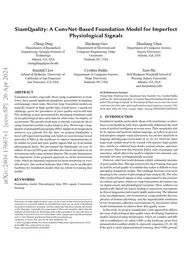
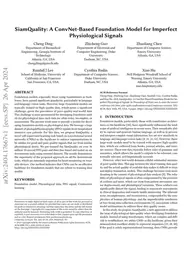
SiamQuality is a convolutional foundation model for PPG built to cope with poor signal quality, described in "SiamQuality: A ConvNet-Based Foundation Model for Imperfect Physiological Signals" by Cheng Ding, Zhicheng Guo, Zhaoliang Chen, Randall J. Lee, Cynthia Rudin and Xiao Hu (arXiv 2404.17667, 2024).
Large foundation models are usually trained on clean data, but physiological recordings are often noisy, incomplete or inconsistent, and PPG from wearables is a clear example. SiamQuality takes that noise head on. Its self-supervised task, written as SimQuality in the abstract, uses a CNN backbone and pushes the representations of good-quality and poor-quality PPG signals from similar physiological states to be similar. In other words, the model learns to see past artifacts to the underlying physiology.
The pre-training data comes from routine patient monitoring in the intensive care units of the University of California, San Francisco (UCSF) Medical Center: over 36 million 30-second PPG pairs (600,000+ hours) from 21,000 patients. After pre-training, the model was fine-tuned and tested on six downstream tasks using external datasets. Those tasks include heart rate estimation, blood pressure estimation, respiration rate estimation and atrial fibrillation detection, on public datasets such as WESAD, BIDMC, the Stanford AF dataset and PulseDB. The authors report that the approach was better than the comparison methods on all of the downstream tasks.
A second message of the paper is architectural. Transformers dominate foundation-model work, but the authors argue that CNNs can be an effective backbone for foundation models that need to tolerate low-quality training data.
The code is on GitHub (chengding0713/SiamQuality), but the repository has no license file, so reuse needs the authors' permission. The UCSF pre-training data is not public, while the downstream datasets are. SiamQuality is a good comparison point for anyone working on motion-corrupted wrist PPG or signal quality, and it pairs naturally with PPG foundation models such as PaPaGei that were trained on cleaner clinical recordings.
Signals
PPG
Backbone
convolutional neural network
Code
github.com/chengding0713/SiamQuality
Year
2024
Paper
SiamQuality: A ConvNet-Based Foundation Model for Imperfect Physiological Signals (Ding, Guo, Chen, Lee, Rudin, Hu), arXiv 2404.17667, 2024
Pre-training
over 36 million 30-second PPG pairs (600,000+ hours) from 21,000 UCSF ICU patients
Objective
make good- and poor-quality PPG from similar physiological states map to similar representations
Downstream
six tasks on external datasets (heart rate, blood pressure, respiration rate, AF detection)
Results as reported by the authors; not independently reproduced. A SOTA star marks the best value among results reported under the same evaluation protocol; ties go to the earlier publication.
Embed this badge (1 badge for READMEs and project pages)
Markdown
[](https://chatppg.com/research/models/siamquality#key-results)
Foundation models, especially those using transformers as backbones, have gained significant popularity, particularly in language and language-vision tasks. However, large foundation models are typically trained on high-quality data, which poses a significant challenge, given the prevalence of poor-quality real-world data. This challenge is more pronounced for developing foundation models for physiological data; such data are often noisy, incomplete, or inconsistent. The present work aims to provide a toolset for developing foundation models on physiological data. We leverage a large dataset of photoplethysmography (PPG) signals from hospitalized intensive care patients. For this data, we propose SimQuality, a novel self-supervised learning task based on convolutional neural networks (CNNs) as the backbone to enforce representations to be similar for good and poor quality signals that are from similar physiological states. We pre-trained the SimQuality on over 36 million 30-second PPG pairs and then fine-tuned and tested on six downstream tasks using external datasets. The results demonstrate the superiority of the proposed approach on all the downstream tasks, which are extremely important for heart monitoring on wearable devices. Our method indicates that CNNs can be an effective backbone for foundation models that are robust to training data quality.
Verbatim fromarXiv· arXiv metadata (abstracts are released under CC0)
How it works
Datasets linked in the hub; pretraining vs evaluation roles follow the paper.
SiamQuality is a CNN-based PPG foundation model that learns similar representations for good- and poor-quality PPG from similar physiological states. It was pre-trained on over 36 million 30-second PPG pairs from ICU patients.
How do I get SiamQuality?
The code is at https://github.com/chengding0713/SiamQuality, with no license file, so reuse needs the authors' permission. The UCSF ICU data used for pre-training is not public.
SiamQuality vs PaPaGei?
SiamQuality uses a CNN and a quality-pairing objective aimed at noisy PPG. PaPaGei uses morphology-aware contrastive learning on more than 57,000 hours of public clinical PPG and publishes weights on Zenodo.
What are SiamQuality's benchmark results?
The paper reports better results than comparison methods on all six downstream tasks, which cover heart rate, blood pressure and respiration rate estimation and atrial fibrillation detection.
Cite this model
Cite the publication recorded for this model. Check it against the publisher before submitting.
Ding, C., Guo, Z., Chen, Z., Lee, R. J., Rudin, C., & Hu, X. (2024). SiamQuality: A ConvNet-Based Foundation Model for Imperfect Physiological Signals. Physiological Measurement 2024. https://doi.org/10.48550/ARXIV.2404.17667
Ding, Cheng, Zhicheng Guo, Zhaoliang Chen, Randall J Lee, Cynthia Rudin, and Xiao Hu. 2024. "SiamQuality: A ConvNet-Based Foundation Model for Imperfect Physiological Signals." Physiological Measurement 2024. https://doi.org/10.48550/ARXIV.2404.17667.
Ding, C., Guo, Z., Chen, Z., Lee, R. J., Rudin, C. and Hu, X. (2024) 'SiamQuality: A ConvNet-Based Foundation Model for Imperfect Physiological Signals', Physiological Measurement 2024. doi: 10.48550/ARXIV.2404.17667.
Ding, Cheng, et al. "SiamQuality: A ConvNet-Based Foundation Model for Imperfect Physiological Signals." Physiological Measurement 2024, 2024. https://doi.org/10.48550/ARXIV.2404.17667.
C. Ding, Z. Guo, Z. Chen, R. J. Lee, C. Rudin, and X. Hu, "SiamQuality: A ConvNet-Based Foundation Model for Imperfect Physiological Signals," Physiological Measurement 2024, 2024, doi: 10.48550/ARXIV.2404.17667.
@misc{ding2024siamquality,
  title         = {{SiamQuality: A ConvNet-Based Foundation Model for Imperfect Physiological Signals}},
  author        = {Ding, Cheng and Guo, Zhicheng and Chen, Zhaoliang and Lee, Randall J. and Rudin, Cynthia and Hu, Xiao},
  year          = {2024},
  howpublished  = {Physiological Measurement 2024},
  publisher     = {arXiv},
  doi           = {10.48550/ARXIV.2404.17667},
  eprint        = {2404.17667},
  archivePrefix = {arXiv}
}
History
Record updated
Added to the ChatPPG research hub
Newsletter
Get new PPG datasets, papers and models
Get alerts when SiamQuality is benchmarked on new datasets, plus the weekly digest.
New datasets, papers and models
Practical guides from the hub
Unsubscribe anytime
The waveform is an illustration of a PPG pulse, not a recording.