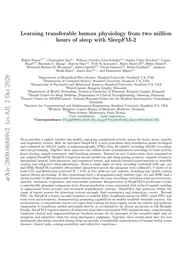
Thapa, Rahul et al., "SleepFM: Multi-modal Representation Learning for Sleep Across Brain Activity, ECG and Respiratory Signals", arXiv:2405.17766, CC BY 4.0
Activity counts measure attention, not model quality. Missing counts are unknown. Publication status follows the linked source; a listed venue alone does not confirm peer review.
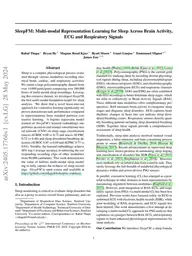
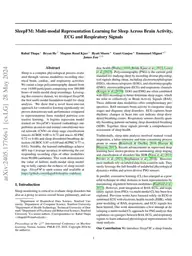
SleepFM is a multi-modal foundation model for sleep analysis from Rahul Thapa, Bryan He, Magnus Ruud Kjaer, Hyatt Moore, Gauri Ganjoo, Emmanuel Mignot and James Zou, described in "SleepFM: Multi-modal Representation Learning for Sleep Across Brain Activity, ECG and Respiratory Signals" (arXiv 2405.17766). The code README says the paper was accepted at ICML 2024.
Sleep is assessed through several kinds of signals at once. A polysomnography study records brain activity (EEG, EOG and EMG, grouped in the paper as brain activity signals), ECG and respiratory channels. The authors curated a large polysomnography dataset from over 14,000 participants with over 100,000 hours of multi-modal sleep recordings, and they describe SleepFM as the first multi-modal foundation model for sleep analysis.
The main method idea is a leave-one-out approach to contrastive learning. Instead of contrasting each pair of modalities separately, the embedding of each modality is contrasted against the average embedding of all the other modalities. The paper shows this improves downstream performance compared with standard pairwise contrastive learning.
The gains are large on standard sleep tasks. A logistic regression trained on SleepFM embeddings beat an end-to-end convolutional neural network on sleep stage classification (macro AUROC 0.88 vs 0.72, macro AUPRC 0.72 vs 0.48) and on sleep disordered breathing detection (AUROC 0.85 vs 0.69, AUPRC 0.77 vs 0.61). The embeddings also reached 48% top-1 average accuracy when retrieving the matching recording clip of another modality from 90,000 candidates.
SleepFM is open source, with code at github.com/rthapa84/sleepfm-codebase under the MIT license. It does not use PPG directly, but it is the main reference point for multi-modal sleep foundation models, and its ECG and respiratory branches cover signals that PPG-based sleep work often tries to approximate from the wrist.
Signals
ECG, Resp, EEG, EMG
Method
leave-one-out multi-modal contrastive learning
Sleep staging
macro AUROC 0.88 vs 0.72 for an end-to-end CNN
Sleep disordered breathing
AUROC 0.85 vs 0.69
Code
github.com/rthapa84/sleepfm-codebase (MIT)
Year
2024
Paper
SleepFM: Multi-modal Representation Learning for Sleep Across Brain Activity, ECG and Respiratory Signals (Thapa et al.), arXiv 2405.17766; ICML 2024 per the README
Data
over 14,000 participants, over 100,000 hours of polysomnography
Sleep is a complex physiological process evaluated through various modalities recording electrical brain, cardiac, and respiratory activities. We curate a large polysomnography dataset from over 14,000 participants comprising over 100,000 hours of multi-modal sleep recordings. Leveraging this extensive dataset, we developed SleepFM, the first multi-modal foundation model for sleep analysis. We show that a novel leave-one-out approach for contrastive learning significantly improves downstream task performance compared to representations from standard pairwise contrastive learning. A logistic regression model trained on SleepFM's learned embeddings outperforms an end-to-end trained convolutional neural network (CNN) on sleep stage classification (macro AUROC 0.88 vs 0.72 and macro AUPRC 0.72 vs 0.48) and sleep disordered breathing detection (AUROC 0.85 vs 0.69 and AUPRC 0.77 vs 0.61). Notably, the learned embeddings achieve 48% top-1 average accuracy in retrieving the corresponding recording clips of other modalities from 90,000 candidates. This work demonstrates the value of holistic multi-modal sleep modeling to fully capture the richness of sleep recordings. SleepFM is open source and available at https://github.com/rthapa84/sleepfm-codebase.
Verbatim fromarXiv· arXiv metadata (abstracts are released under CC0)
How it works
Architecture
PSG foundation model (leave-one-out multimodal contrastive pretraining).
SleepFM is a multi-modal sleep foundation model trained on over 100,000 hours of polysomnography from over 14,000 participants, covering brain activity, ECG and respiratory signals.
How do I get SleepFM?
The code is open source at https://github.com/rthapa84/sleepfm-codebase under the MIT license.
SleepFM vs pairwise contrastive learning?
SleepFM uses a leave-one-out contrastive approach across modalities, which the paper shows improves downstream performance over standard pairwise contrastive learning.
What are SleepFM's benchmark results?
On sleep staging, a logistic regression on SleepFM embeddings reached macro AUROC 0.88 vs 0.72 for an end-to-end CNN; on sleep disordered breathing it reached AUROC 0.85 vs 0.69.
Cite this model
Cite the publication recorded for this model. Check it against the publisher before submitting.
Thapa, R., He, B., Kjaer, M. R., Moore, H., Ganjoo, G., Mignot, E., & Zou, J. (2024). SleepFM: Multi-modal Representation Learning for Sleep Across Brain Activity, ECG and Respiratory Signals. ICML 2024. https://doi.org/10.48550/ARXIV.2405.17766
Thapa, Rahul, Bryan He, Magnus Ruud Kjaer, Hyatt Moore, Gauri Ganjoo, Emmanuel Mignot, and James Zou. 2024. "SleepFM: Multi-modal Representation Learning for Sleep Across Brain Activity, ECG and Respiratory Signals." ICML 2024. https://doi.org/10.48550/ARXIV.2405.17766.
Thapa, R., He, B., Kjaer, M. R., Moore, H., Ganjoo, G., Mignot, E. and Zou, J. (2024) 'SleepFM: Multi-modal Representation Learning for Sleep Across Brain Activity, ECG and Respiratory Signals', ICML 2024. doi: 10.48550/ARXIV.2405.17766.
Thapa, Rahul, et al. "SleepFM: Multi-modal Representation Learning for Sleep Across Brain Activity, ECG and Respiratory Signals." ICML 2024, 2024. https://doi.org/10.48550/ARXIV.2405.17766.
R. Thapa et al., "SleepFM: Multi-modal Representation Learning for Sleep Across Brain Activity, ECG and Respiratory Signals," ICML 2024, 2024, doi: 10.48550/ARXIV.2405.17766.
@misc{thapa2024sleepfm,
  title         = {{SleepFM: Multi-modal Representation Learning for Sleep Across Brain Activity, ECG and Respiratory Signals}},
  author        = {Thapa, Rahul and He, Bryan and Kjaer, Magnus Ruud and Moore, Hyatt and Ganjoo, Gauri and Mignot, Emmanuel and Zou, James},
  year          = {2024},
  howpublished  = {ICML 2024},
  publisher     = {arXiv},
  doi           = {10.48550/ARXIV.2405.17766},
  eprint        = {2405.17766},
  archivePrefix = {arXiv}
}
History
Record updated
Added to the ChatPPG research hub
Newsletter
Get new PPG datasets, papers and models
Get alerts when SleepFM (v1) is benchmarked on new datasets, plus the weekly digest.
New datasets, papers and models
Practical guides from the hub
Unsubscribe anytime
The waveform is an illustration of a PPG pulse, not a recording.