Activity counts measure attention, not model quality. Missing counts are unknown. Publication status follows the linked source; a listed venue alone does not confirm peer review.
- Signals
- ECG, EEG, Text
- Form factor
- Other
- Year
- 2026
- Architecture
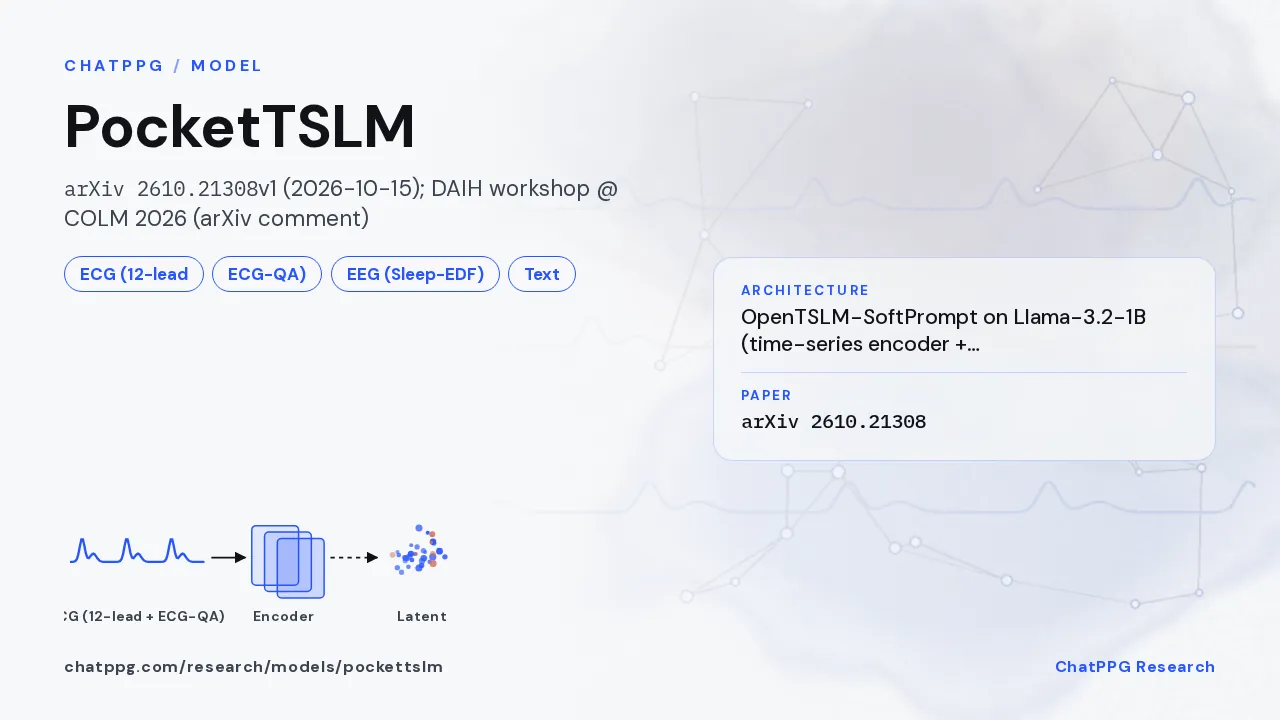
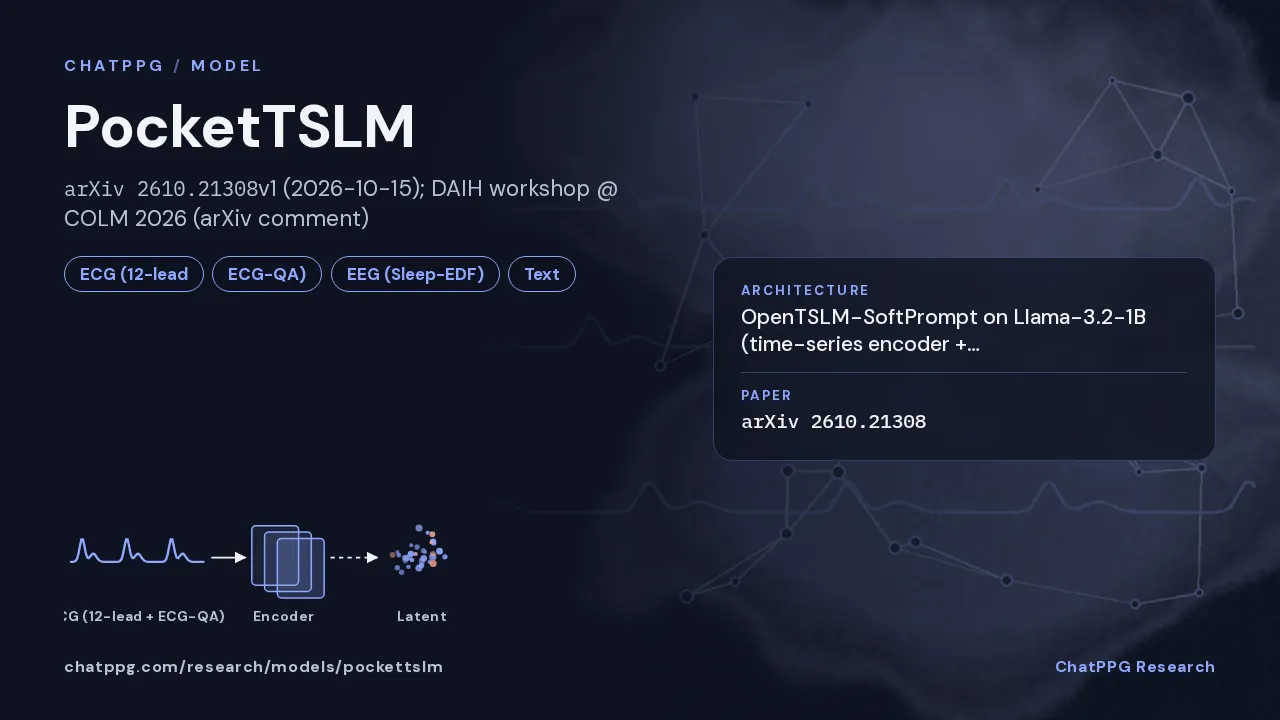
OpenTSLM-SoftPrompt on Llama-3.2-1B (time-series encoder + projector → soft-prompt embeddings; LoRA adapter) ported to MLX Swift; runs fully on iPhone
- License
Code MIT. Runs the ungated OpenTSLM-SP HF checkpoints on the gated meta-llama/Llama-3.2-1B base (Llama 3.2 Community License).
- Type
- FM adaptation
- Form factor
- Other
- Parameters
- Not reported
- Architecture
- OpenTSLM-SoftPrompt on Llama-3.2-1B (time-series encoder + projector → soft-prompt embeddings; LoRA adapter) ported to MLX Swift; runs fully on iPhone
- Venue
- arXiv 2610.21308v1 (2026-10-15); DAIH workshop @ COLM 2026 (arXiv comment)
- Year
- 2026
- DOI
- Not reported
- Weights
- Open (opens in a new tab)
- Licence
- Code MIT. Runs the ungated OpenTSLM-SP HF checkpoints on the gated meta-llama/Llama-3.2-1B base (Llama 3.2 Community License).
- Caveats
- Not reported
- Datasets
- Not reported
- Papers
- Added
- Oct 17, 2026
- Updated
- Oct 17, 2026
Abstract
Consumer phones and wearables increasingly collect physiological time-series data, yet most mobile systems treat these streams as summaries or text rather than as temporal evidence. This representation is poorly matched to personal health systems that need to retrieve, route, or summarize sensor evidence while preserving temporal structure. Cloud-hosted time-series language models avoid smartphone limits, but they repeatedly move sensitive physiology off the device and add latency and per-query compute cost. Mobile model alternatives that aggregate time-series data into statistical features or serialize raw samples as text either compress temporal structure or exhaust the context and memory budgets of small on-device models. We present PocketTSLM, a mobile-native deployment of OpenTSLM SoftPrompt, the soft-prompt variant of the OpenTSLM time-series language model. PocketTSLM runs fully on a consumer smartphone by injecting encoded time-series windows as embeddings instead of tokenizing time series as text. A numerical parity protocol verifies identical greedy-decoded token sequences between the Swift port and a Python reference using Apple's MLX machine-learning framework. Answers also match the PyTorch reference, although rationale wording can differ. An on-device context-economics benchmark compares the soft-prompt path with a text-serialized baseline on the same backbone. In our benchmark format, soft-prompting uses approximately 12 times fewer time-series tokens and reduces prompt-prefill cost. PocketTSLM processes 30-second Sleep-EDF electroencephalography clips for sleep staging and a 1,000-sample (10 s) 12-lead electrocardiogram clip from ECG-QA. In comparison, text-serialized baselines exceed the phone's context or memory budget at longer time-series windows. All inference runs entirely on the device, with no health data transmitted during inference.
Verbatim fromarXiv· arXiv metadata (abstracts are released under CC0)
How it works
- Architecture
- OpenTSLM-SoftPrompt on Llama-3.2-1B (time-series encoder + projector → soft-prompt embeddings; LoRA adapter) ported to MLX Swift; runs fully on iPhone
- Inputs
- ECG, EEG, Text
- Approach
- time series language model · TSLM · on device · MLX · Swift · iPhone
Datasets
Papers· 2
 PocketTSLM: Deploying an On-Device Soft-Prompt Time-Series Language Model for Privacy-Preserving Smartphone ReasoningarXiv 2610.21308v1 · 2026arXiv 2610.21308v1 · 2026
 TimeCap: A Scalable Open-Source Pipeline for Captioning Wearable Health Time-Series DataarXiv 2610.21274v1 · 2026arXiv 2610.21274v1 · 2026
Authors· 10



Cite
APA
Rosenblattl, M., Krishnaswamy, N., Nissen, L., Milling, M., Zumarraga, N., Wang, N., Kaar, T., Jakob, R., Schuller, B. W., Fleisch, E., Langer, P., & Schmiedmayer, P. (2026). PocketTSLM: Deploying an On-Device Soft-Prompt Time-Series Language Model for Privacy-Preserving Smartphone Reasoning. arXiv 2610.21308v1. https://arxiv.org/abs/2610.21308
BibTeX
@misc{rosenblattl2026pockettslm,
  title         = {{PocketTSLM: Deploying an On-Device Soft-Prompt Time-Series Language Model for Privacy-Preserving Smartphone Reasoning}},
  author        = {Rosenblattl, Max and Krishnaswamy, Nikhil and Nissen, Leon and Milling, Manuel and Zumarraga, Nicolas and Wang, Ning and Kaar, Thomas and Jakob, Robert and Schuller, Björn W. and Fleisch, Elgar and Langer, Patrick and Schmiedmayer, Paul},
  year          = {2026},
  howpublished  = {arXiv 2610.21308v1},
  eprint        = {2610.21308},
  archivePrefix = {arXiv}
}
Built from the hub record. Check it against the publisher before submitting.
History
Added to the ChatPPG research hub