Activity counts measure attention, not model quality. Missing counts are unknown. Publication status follows the linked source; a listed venue alone does not confirm peer review.
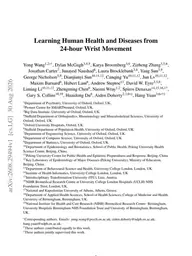
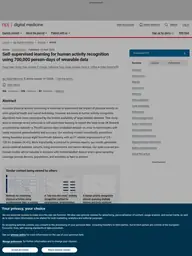
Sensori is a self-supervised foundation model that learns health representations from 24 hours of raw wrist accelerometer data. It was built and tested on four population cohorts from the UK, China and the United States, totalling 122,640 people and 683,617 person-days of free-living data. Added to standard clinical covariates, it improved disease classification for 52 of 102 conditions.
Published
arXiv preprint, 2026
Signals
IMU
Cohort
122,640 participants, 683,617 person-days
Year
2026
Result
improved prevalent disease classification for 52 of 102 conditions (median delta AUROC 0.060)
Much of human health and function unfolds beyond the clinic, through the movements of everyday life. Wrist-worn accelerometers capture these movements continuously, yet their rich signals are often reduced to a small set of predefined behavioural summary measures. Here, we present Sensori, a self-supervised foundation model that learns general-purpose health representations directly from 24 hours of raw tri-axial wrist movement. We developed and evaluated the model across four population-based cohorts from the United Kingdom, China and the United States, comprising 122,640 participants contributing 683,617 person-days of free-living recordings. Sensori condensed each day of movement into a representation that captured diverse movement behaviours, demographic characteristics, health axes and physical function. Evaluation in independent cohorts showed that these representations generalised across populations and measurement settings without retraining. When added to common clinical covariates, Sensori significantly improved prevalent disease classification for 52 of 102 eligible conditions (median delta AUROC, 0.060; range, 0.012-0.242) and incident disease risk prediction for 26 of 87 eligible conditions (median delta Uno's C-index, 0.064; range, 0.025-0.172), with the largest gains for neurological and psychiatric disorders. These findings establish 24-hour wrist movement as a rich and scalable source of health information, with the potential to support passive health monitoring and disease prediction at population scale.
Verbatim fromarXiv· arXiv metadata (abstracts are released under CC0)
How it works
Datasets linked in the hub; pretraining vs evaluation roles follow the paper.
Cite the publication recorded for this model. Check it against the publisher before submitting.
Wang, Y., McGagh, D., Broomberg, K., Zhang, Z., Carter, J., Naushad, J., Brocklebank, L., Sun, Y., Nicholson, G., Sun, D., Yu, C., Lv, J., Barnard, M., Lam, H., Steptoe, A., Eyre, D. W., Li, L., Chen, Z., Wray, N., . . . Yuan, H. (2026). Sensori — Learning Human Health and Diseases from 24-hour Wrist Movement. arXiv preprint. https://arxiv.org/abs/2608.29494
Wang, Yong, Dylan McGagh, Katya Broomberg, Zizheng Zhang, Jonathan Carter, Junayed Naushad, and Laura Brocklebank, et al. 2026. "Sensori — Learning Human Health and Diseases from 24-hour Wrist Movement." arXiv preprint. https://arxiv.org/abs/2608.29494.
Wang, Y., McGagh, D., Broomberg, K., Zhang, Z., Carter, J., Naushad, J. and Brocklebank, L. et al. (2026) 'Sensori — Learning Human Health and Diseases from 24-hour Wrist Movement', arXiv preprint. Available at: https://arxiv.org/abs/2608.29494
Wang, Yong, et al. "Sensori — Learning Human Health and Diseases from 24-hour Wrist Movement." arXiv preprint, 2026. https://arxiv.org/abs/2608.29494.
Y. Wang et al., "Sensori — Learning Human Health and Diseases from 24-hour Wrist Movement," arXiv preprint, 2026, [Online]. Available: https://arxiv.org/abs/2608.29494.
@misc{wang2026sensori,
  title         = {{Sensori — Learning Human Health and Diseases from 24-hour Wrist Movement}},
  author        = {Wang, Yong and McGagh, Dylan and Broomberg, Katya and Zhang, Zizheng and Carter, Jonathan and Naushad, Junayed and Brocklebank, Laura and Sun, Yang and Nicholson, George and Sun, Dianjianyi and Yu, Canqing and Lv, Jun and Barnard, Maxim and Lam, Hubert and Steptoe, Andrew and Eyre, David W. and Li, Liming and Chen, Zhengming and Wray, Naomi and Denaxas, Spiros and Collins, Gary S. and Du, Huaidong and Doherty, Aiden and Yuan, Hang},
  year          = {2026},
  howpublished  = {arXiv preprint},
  eprint        = {2608.29494},
  archivePrefix = {arXiv}
}
History
Record updated
Added to the ChatPPG research hub
Newsletter
Get new PPG datasets, papers and models
Get alerts when Sensori is benchmarked on new datasets, plus the weekly digest.
New datasets, papers and models
Practical guides from the hub
Unsubscribe anytime
The waveform is an illustration of a PPG pulse, not a recording.