PaperarXiv:2409.07485
Optimization and Deployment of Deep Neural Networks for PPG-based Blood Pressure Estimation Targeting Low-power Wearables
arXiv preprint
 (opens in a new tab)
Burrello, Alessio et al., "Optimization and Deployment of Deep Neural Networks for PPG-based Blood Pressure Estimation Targeting Low-power Wearables", arXiv:2409.07485, CC BY 4.0
TL;DR
This paper optimizes deep networks for estimating blood pressure from PPG so they fit low-power wearables such as the GAP8 chip. Starting from top models on four public datasets, the optimized versions had up to 4.99% lower error or 73.36% smaller size at the same error. The most accurate one used just 0.37 mJ per estimate and reached a diastolic MAE of 8.08.
- Result: Starting from both regression and signal-to-signal state-of-the-art models on four public datasets, the authors obtain optimized versions that achieve up to 4.99% lower error or 73.36% lower size at iso-error.
- Result: Noteworthy, while the most accurate SoA network on the largest dataset can not fit the GAP8 memory, all their optimized models can; their most accurate DNN consumes as little as 0.37 mJ while reaching the lowest MAE of 8.08 on Diastolic BP estimation.
Abstract
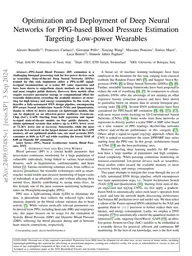
PPG-based Blood Pressure (BP) estimation is a challenging biosignal processing task for low-power devices such as wearables. State-of-the-art Deep Neural Networks (DNNs) trained for this task implement either a PPG-to-BP signal-to-signal reconstruction or a scalar BP value regression and have been shown to outperform classic methods on the largest and most complex public datasets. However, these models often require excessive parameter storage or computational effort for wearable deployment, exceeding the available memory or incurring too high latency and energy consumption. In this work, we describe a fully-automated DNN design pipeline, encompassing HW-aware Neural Architecture Search (NAS) and Quantization, thanks to which we derive accurate yet lightweight models, that can be deployed on an ultra-low-power multicore System-on-Chip (SoC), GAP8. Starting from both regression and signal-to-signal state-of-the-art models on four public datasets, we obtain optimized versions that achieve up to 4.99% lower error or 73.36% lower size at iso-error. Noteworthy, while the most accurate SoA network on the largest dataset can not fit the GAP8 memory, all our optimized models can; our most accurate DNN consumes as little as 0.37 mJ while reaching the lowest MAE of 8.08 on Diastolic BP estimation.
Verbatim from arXiv (opens in a new tab) · arXiv metadata (abstracts are released under CC0)
Results on ChatPPG leaderboards
All leaderboardsNo results from this paper on ChatPPG leaderboards yet. Browse the leaderboards.
Tasks & signals
Signals
Datasets used
How it works
Cite this paper
Burrello, A., Carlucci, F., Pollo, G., Wang, X., Poncino, M., Macii, E., Benini, L., & Pagliari, D. J. (2024). Optimization and Deployment of Deep Neural Networks for PPG-based Blood Pressure Estimation Targeting Low-power Wearables. arXiv preprint. https://arxiv.org/abs/2409.07485
Burrello, Alessio, Francesco Carlucci, Giovanni Pollo, Xiaying Wang, Massimo Poncino, Enrico Macii, Luca Benini, and Daniele Jahier Pagliari. 2024. "Optimization and Deployment of Deep Neural Networks for PPG-based Blood Pressure Estimation Targeting Low-power Wearables." arXiv preprint. https://arxiv.org/abs/2409.07485.
Burrello, A., Carlucci, F., Pollo, G., Wang, X., Poncino, M., Macii, E., Benini, L. and Pagliari, D. J. (2024) 'Optimization and Deployment of Deep Neural Networks for PPG-based Blood Pressure Estimation Targeting Low-power Wearables', arXiv preprint. Available at: https://arxiv.org/abs/2409.07485
Burrello, Alessio, et al. "Optimization and Deployment of Deep Neural Networks for PPG-based Blood Pressure Estimation Targeting Low-power Wearables." arXiv preprint, 2024. https://arxiv.org/abs/2409.07485.
A. Burrello et al., "Optimization and Deployment of Deep Neural Networks for PPG-based Blood Pressure Estimation Targeting Low-power Wearables," arXiv preprint, 2024, [Online]. Available: https://arxiv.org/abs/2409.07485.
@misc{burrello2024optimization,
  title         = {{Optimization and Deployment of Deep Neural Networks for PPG-based Blood Pressure Estimation Targeting Low-power Wearables}},
  author        = {Burrello, Alessio and Carlucci, Francesco and Pollo, Giovanni and Wang, Xiaying and Poncino, Massimo and Macii, Enrico and Benini, Luca and Pagliari, Daniele Jahier},
  year          = {2024},
  howpublished  = {arXiv preprint},
  eprint        = {2409.07485},
  archivePrefix = {arXiv}
}