Cite this dataset
EarSet [Data set]. (n.d.). zenodo. https://doi.org/10.5281/zenodo.8142332
@misc{earsetearset,
  title         = {{EarSet}},
  howpublished  = {zenodo},
  doi           = {10.5281/zenodo.8142332}
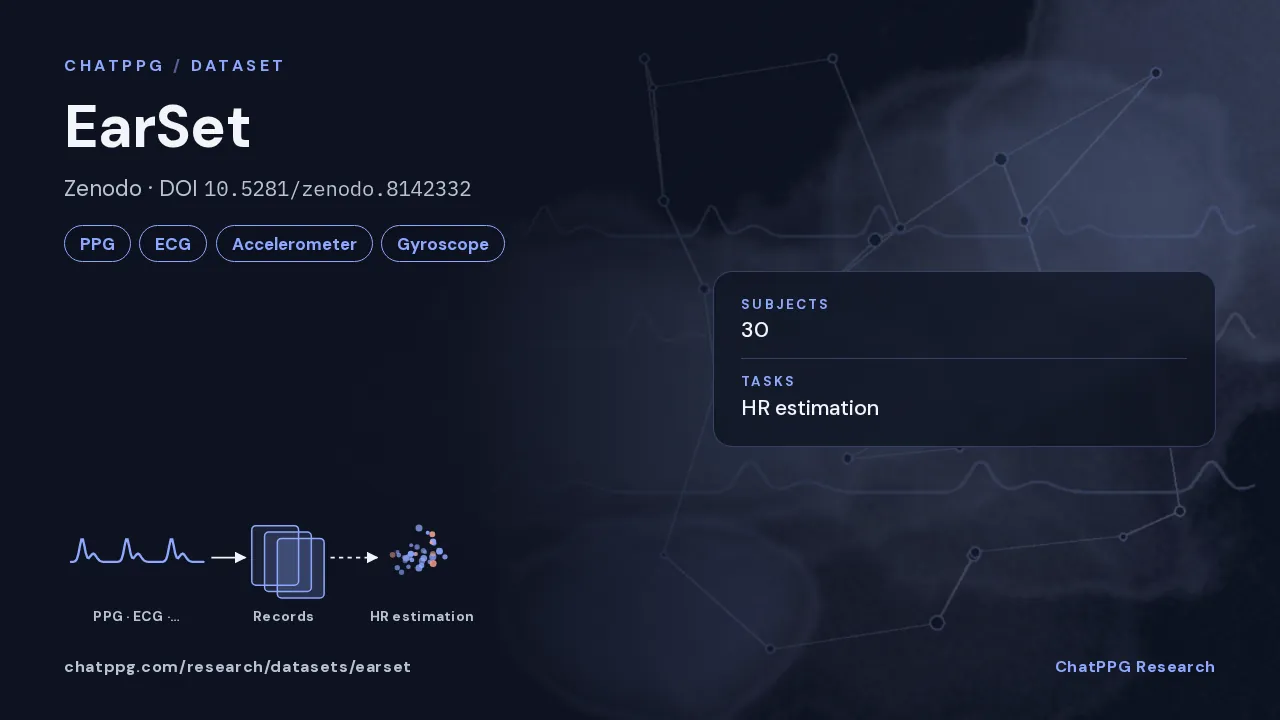
}EarSet is a multimodal dataset for studying how body, head and face movement affects in-ear PPG wave shape and vital-sign estimates. The authors built an in-ear research platform that records PPG at several wavelengths from both ears together with 6-axis motion, 18 data streams in total. Recordings cover facial and head movements as well as walking and running.
EarSet aims at providing the research community with a novel, multi-modal, dataset, which, for the first time, will allow studying of the impact of body and head/face movements on both the morphology of the PPG wave captured at the ear, as well as on the vital signs estimation. To accurately collect in-ear PPG data, coupled with a 6 degrees-of-freedom (DoF) motion signature, we prototyped and built a flexible research platform for in-the-ear data collection. The platform is centered around a novel ear-tip design which includes a 3-channel PPG (green, red, infrared) and a 6-axis (accelerometer, gyroscope) motion sensor (IMU) co-located on the same ear-tip. This allows the simultaneous collection of spatially distant (i.e., one tip in the left and one in the right ear) PPG data at multiple wavelengths and the corresponding motion signature, for a total of 18 data streams.
Inspired by the Facial Action Coding Systems (FACS), we consider a set of potential sources of motion artifact (MA) caused by natural facial and head movements. Specifically, we gather data on 16 different head and facial motions - head movements (nodding, shaking, tilting), eyes movements (vertical eyes movements, horizontal eyes movements, brow raiser, brow lowerer, right eye wink, left eye wink), and mouth movements (lip puller, chin raiser, mouth stretch, speaking, chewing).
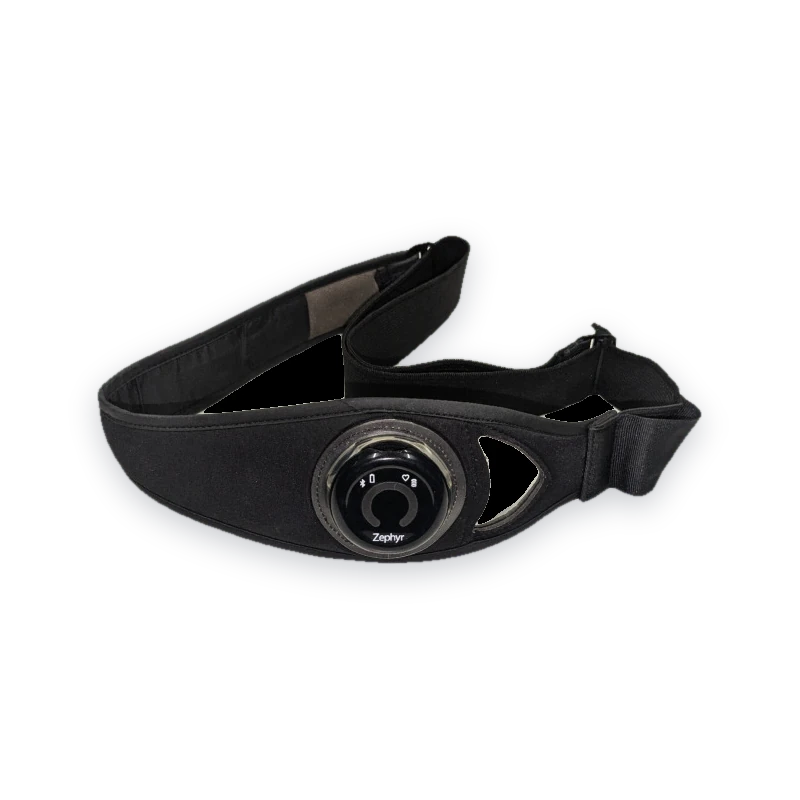
We also collect motion and PPG data under activities, of different intensities, which entail the movement of the entire body (walking and running). Together with in-ear PPG and IMU data, we collect several vital signs including, heart rate, heart rate variability, breathing rate, and raw ECG, from a medical-grade chest device.
With approximately 17 hours of data from 30 participants of mixed gender and ethnicity (mean age: 28.9 years, standard deviation: 6.11 years), our dataset empowers the research community to analyze the morphological characteristics of in-ear PPG signals with respect to motion, device positioning (left ear, right ear), as well as a set of configuration parameters and their corresponding data quality/power consumption trade-off. We envision such a dataset could open the door to innovative filtering techniques to mitigate, and eventually eliminate, the impact of MA on in-ear PPG. We ran a set of preliminary analyses on the data, considering both handcrafted features, as well as a DNN (Deep Neural Network) approach. Ultimately, we observe statistically significant morphological differences in the PPG signal across different types of motions when compared to a situation where there is no motion. We also discuss a 3-classes classification task and show how full-body motions and head/face motions can be discriminated from a still baseline (and among themselves). These preliminary results represent the first step towards the detection of corrupted PPG segments and show the importance of studying how head/face movements impact PPG signals in the ear.
To the best of our knowledge, this is the first in-ear PPG dataset that covers a wide range of full-body and head/facial motion artifacts. Being able to study the signal quality and motion artifacts under such circumstances will serve as a reference for future research in the field, acting as a stepping stone to fully enable PPG-equipped earables.
Verbatim fromZenodo· Licence: cc-by-4.0
Full photo credits, sources and licences are on each device page.
| Task | Dataset | Metric | Value | Rank |
|---|---|---|---|---|
| Heart rate estimation | EarSet | MAE (bpm) ↓ | 5.020 | #1 / 1 |
#79 of 186 most-used datasets by published papers and models · #41 of 88 PPG · #33 of 78 ECG · #36 of 84 IMU
EarSet [Data set]. (n.d.). zenodo. https://doi.org/10.5281/zenodo.8142332
@misc{earsetearset,
title = {{EarSet}},
howpublished = {zenodo},
doi = {10.5281/zenodo.8142332}
}Cite the dated snapshot 2026-10 for a fixed, reproducible version. Please also cite the original publications listed above.
ChatPPG. (2026). EarSet: dataset record (Version 2026-10) [Data set]. ChatPPG Research Hub. https://chatppg.com/research/datasets/earset
@misc{chatppg_dataset_earset,
  author       = {{ChatPPG}},
  title        = {{EarSet: dataset record}},
  year         = {2026},
  month        = nov,
  version      = {2026-10},
  howpublished = {\url{https://chatppg.com/research/datasets/earset}},
  note         = {ChatPPG Research Hub, Snapshot 2026-10, https://chatppg.com/research/snapshots/2026-10}
}cff-version: 1.2.0 message: "If you use this resource, please cite it as below." type: dataset title: "EarSet: dataset record" authors: - name: "ChatPPG" url: "https://chatppg.com/research/datasets/earset" repository-artifact: "https://chatppg.com/research/snapshots/2026-10" version: "2026-10" date-released: "2026-11-13"
Record updated
 AuricleSame task: Respirationmultimodal cardiovascular set: ECG, finger + ear PPG, SCG, in-ear audio, PCG, CNAP + arm cuff (70 subj incl. 28 heart failure, 1 kHz)70 subjects · PPG · ECG · IMU
 BIDMC PPG and Respiration (Pimentel 2016 / PhysioNet)Same task: Respiration53 subjects · PPG · ECG · SpO₂
 WildPPGSame task: Heart rate16 subjects · PPG · ECG · IMU