PaperarXiv:2511.00301
A systematic evaluation of uncertainty quantification techniques in deep learning: a case study in photoplethysmography signal analysis
arXiv preprint (cs.LG, physics.med-ph)
 (opens in a new tab)
Bench, Ciaran et al., "A systematic evaluation of uncertainty quantification techniques in deep learning: a case study in photoplethysmography signal analysis", arXiv:2511.00301, CC BY-SA 4.0
TL;DR
In principle, deep learning models trained on medical time-series, including wearable photoplethysmography (PPG) sensor data, can provide a means to continuously monitor physiological parameters outside of clinical settings. However, there is considerable risk of poor performance when deployed in practical measurement scenarios leading to negative patient outcomes. Reliable uncertainties accompanying predictions can provide guidance to clinicians in their interpretation of the trustworthiness of model outputs.
- Form factor: other
Abstract
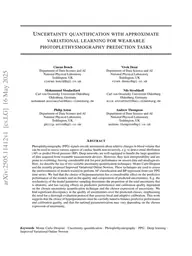
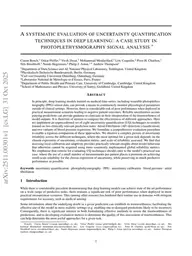
In principle, deep learning models trained on medical time-series, including wearable photoplethysmography (PPG) sensor data, can provide a means to continuously monitor physiological parameters outside of clinical settings. However, there is considerable risk of poor performance when deployed in practical measurement scenarios leading to negative patient outcomes. Reliable uncertainties accompanying predictions can provide guidance to clinicians in their interpretation of the trustworthiness of model outputs. It is therefore of interest to compare the effectiveness of different approaches. Here we implement an unprecedented set of eight uncertainty quantification (UQ) techniques to models trained on two clinically relevant prediction tasks: Atrial Fibrillation (AF) detection (classification), and two variants of blood pressure regression. We formulate a comprehensive evaluation procedure to enable a rigorous comparison of these approaches. We observe a complex picture of uncertainty reliability across the different techniques, where the most optimal for a given task depends on the chosen expression of uncertainty, evaluation metric, and scale of reliability assessed. We find that assessing local calibration and adaptivity provides practically relevant insights about model behaviour that otherwise cannot be acquired using more commonly implemented global reliability metrics. We emphasise that criteria for evaluating UQ techniques should cater to the model's practical use case, where the use of a small number of measurements per patient places a premium on achieving small-scale reliability for the chosen expression of uncertainty, while preserving as much predictive performance as possible.
Verbatim from arXiv (opens in a new tab) · arXiv metadata (abstracts are released under CC0)
Results on ChatPPG leaderboards
All leaderboardsNo results from this paper on ChatPPG leaderboards yet. Browse the leaderboards.
Tasks & signals
Signals
Keywords
How it works
Cite this paper
APA
Bench, C., Pfeffer, O., Desai, V., Moulaeifard, M., Coquelin, L., Charlton, P. H., et al. (2025). A systematic evaluation of uncertainty quantification techniques in deep learning: a case study in photoplethysmography signal analysis. arXiv preprint. https://doi.org/10.48550/arXiv.2511.00301
BibTeX
@misc{bench2025systematic,
  title         = {{A systematic evaluation of uncertainty quantification techniques in deep learning: a case study in photoplethysmography signal analysis}},
  author        = {Bench, Ciaran and Pfeffer, Oskar and Desai, Vivek and Moulaeifard, Mohammad and Coquelin, Loïc and Charlton, Peter H. and others},
  year          = {2025},
  howpublished  = {arXiv preprint},
  doi           = {10.48550/arXiv.2511.00301},
  eprint        = {2511.00301},
  archivePrefix = {arXiv}
}
Built from the hub record. Check it against the publisher before submitting.
Added to the ChatPPG research hub