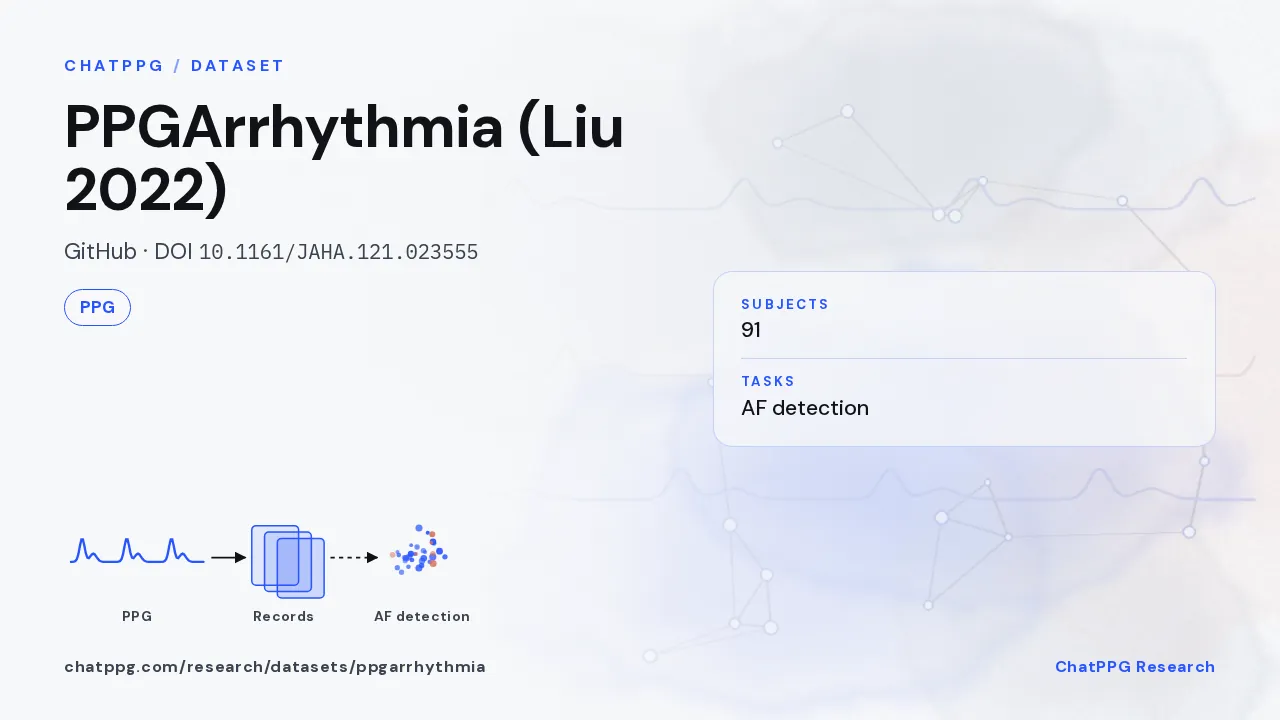
This dataset comes from "Multiclass Arrhythmia Detection and Classification From Photoplethysmography Signals Using a Deep Convolutional Neural Network" by Zengding Liu, Bin Zhou, Zhiming Jiang, Xi Chen, Ye Li, Min Tang and Fen Miao, published in the Journal of the American Heart Association 11(7):e023555 (2022). It is one of the few public PPG datasets labeled with several arrhythmia types beyond atrial fibrillation.
Earlier studies had shown that PPG can detect AF, but classifying multiple arrhythmias from PPG had rarely been reported. To test whether it is feasible, the team collected ECG and PPG at the same time from patients undergoing radiofrequency ablation for arrhythmias. Two cardiologists annotated the rhythm using the ECG, and those labels were applied to the paired 10-second PPG waveforms.
In total, 228 patients were included, with 118 217 pairs of 10-second PPG and ECG waveforms. There are six rhythm types: sinus rhythm, premature ventricular contraction, premature atrial contraction, ventricular tachycardia, supraventricular tachycardia and atrial fibrillation.
A deep convolutional neural network trained on 10-second PPG segments was tested on an independent set of 23 384 PPG waveforms from 45 patients. It reached an overall accuracy of 85.0% across the six rhythm types and a microaverage AUC of 0.978. The average sensitivity, specificity, positive predictive value and negative predictive value were 75.8%, 96.9%, 75.2% and 97.0%. The authors conclude that multiclass arrhythmia classification from PPG is feasible and attractive for population-based screening.
The GitHub repository (zdzdliu/PPGArrhythmiaDetection) shares the code and the validation and test sets in .mat format, one file per individual. Each file holds 10-second PPG segments sampled at 100 Hz and labels from 0 to 5 for the six classes. The README lists only the validation and test sets. The GitHub API reports no license for the repository, so ask the authors before reuse beyond research and cite the paper.
The hub lists this dataset on its AF leaderboard as the 6-class benchmark. It is the natural test when a model claims to separate ectopic beats and tachycardias from AF using PPG alone.
Classes
sinus rhythm, PVC, PAC, VT, SVT, AF (labels 0 to 5)
Public files
validation and test .mat files, 100 Hz
License
none stated on GitHub
Paper
Liu et al., Journal of the American Heart Association 11(7):e023555 (2022), doi 10.1161/JAHA.121.023555
Studies have reported the use of photoplethysmography signals to detect atrial fibrillation; however, the use of photoplethysmography signals in classifying multiclass arrhythmias has rarely been reported. Our study investigated the feasibility of using photoplethysmography signals and a deep convolutional neural network to classify multiclass arrhythmia types.
Methods and Results
ECG and photoplethysmography signals were collected simultaneously from a group of patients who underwent radiofrequency ablation for arrhythmias. A deep convolutional neural network was developed to classify multiple rhythms based on 10‐second photoplethysmography waveforms. Classification performance was evaluated by calculating the area under the microaverage receiver operating characteristic curve, overall accuracy, sensitivity, specificity, and positive and negative predictive values against annotations on the rhythm of arrhythmias provided by 2 cardiologists consulting the ECG results. A total of 228 patients were included; 118 217 pairs of 10‐second photoplethysmography and ECG waveforms were used. When validated against an independent test data set (23 384 photoplethysmography waveforms from 45 patients), the DCNN achieved an overall accuracy of 85.0% for 6 rhythm types (sinus rhythm, premature ventricular contraction, premature atrial contraction, ventricular tachycardia, supraventricular tachycardia, and atrial fibrillation); the microaverage area under the microaverage receiver operating characteristic curve was 0.978; the average sensitivity, specificity, and positive and negative predictive values were 75.8%, 96.9%, 75.2%, and 97.0%, respectively.
Conclusions
This study demonstrated the feasibility of classifying multiclass arrhythmias from photoplethysmography signals using deep learning techniques. The approach is attractive for population‐based screening and may hold promise for the long‐term surveillance and management of arrhythmia.
It is a dataset of paired 10-second PPG and ECG waveforms from 228 ablation patients labeled with six rhythm types, including AF, PVC, PAC, VT and SVT.
How do I download the PPG arrhythmia dataset?
The validation and test sets are in https://github.com/zdzdliu/PPGArrhythmiaDetection as .mat files with 10-second PPG at 100 Hz and labels 0 to 5.
PPG Arrhythmia vs Stanford DeepBeat?
DeepBeat labels AF and signal quality from wrist wearables. The Liu dataset labels six rhythm types from PPG recorded during ablation procedures.
What are the benchmark results?
The original CNN reached 85.0% overall accuracy and a microaverage AUC of 0.978 on 23 384 test waveforms from 45 patients.
Cite this dataset
This citation is the paper recorded with this dataset. Check it against the publisher before submitting.
Liu, Z., Zhou, B., Jiang, Z., Chen, X., Li, Y., Tang, M., & Miao, F. (2022). Multiclass Arrhythmia Detection and Classification From Photoplethysmography Signals Using a Deep Convolutional Neural Network. Journal of the American Heart Association, 11(7). https://doi.org/10.1161/jaha.121.023555
Liu, Zengding, Bin Zhou, Zhiming Jiang, Xi Chen, Ye Li, Min Tang, and Fen Miao. 2022. "Multiclass Arrhythmia Detection and Classification From Photoplethysmography Signals Using a Deep Convolutional Neural Network." Journal of the American Heart Association 11 (7). https://doi.org/10.1161/jaha.121.023555.
Liu, Z., Zhou, B., Jiang, Z., Chen, X., Li, Y., Tang, M. and Miao, F. (2022) 'Multiclass Arrhythmia Detection and Classification From Photoplethysmography Signals Using a Deep Convolutional Neural Network', Journal of the American Heart Association, 11(7). doi: 10.1161/jaha.121.023555.
Liu, Zengding, et al. "Multiclass Arrhythmia Detection and Classification From Photoplethysmography Signals Using a Deep Convolutional Neural Network." Journal of the American Heart Association, vol. 11, no. 7, 2022. https://doi.org/10.1161/jaha.121.023555.
Z. Liu et al., "Multiclass Arrhythmia Detection and Classification From Photoplethysmography Signals Using a Deep Convolutional Neural Network," Journal of the American Heart Association, vol. 11, no. 7, 2022, doi: 10.1161/jaha.121.023555.
@article{liu2022multiclass,
  title         = {{Multiclass Arrhythmia Detection and Classification From Photoplethysmography Signals Using a Deep Convolutional Neural Network}},
  author        = {Liu, Zengding and Zhou, Bin and Jiang, Zhiming and Chen, Xi and Li, Ye and Tang, Min and Miao, Fen},
  year          = {2022},
  journal       = {Journal of the American Heart Association},
  volume        = {11},
  number        = {7},
  publisher     = {Ovid Technologies (Wolters Kluwer Health)},
  doi           = {10.1161/jaha.121.023555}
}
Cite the ChatPPG record
Cite the dated snapshot 2026-10 for a fixed, reproducible version. Please also cite the original publications listed above.
APA
ChatPPG. (2026). PPGArrhythmia (Liu 2022): dataset record (Version 2026-10) [Data set]. ChatPPG Research Hub. https://chatppg.com/research/datasets/ppgarrhythmia
BibTeX
@misc{chatppg_dataset_ppgarrhythmia,
  author       = {{ChatPPG}},
  title        = {{PPGArrhythmia (Liu 2022): dataset record}},
  year         = {2026},
  month        = nov,
  version      = {2026-10},
  howpublished = {\url{https://chatppg.com/research/datasets/ppgarrhythmia}},
  note         = {ChatPPG Research Hub, Snapshot 2026-10, https://chatppg.com/research/snapshots/2026-10}
}
CITATION.cff
cff-version: 1.2.0
message: "If you use this resource, please cite it as below."
type: dataset
title: "PPGArrhythmia (Liu 2022): dataset record"
authors:
  - name: "ChatPPG"
url: "https://chatppg.com/research/datasets/ppgarrhythmia"
repository-artifact: "https://chatppg.com/research/snapshots/2026-10"
version: "2026-10"
date-released: "2026-11-16"
History
Record updated
Newsletter
Get new PPG datasets, papers and models
Get alerts when new models are benchmarked on PPGArrhythmia (Liu 2022), plus the weekly digest.
New datasets, papers and models
Practical guides from the hub
Unsubscribe anytime
The waveform is an illustration of a PPG pulse, not a recording.