Dataset

Long-term ECG and wrist PPG with annotated AF episodes (AFPPGECG)

45 patients with suspected atrial fibrillation, monitored 5–8 days each (306 monitoring days total), starting at Vilnius University Hospital and continuing at home. Wrist PPG device running continuously alongside a clinical ECG patch. Zenodo record v2, June 2024 (DOI 10.5281/zenodo.11242869).

License
Zenodo lists the licence as Other (Non-Commercial)

Original description

Rationale

Atrial fibrillation (AF) has emerged as a worldwide cardiovascular epidemic affecting more than 33 million individuals worldwide and carrying a 5-fold increased risk of brain stroke and a 3-fold increased risk of heart failure (Hindricks et al. 2021). AF is a progressive disease, with primary paroxysmal episodes being self-terminating; therefore, the success of complication management highly depends on early arrhythmia detection, which often requires long-term AF monitoring (Keach et al. 2015). Unfortunately, existing devices for long-term AF monitoring are either expensive (implantable cardiac monitors) or inconvenient due to skin irritation (Holter monitors, electrocardiogram (ECG) patches). Thus, it is desirable to develop inexpensive technologies ensuring wearing comfort. Recently, biooptical photoplethysmography (PPG) signal has emerged as such technology with immense potential for convenient long-term AF monitoring (Pereira et al. 2020). However, due to the lack of guidelines for arrhythmia interpretation in PPG, simultaneous ECG recording is needed for verification of the episodes detected in PPG. The present dataset contains simultaneously acquired wrist-based PPG and reference ECG signals with annotated AF episodes, and thus, is particularly suitable for use in the development and testing of automatic PPG-based AF detectors.

Subjects and data acquisition protocol

The dataset contains long-term ECG and PPG signals from 39 patients with suspected AF monitored for 5 to 8 days (261 days in total). Detailed demographic (sex, age, height, weight) and clinical (diagnosed comorbidities, medications) characteristics of the patients are provided in the supplementary file subject_info.xlsx.

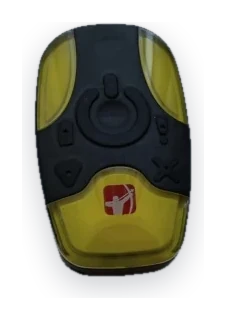
The acquisition of the PPG and ECG signals was started at Vilnius University Hospital Santaros Klinikos (Vilnius, Lithuania) and continued for a week at the patient’s home. The PPG signal was acquired at a sampling frequency of 100 Hz using a green LED embedded in a wrist-worn device developed at the Biomedical Engineering Institute (Kaunas, Lithuania). The reference ECG signal was acquired at a sampling frequency of 500 Hz using the Bittium Faros™ 180 ECG device together with the Bittium OmegaSnap™ patch electrode (Oulu, Finland). Additionally, triaxial acceleration signals were acquired with both devices at sampling frequencies of 50 and 25 Hz using wrist-worn and reference ECG devices, respectively. The occurrence times of QRS-complexes in ECG signals were obtained using an open-source QRS detector (Moeyersons et al. 2020), and initial AF episodes were automatically detected using a low-complexity AF detector relying on rhythm irregularity information (Petrėnas et al. 2015). Then, the AF detector output was visually inspected and manually corrected by medical specialists experienced in arrhythmia diagnosis with the aim to find undetected and discard falsely detected episodes.

The data acquisition protocol was in accordance with the ethical principles of the Declaration of Helsinki and was approved by Vilnius Region Biomedical Research Ethics Committee (No. 158200-18/7-1052-557). All patients gave written informed consent to participate.

In this third version of the database, AF annotations were further reviewed and manually refined. Subject identifiers were also reassigned and may differ from those used in previous versions. Users should use the subject identifiers and corresponding metadata provided with this version when linking recordings to subject information.

Technical details

The acquired signals are provided in MAT-files named as follows:

XX_YYY,

where XX is the patient ID, YYY is ECG for the signals from the Bittium Faros™ 180 ECG device and PPG for the signals from the wrist-worn device. For each patient, there are a single continuous ECG recording and multiple PPG recordings because the acquisition of the PPG could be interrupted for a short time due to technical reasons or for a longer time to allow battery charging of the wrist-worn device.

In addition to PPG, ECG, and acceleration signals, each file contains a signal header, the day when the recording started with respect to the first monitoring day of the patient, and the time of day when the recording started. The ECG files also contain QRS time indices and calculated RR intervals together with AF annotations on a beat-to-beat basis. PPG and acceleration signals from a wrist-worn device were synchronized to correspond time of  ECG acquisition device.

In the subject_info.xlsx file, physical inactivity is defined as 750 min/week of moderate-intensity exercise, and hypertension is classified into stages based on systolic/diastolic blood pressure: stage I corresponding to 140/90–159/99 mmHg, stage II to 160/100–179/109 mmHg, and stage III to ≥ 180/100 mmHg.

Limitations

When using the resource, researchers should be aware that the PPG and ECG acquisition devices have been synchronized, however, the exact alignment of the signals cannot be reached due to physiological features, e.g., the heart rate obtained from the PPG and ECG signals. Users should also be aware that the sampling frequencies of the devices can vary slightly.
Verbatim fromZenodo· Licence: other-nc

Long-term ECG and wrist PPG with annotated AF episodes (AFPPGECG): overview

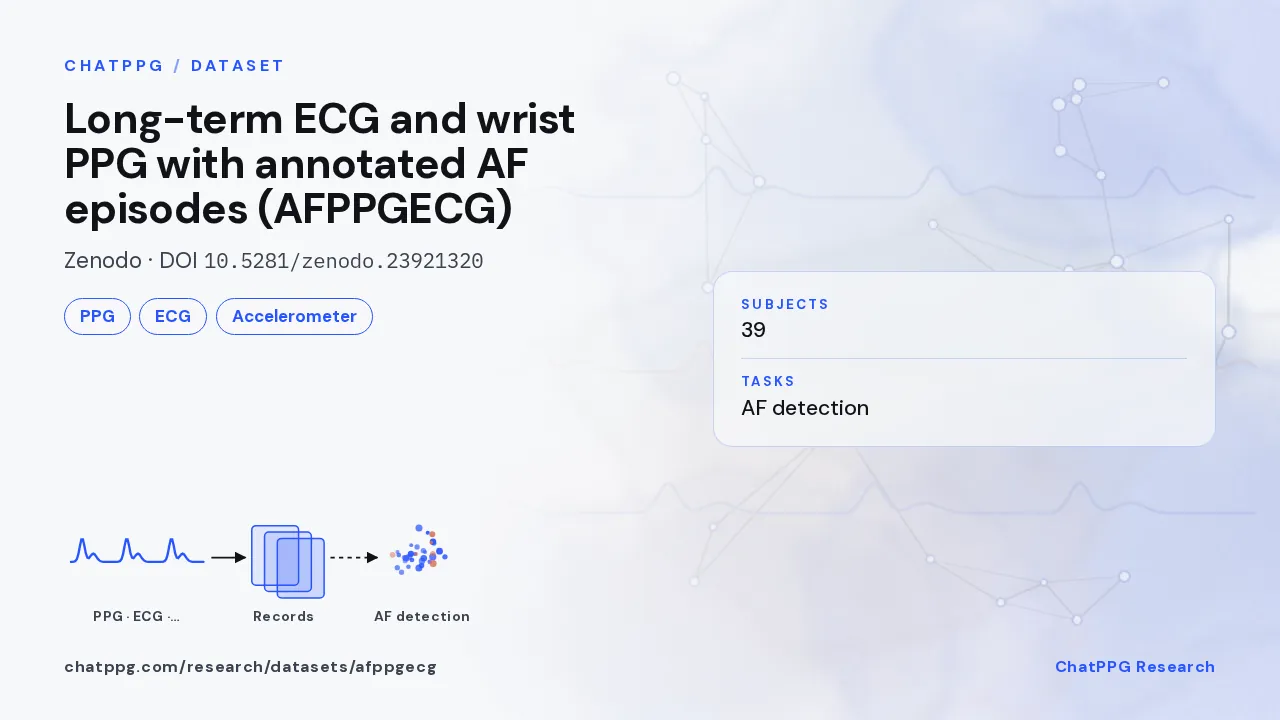
This Zenodo dataset pairs a wrist-worn green-light PPG device (100 Hz, developed at the Biomedical Engineering Institute in Kaunas, Lithuania) with a Bittium Faros 180 ECG patch (500 Hz) in 39 patients with suspected atrial fibrillation. Each patient was monitored for 5 to 8 days (261 days in total), starting at Vilnius University Hospital Santaros Klinikos and continuing at home. QRS times, RR intervals and beat-by-beat AF annotations come with the ECG; the AF episodes were detected automatically and then reviewed and corrected by arrhythmia specialists. Version 3 (October 2026) refined the annotations and reassigned subject IDs. Access is restricted and the licence is non-commercial.

What's inside

Patients
39 with suspected AF (version 3)
Duration
5–8 days each, 261 monitoring days in total, in hospital then at home
Wrist PPG
Green LED, 100 Hz, with 50 Hz triaxial accelerometer; several PPG files per patient because of charging breaks
Reference ECG
Bittium Faros 180 with OmegaSnap patch, 500 Hz, 25 Hz accelerometer; one continuous recording per patient
Annotations
QRS times, RR intervals and beat-to-beat AF labels, reviewed by medical specialists
Metadata
subject_info.xlsx with sex, age, height, weight, comorbidities and medications

How to access it

Host: Zenodo

  1. Request access on the Zenodo record (restricted).
  2. Use the version 3 subject IDs and subject_info.xlsx; IDs differ from earlier versions.
  3. Files are MAT files named <patient>_ECG and <patient>_PPG.

Licence: Zenodo lists the licence as Other (Non-Commercial)

What it allows: Non-commercial research use under the terms granted with access. Read the record before use.

Load Long-term ECG and wrist PPG with annotated AF episodes (AFPPGECG) in Python

Untestedpip install scipy
from scipy.io import loadmat

# After access is granted and files are downloaded from Zenodo
ecg = loadmat("01_ECG.mat", simplify_cells=True)
ppg = loadmat("01_PPG.mat", simplify_cells=True)
print([k for k in ecg if not k.startswith("__")])   # inspect field names first
print([k for k in ppg if not k.startswith("__")])

Untested: access is restricted, and the field names inside the MAT files are not documented on the public record, so list the keys first.

Caveats

  • Version 3 reassigned subject IDs. Do not join it with metadata or splits from versions 1 or 2 (version 2 described 45 patients and 306 days).
  • The record warns that PPG and ECG are synchronised but cannot be perfectly aligned, and that device sampling rates can drift slightly.
  • Patients were referred for suspected AF, so prevalence is far higher than in a general wearable population.
  • Split by patient: each patient contributes days of data.

Similar datasets

DatasetSubjectsSignalsLicence
Pulsewatch106ppg, ecg, accelNot stated
MIMIC PERform35ppg, ecg, resp, abpODbL
MIMIC-III-Ext-PPG6,189ppg, ecg, resp, abpPhysioNet Credentialed Health Data License 1.5.0
WatchMyHeart93ecgNot stated

Sources: Zenodo record (version 3) · Zenodo record (version 2) · Updated 2026-10-21

Long-term ECG and wrist PPG with annotated AF episodes (AFPPGECG): ChatPPG research summary card

Key numbers

39
Subjects
2
Reference labels
AFIB, ECG
500Hz
Released sampling rate
wrist green PPG 100Hz, accel 50Hz; Faros ECG 500Hz

How it works

How Long-term ECG and wrist PPG with annotated AF episodes (AFPPGECG) works: Devices & body sites → Signals recorded → TasksDevices & body sites: Bittium Faros (Bittium · Chest). PPG sites: Wrist. Signals recorded: Long-term ECG and wrist PPG with annotated AF episodes (AFPPGECG), 39 subjects · 500Hz, signals PPG, ECG, IMU. Tasks: AF / rhythm.Devices & body sitesBittium Faros: Bittium · ChestBittium FarosBittium · ChestPPG sites: WristPPG sitesWristSignals recordedLong-term ECG and wrist PPG…39 subjects · 500HzPPGECGxyzIMUTasksAF / rhythmAF / rhythm
Sampling
wrist green PPG 100Hz, accel 50Hz; Faros ECG 500Hz
Reference labels
afib, ecg
Device roles
Study wearable (IMU)

Devices· 1

Full photo credits, sources and licences are on each device page.

Leaderboard rows· 2

All leaderboards
TaskDatasetMetricValueRank
AFib / arrhythmiaLong-term ECG and wrist PPG with annotated AF episodes (AFPPGECG)Bal. accuracy ↑0.672#1 / 1
AFib / arrhythmiaLong-term ECG and wrist PPG with annotated AF episodes (AFPPGECG)exact_match ↑0.861#1 / 1

Papers and models using this dataset· 8

#32 of 186 most-used datasets by published papers and models · #15 of 88 PPG · #16 of 78 ECG · #15 of 84 IMU

Browse these 5 papers in the research explorer (filtered to Long-term ECG and wrist PPG with annotated AF episodes (AFPPGECG))

FAQ

How many patients are in the AFPPGECG dataset?

Version 3 on Zenodo has 39 patients with suspected AF, each monitored for 5 to 8 days (261 days in total).

What sampling rate is the wrist PPG?

The wrist PPG is 100 Hz (green LED); the reference ECG is 500 Hz.

Is AFPPGECG open access?

No. Access is restricted on Zenodo and the licence is non-commercial.

Cite this dataset

Cite this dataset with the fields recorded here. Check it against the publisher before submitting.

Long-term ECG and wrist PPG with annotated AF episodes (AFPPGECG) [Data set]. (n.d.). zenodo. https://doi.org/10.5281/zenodo.23921320
@misc{afppgecglongterm,
  title         = {{Long-term ECG and wrist PPG with annotated AF episodes (AFPPGECG)}},
  howpublished  = {zenodo},
  doi           = {10.5281/zenodo.23921320}
}

Cite the ChatPPG record

Cite the dated snapshot 2026-10 for a fixed, reproducible version. Please also cite the original publications listed above.

APA

ChatPPG. (2026). Long-term ECG and wrist PPG with annotated AF episodes (AFPPGECG): dataset record (Version 2026-10) [Data set]. ChatPPG Research Hub. https://chatppg.com/research/datasets/afppgecg

BibTeX
@misc{chatppg_dataset_afppgecg,
  author       = {{ChatPPG}},
  title        = {{Long-term ECG and wrist PPG with annotated AF episodes (AFPPGECG): dataset record}},
  year         = {2026},
  month        = nov,
  version      = {2026-10},
  howpublished = {\url{https://chatppg.com/research/datasets/afppgecg}},
  note         = {ChatPPG Research Hub, Snapshot 2026-10, https://chatppg.com/research/snapshots/2026-10}
}
CITATION.cff
cff-version: 1.2.0
message: "If you use this resource, please cite it as below."
type: dataset
title: "Long-term ECG and wrist PPG with annotated AF episodes (AFPPGECG): dataset record"
authors:
  - name: "ChatPPG"
url: "https://chatppg.com/research/datasets/afppgecg"
repository-artifact: "https://chatppg.com/research/snapshots/2026-10"
version: "2026-10"
date-released: "2026-11-20"

History

  1. Record updated