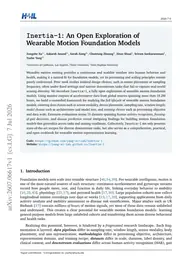
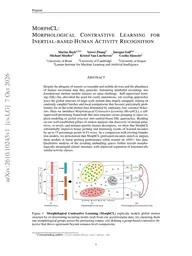
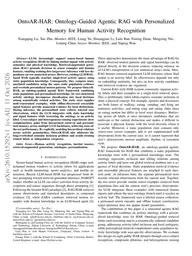
Dataset

PAMAP2

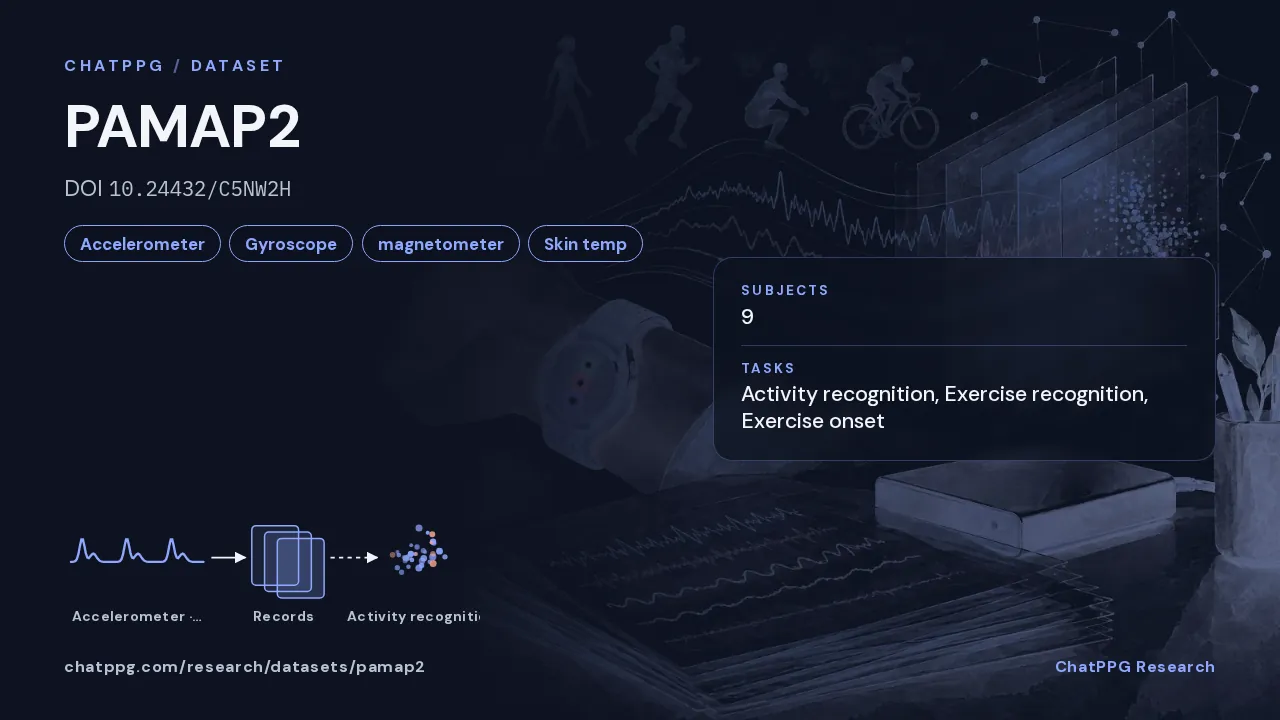
Physical Activity Monitoring (n=9, 3× IMU + HR)

PAMAP2 is a physical activity monitoring dataset from Attila Reiss and Didier Stricker, introduced in "Introducing a New Benchmarked Dataset for Activity Monitoring" at the 16th International Symposium on Wearable Computers (2012, pages 108-109). It is hosted on the UCI Machine Learning Repository. The dataset covers 18 different physical activities, such as walking, cycling and playing soccer, performed by 9 subjects. Each subject wore 3 Colibri wireless inertial measurement units and a heart rate monitor. One IMU sat over the wrist on the dominant arm, one on the chest and one on the dominant side's ankle. The IMUs sampled at 100Hz and the heart rate monitor at about 9Hz. Every subject followed a protocol of 12 activities, and some also did a few optional activities, stored in a separate folder. The activity list runs from lying, sitting and standing through walking, running, cycling and Nordic walking to household and office tasks such as ironing, vacuum cleaning, computer work and car driving, plus stair climbing, rope jumping and playing soccer. Transient periods are labeled as other. The raw data is in space-separated text files, one per subject per session. Each line has 54 columns: a timestamp, an activity label and 52 attributes of raw sensor data. Those attributes are heart rate in beats per minute and, for each IMU, temperature, two 3D accelerometers (plus or minus 16g and plus or minus 6g, both 13-bit), a 3D gyroscope and a 3D magnetometer. Orientation columns are marked invalid. Missing values appear as NaN. PAMAP2 has no PPG waveform. It is in this hub because it is a standard activity recognition benchmark used by wearable foundation models that combine motion and cardiac signals, and the hub tracks it on its activity recognition leaderboard. The heart rate channel also makes it useful for activity intensity estimation. The ZIP file is 656.3 MB. UCI lists the dataset under CC BY 4.0 with DOI 10.24432/C5NW2H, and it can be loaded with the ucimlrepo Python package.

Size
656.3 MB; CC BY 4.0; DOI 10.24432/C5NW2H
Paper

Reiss and Stricker, 16th International Symposium on Wearable Computers (2012), pages 108-109, doi 10.1109/ISWC.2012.13

Sensors

3 Colibri IMUs (wrist, chest, ankle) at 100Hz; heart rate monitor at about 9Hz

Data

54 columns per line (timestamp, activity label, 52 sensor attributes)

Original description

The PAMAP2 Physical Activity Monitoring dataset contains data of 18 different physical activities, performed by 9 subjects wearing 3 inertial measurement units and a heart rate monitor.

The PAMAP2 Physical Activity Monitoring dataset contains data of 18 different physical activities (such as walking, cycling, playing soccer, etc.), performed by 9 subjects wearing 3 inertial measurement units and a heart rate monitor. The dataset can be used for activity recognition and intensity estimation, while developing and applying algorithms of data processing, segmentation, feature extraction and classification.

** Sensors ** 3 Colibri wireless inertial measurement units (IMU): - sampling frequency: 100Hz - position of the sensors: - 1 IMU over the wrist on the dominant arm - 1 IMU on the chest - 1 IMU on the dominant side's ankle HR-monitor: - sampling frequency: ~9Hz

** Data collection protocol ** Each of the subjects had to follow a protocol, containing 12 different activities. The folder “Protocol” contains these recordings by subject. Furthermore, some of the subjects also performed a few optional activities. The folder “Optional” contains these recordings by subject.

** Data files ** Raw sensory data can be found in space-separated text-files (.dat), 1 data file per subject per session (protocol or optional). Missing values are indicated with NaN. One line in the data files correspond to one timestamped and labeled instance of sensory data. The data files contain 54 columns: each line consists of a timestamp, an activity label (the ground truth) and 52 attributes of raw sensory data.

Verbatim fromUCI Machine Learning Repository· Licence: CC BY 4.0 (UCI default)

PAMAP2: overview

PAMAP2 (Reiss and Stricker, 2012) is a standard benchmark for activity recognition and intensity estimation. Nine subjects wore three Colibri wireless IMUs (dominant wrist, chest, dominant ankle) sampled at 100 Hz and a heart-rate monitor sampled at about 9 Hz while following a 12-activity protocol; some also performed optional activities, for 18 activities in total. It is on the UCI Machine Learning Repository under CC BY 4.0.

What's inside

Subjects
9
Activities
18 (12 protocol + optional): lying, sitting, standing, walking, running, cycling, Nordic walking, watching TV, computer work, car driving, stairs up/down, vacuum cleaning, ironing, folding laundry, house cleaning, playing soccer, rope jumping
Sensors
3 Colibri IMUs (wrist, chest, ankle) at 100 Hz: temperature, ±16 g and ±6 g accelerometers, gyroscope, magnetometer
Heart rate
HR monitor at ~9 Hz (bpm column)
Format
Space-separated .dat, one file per subject per session (Protocol / Optional); 54 columns; NaN for missing
Instances
3,850,505 rows
Size
656.3 MB zip

How to access it

Host: UCI Machine Learning Repository

  1. Download PAMAP2_Dataset.zip (656.3 MB) from the UCI page; no registration.
  2. Unzip: subject files are in the Protocol and Optional folders.
  3. Read readme.pdf for column definitions.

Licence: Creative Commons Attribution 4.0 International (CC BY 4.0)

What it allows: Sharing and adaptation for any purpose, including commercial, with credit.

Load PAMAP2 in Python

Untestedpip install pandas numpy
import numpy as np
import pandas as pd

imu = ["temp", "ax16", "ay16", "az16", "ax6", "ay6", "az6",
       "gx", "gy", "gz", "mx", "my", "mz", "o1", "o2", "o3", "o4"]
cols = ["t", "activity", "hr"] + [f"{p}_{c}" for p in ("hand", "chest", "ankle") for c in imu]

df = pd.read_csv("PAMAP2_Dataset/Protocol/subject101.dat", sep=" ", header=None, names=cols)
df = df[df.activity != 0]                 # 0 = transient activity
df = df.drop(columns=[c for c in cols if c.endswith(("_o1", "_o2", "_o3", "_o4"))])  # orientation is invalid
df["hr"] = df["hr"].ffill()               # HR is ~9 Hz, IMUs 100 Hz

Not run here (656 MB download). Column layout follows the UCI variable description.

Caveats

  • Only 9 subjects: use leave-one-subject-out evaluation, not random window splits.
  • Orientation columns are marked invalid for this collection; drop them.
  • Heart rate is sampled at ~9 Hz, so most rows have NaN HR; forward-fill or resample.
  • Activity ID 0 marks transient periods and should be removed before training.
  • Optional activities were performed by only some subjects, so class counts are uneven.

Similar datasets

DatasetSubjectsSignalsLicence
OPPORTUNITY4accelCreative Commons Attribution 4.0 International (CC BY 4.0)
MHEALTH10accelCreative Commons Attribution 4.0 International (CC BY 4.0)
RealWorld HAR15accel, gyro, magnetometer, audio, gps, lightNot stated
UCI Human Activity Recognition Using Smartphones (UCI-HAR)30imuCreative Commons Attribution 4.0 International (CC BY 4.0)
WISDM AR v1.136accelNot stated

Sources: PAMAP2 on UCI · Reiss & Stricker 2012 · Updated 2026-10-19

PAMAP2: ChatPPG research summary card

Key numbers

9
Subjects
2
Reference labels
HR, ACTIVITY
9 Hz
Released sampling rate
IMU 100 Hz (ACC±16g + ACC±6g, gyro, mag, IMU temp); HR ~9 Hz

How it works

How PAMAP2 works: Devices & body sites → Signals recorded → TasksDevices & body sites: None (PPG site). Signals recorded: PAMAP2, 9 subjects · 9 Hz, signals IMU, Temperature, HR. Tasks: Activity recognition; Exercise recognition; Exercise onset.Devices & body sitesNone: PPG siteNonePPG siteSignals recordedPAMAP29 subjects · 9 HzxyzIMUTemperatureHRTasksActivity recognitionActivity recognitionExercise recognitionExercise recognitionExercise onsetExercise onset
Sampling
IMU 100 Hz (ACC±16g + ACC±6g, gyro, mag, IMU temp); HR ~9 Hz
Reference labels
hr, activity
Device roles
Study wearable (IMU)

Leaderboard rows· 8

All leaderboards
TaskDatasetMetricValueRank
Human activity recognition (IMU)PAMAP2Accuracy ↑92.21#1 / 1
Human activity recognition (IMU)PAMAP2f1_har_unspecified ↑94.88#1 / 4
Human activity recognition (IMU)PAMAP2f1_har_unspecified ↑92.66#2 / 4
Human activity recognition (IMU)PAMAP2f1_har_unspecified ↑91.64#3 / 4
Human activity recognition (IMU)PAMAP2Macro-F1 ↑78.9 ± 5.4 (%)#1 / 4
Human activity recognition (IMU)PAMAP2Macro-F1 ↑75.3 ± 9.3 (%)#2 / 4
Human activity recognition (IMU)PAMAP2Macro-F1 ↑75.15 LP / 75.80 FT (%)#3 / 4
Human activity recognition (IMU)PAMAP2Macro-F1 ↑87.3 ± 1.1 (%)#1 / 3

Papers and models using this dataset· 35

Papers

Show 13 more papers

Models

#5 of 186 most-used datasets by published papers and models · #3 of 84 IMU

Browse these 25 papers in the research explorer (filtered to PAMAP2)

FAQ

How many activities and subjects are in PAMAP2?

18 activities performed by 9 subjects: a 12-activity protocol plus optional activities done by some subjects.

What sensors does PAMAP2 use?

Three Colibri wireless IMUs on the dominant wrist, chest and dominant ankle at 100 Hz, plus a heart-rate monitor at about 9 Hz.

What are the columns in the PAMAP2 .dat files?

54 columns: timestamp, activity ID, heart rate, then 17 columns for each IMU (temperature, two 3-axis accelerometers, gyroscope, magnetometer, and 4 orientation columns that are invalid).

What is the PAMAP2 licence?

CC BY 4.0 on the UCI Machine Learning Repository.

How do I download the PAMAP2 dataset?

From the UCI Machine Learning Repository (dataset 231 / DOI 10.24432/C5NW2H). The Protocol and Optional folders contain .dat files. The UCI licence is CC BY 4.0.

What is PAMAP2?

PAMAP2 is an activity monitoring dataset of 9 subjects doing 18 physical activities while wearing 3 IMUs (wrist, chest, ankle) and a heart rate monitor.

How do I download PAMAP2?

Download the 656.3 MB ZIP from https://archive.ics.uci.edu/dataset/231/pamap2+physical+activity+monitoring or use the ucimlrepo package. It is CC BY 4.0.

PAMAP2 vs CAPTURE-24?

PAMAP2 is a small, scripted multi-sensor dataset with heart rate. CAPTURE-24 is a large free-living wrist accelerometer dataset with 151 participants and no heart rate.

What are PAMAP2 benchmark results?

The original paper benchmarked activity recognition and intensity estimation; the hub tracks newer results on its activity recognition leaderboard.

Cite this dataset

This citation is the paper recorded with this dataset. Check it against the publisher before submitting.

Reiss, A., & Stricker, D. (2012). Introducing a New Benchmarked Dataset for Activity Monitoring. 2012 16th International Symposium on Wearable Computers, 108–109. https://doi.org/10.1109/iswc.2012.13
Reiss, Attila and Didier Stricker. 2012. "Introducing a New Benchmarked Dataset for Activity Monitoring." 2012 16th International Symposium on Wearable Computers, 108–109. https://doi.org/10.1109/iswc.2012.13.
Reiss, A. and Stricker, D. (2012) 'Introducing a New Benchmarked Dataset for Activity Monitoring', 2012 16th International Symposium on Wearable Computers, pp. 108–109. doi: 10.1109/iswc.2012.13.
Reiss, Attila, and Didier Stricker "Introducing a New Benchmarked Dataset for Activity Monitoring." 2012 16th International Symposium on Wearable Computers, 2012, pp. 108–109. https://doi.org/10.1109/iswc.2012.13.
A. Reiss and D. Stricker, "Introducing a New Benchmarked Dataset for Activity Monitoring," 2012 16th International Symposium on Wearable Computers, pp. 108–109, 2012, doi: 10.1109/iswc.2012.13.
@inproceedings{reiss2012introducing,
  title         = {{Introducing a New Benchmarked Dataset for Activity Monitoring}},
  author        = {Reiss, Attila and Stricker, Didier},
  year          = {2012},
  booktitle     = {2012 16th International Symposium on Wearable Computers},
  pages         = {108--109},
  publisher     = {IEEE},
  doi           = {10.1109/iswc.2012.13}
}

Cite the ChatPPG record

Cite the dated snapshot 2026-10 for a fixed, reproducible version. Please also cite the original publications listed above.

APA

ChatPPG. (2026). PAMAP2: dataset record (Version 2026-10) [Data set]. ChatPPG Research Hub. https://chatppg.com/research/datasets/pamap2

BibTeX
@misc{chatppg_dataset_pamap2,
  author       = {{ChatPPG}},
  title        = {{PAMAP2: dataset record}},
  year         = {2026},
  month        = nov,
  version      = {2026-10},
  howpublished = {\url{https://chatppg.com/research/datasets/pamap2}},
  note         = {ChatPPG Research Hub, Snapshot 2026-10, https://chatppg.com/research/snapshots/2026-10}
}
CITATION.cff
cff-version: 1.2.0
message: "If you use this resource, please cite it as below."
type: dataset
title: "PAMAP2: dataset record"
authors:
  - name: "ChatPPG"
url: "https://chatppg.com/research/datasets/pamap2"
repository-artifact: "https://chatppg.com/research/snapshots/2026-10"
version: "2026-10"
date-released: "2026-11-25"

History

  1. Record updated