Ding, Zihan et al., "HALO: A Heterogeneity-Aware Language-Aligned IMU Foundation Model for Open-Set Human Activity Recognition", arXiv:2608.27233, CC BY 4.0
Activity counts measure attention, not model quality. Missing counts are unknown. Publication status follows the linked source; a listed venue alone does not confirm peer review.
Domain-specific IMU foundation model for open-vocabulary HAR across heterogeneous rates/channels/placements. Two-stage: heterogeneity-aware SSL encoder → synonym-aware soft contrastive alignment to frozen Sentence-BERT. ~35M trainable params; zero-shot = cosine retrieval over arbitrary label text (no per-dataset classifier).
Parameters
35M
Signals
IMU
Form factor
wearable_phone_IMU_open_vocabulary_HAR
Year
2026
Architecture
Channel-independent dual-branch Transformer with adaptive-pooling tokenization; Sentence-BERT text alignment
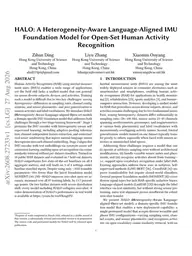
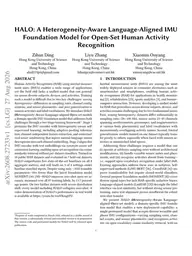
Human Activity Recognition (HAR) using inertial measurement units (IMUs) enables a wide range of applications, yet the field still lacks a unified model that can generalize across diverse subjects, devices, and activities. Training such a model is difficult due to two key challenges: sensing heterogeneity – differences in sampling rates, channel configurations, and sensor placements – and poor generalization to unseen activities and label vocabularies. We introduce HALO (Heterogeneity-Aware Language-aligned Open-set model), a domain-specific IMU foundation model that addresses both challenges through a two-stage training framework. Stage 1 pretrains the IMU encoder with heterogeneity-aware self-supervised learning, including adaptive-pooling tokenization, channel-independent feature extraction, and contextualized sensor conditioning that injects natural-language sensor descriptions into each channel embedding. Stage 2 aligns this IMU encoder with text embeddings via synonym-aware soft contrastive learning, enabling open-set recognition via cosine-similarity retrieval without per-dataset classifiers. Trained on 10 public HAR datasets and evaluated on 7 held-out datasets, HALO outperforms five state-of-the-art baselines on all 8 aggregate metrics, and still leads on 3 of 4 settings under baseline-matched inputs. Despite using only ~35M trainable parameters – 10x fewer than the latest foundation model MOMENT (341.2M) – HALO improves zero-shot open-set accuracy, measured over all 87 training labels, by 13.7 percentage points. On two further datasets with severe distribution shift, every model including HALO collapses zero-shot. A video demonstration of HALO's performance in real world is available at https://youtu.be/rooVKragtFU
Verbatim fromarXiv· arXiv metadata (abstracts are released under CC0)
How it works
Datasets linked in the hub; pretraining vs evaluation roles follow the paper.
Architecture
Channel-independent dual-branch Transformer with adaptive-pooling tokenization; Sentence-BERT text alignment
Inputs
IMU
Approach
IMU · HAR · foundation model · language aligned · open set · HKUST
Full photo credits and licences are on each device page. An icon means we have no openly licensed or manufacturer-cleared photo of that exact device yet.
Cite the publication recorded for this model. Check it against the publisher before submitting.
Ding, Z., Zhang, L., & Ouyang, X. (2026). HALO: A Heterogeneity-Aware Language-Aligned IMU Foundation Model for Open-Set Human Activity Recognition. arXiv preprint. https://arxiv.org/abs/2608.27233
Ding, Zihan, Liyu Zhang, and Xiaomin Ouyang. 2026. "HALO: A Heterogeneity-Aware Language-Aligned IMU Foundation Model for Open-Set Human Activity Recognition." arXiv preprint. https://arxiv.org/abs/2608.27233.
Ding, Z., Zhang, L. and Ouyang, X. (2026) 'HALO: A Heterogeneity-Aware Language-Aligned IMU Foundation Model for Open-Set Human Activity Recognition', arXiv preprint. Available at: https://arxiv.org/abs/2608.27233
Ding, Zihan, et al. "HALO: A Heterogeneity-Aware Language-Aligned IMU Foundation Model for Open-Set Human Activity Recognition." arXiv preprint, 2026. https://arxiv.org/abs/2608.27233.
Z. Ding, L. Zhang, and X. Ouyang, "HALO: A Heterogeneity-Aware Language-Aligned IMU Foundation Model for Open-Set Human Activity Recognition," arXiv preprint, 2026, [Online]. Available: https://arxiv.org/abs/2608.27233.
@misc{ding2026halo,
  title         = {{HALO: A Heterogeneity-Aware Language-Aligned IMU Foundation Model for Open-Set Human Activity Recognition}},
  author        = {Ding, Zihan and Zhang, Liyu and Ouyang, Xiaomin},
  year          = {2026},
  howpublished  = {arXiv preprint},
  eprint        = {2608.27233},
  archivePrefix = {arXiv}
}
History
Added to the ChatPPG research hub
Newsletter
Get new PPG datasets, papers and models
Get alerts when HALO is benchmarked on new datasets, plus the weekly digest.
New datasets, papers and models
Practical guides from the hub
Unsubscribe anytime
The waveform is an illustration of a PPG pulse, not a recording.