PaperarXiv:2611.28033
WISP: composable representations for wrist-worn activity recognition + WristHARBench (9 wrist-ACC datasets, participant-disjoint; 70.20% mean macro-F1 vs 59.62% best of 18 baselines)
arXiv (cs.LG) preprint v1 2026-10-07; University of Birmingham
TL;DR
Preprint from the University of Birmingham introducing WristHARBench, a benchmark that puts nine public wrist-accelerometer activity datasets (plus two 9-channel IMU sets) under one participant-disjoint protocol, and WISP, a composable space of time-series representations (local shape, rhythm, temporal order, cross-axis relations) paired with compatible classifiers. With random search WISP reaches 70.20% mean macro-F1 across the nine wrist datasets versus 59.62% for the strongest of 18 external baselines (RDST). Code and benchmark data are public.
Abstract
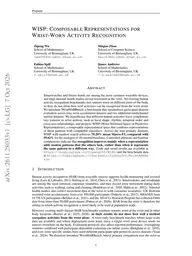
Smartwatches and fitness bands are among the most common wearable devices, and large national health studies record movement at the wrist. Yet existing human activity recognition benchmarks mix sensors worn on different parts of the body, so they do not show how well activities can be recognised from the wrist alone. We introduce WristHARBench, a benchmark that standardises participant-disjoint evaluation across nine wrist-acceleration datasets and two additional multichannel inertial datasets. We hypothesise that different human activities leave complementary patterns in wrist motion, such as local shape, rhythm, temporal order and cross-axis relationships, and propose WISP (Wrist-Informed Space of Predictive Representations), a composable representation space that combines representations of these patterns with compatible classifiers. Across the nine primary datasets, WISP with random search achieves 70.20% mean Macro-F1, compared with 59.62% for the strongest of 18 external baselines. Controlled ablations and baseline comparisons indicate that recognition improves mainly when a representation adds motion patterns that the others lack, rather than when it represents the same pattern in a different way.
Verbatim from arXiv (opens in a new tab) · arXiv metadata (abstracts are released under CC0)
Results on ChatPPG leaderboards
All leaderboardsNo results from this paper on ChatPPG leaderboards yet. Browse the leaderboards.
Tasks & signals
Tasks
Signals
Devices
Keywords
Datasets used
 CAPTURE-24151 subjects · IMU
- HARMESwrist IMU + atmospheric + audio HAR20 subjects · IMU · Audio · atmospheric-temp
 MHEALTH10 subjects · IMU
 PAMAP2Physical Activity Monitoring (n=9, 3× IMU + HR)9 subjects · IMU · Temp · HR
- WHARFsingle wrist accelerometer ADL primitives (n=16)IMU
 WISDM AR v1.1cellphone accelerometer HAR (n=36)36 subjects · IMU
How it works
Cite this paper
Wu, Z., Zhou, S., Spill, F., & Andrews, J. (2026). WISP: composable representations for wrist-worn activity recognition + WristHARBench (9 wrist-ACC datasets, participant-disjoint; 70.20% mean macro-F1 vs 59.62% best of 18 baselines). arXiv preprint v1. https://arxiv.org/abs/2611.28033
Wu, Zipeng, Shiqiao Zhou, Fabian Spill, and James Andrews. 2026. "WISP: composable representations for wrist-worn activity recognition + WristHARBench (9 wrist-ACC datasets, participant-disjoint; 70.20% mean macro-F1 vs 59.62% best of 18 baselines)." arXiv preprint v1. https://arxiv.org/abs/2611.28033.
Wu, Z., Zhou, S., Spill, F. and Andrews, J. (2026) 'WISP: composable representations for wrist-worn activity recognition + WristHARBench (9 wrist-ACC datasets, participant-disjoint; 70.20% mean macro-F1 vs 59.62% best of 18 baselines)', arXiv preprint v1. Available at: https://arxiv.org/abs/2611.28033
Wu, Zipeng, et al. "WISP: composable representations for wrist-worn activity recognition + WristHARBench (9 wrist-ACC datasets, participant-disjoint; 70.20% mean macro-F1 vs 59.62% best of 18 baselines)." arXiv preprint v1, 2026. https://arxiv.org/abs/2611.28033.
Z. Wu, S. Zhou, F. Spill, and J. Andrews, "WISP: composable representations for wrist-worn activity recognition + WristHARBench (9 wrist-ACC datasets, participant-disjoint; 70.20% mean macro-F1 vs 59.62% best of 18 baselines)," arXiv preprint v1, 2026, [Online]. Available: https://arxiv.org/abs/2611.28033.
@misc{wu2026wisp,
  title         = {{WISP: composable representations for wrist-worn activity recognition + WristHARBench (9 wrist-ACC datasets, participant-disjoint; 70.20\% mean macro-F1 vs 59.62\% best of 18 baselines)}},
  author        = {Wu, Zipeng and Zhou, Shiqiao and Spill, Fabian and Andrews, James},
  year          = {2026},
  howpublished  = {arXiv preprint v1},
  eprint        = {2611.28033},
  archivePrefix = {arXiv}
}Added to the ChatPPG research hub