PaperarXiv:2611.12090
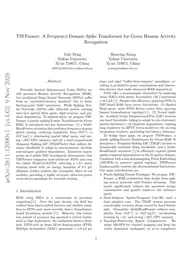
TSFFormer: A Frequency-Domain Spike Transformer for Green Human Activity Recognition
arXiv preprint, v1 2026-11-09
TL;DR
A purely spiking transformer for IMU HAR: multi-head Fourier attention mixes across sensor nodes in the frequency domain (O(V log V)), and a dual-compartment TS-LIF neuron with a dynamic threshold handles non-stationary motion. Evaluated on 8 IMU datasets (Daily-Sports/DSADS, HAR70+, HuGaDB, Opportunity, PAMAP2, TNDA-HAR, USC-HAD, WISDM) with ~2 s windows, reporting accuracy: it beats 11 SNN baselines on all 8 and DeepConvLSTM on 4 (e.g. PAMAP2 83.33 vs 81.16, WISDM 86.35 vs 71.23).
- Form factor: multi
Abstract
Wearable Inertial Measurement Units (IMUs) enable pervasive Human Activity Recognition (HAR), but traditional Deep Neural Networks (DNNs) suffer from an "arithmetic-latency deadlock" due to dense floating-point MAC operations. While Spiking Neural Networks (SNNs) offer ultra-low power, existing ones face spatial blind spots, rigid neurons, and gradient degradation. To address these, we propose TSFFormer, a purely spiking Fourier Transformer for Green HAR. It introduces two key innovations: (1) a MultiHeadFourier attention that performs frequency-domain global mixing, reducing complexity from \(O(V^2)\) to \(O(V V)\), eliminating spatial blind spots, and saving \(~\)50% GPU memory; and (2) a dual-compartment Temporal Spiking LIF (TSLIFNode) that utilizes dynamic thresholds to adapt to non-stationary rhythms and mitigate gradient degradation. Extensive experiments on 8 public IMU benchmarks demonstrate that TSFFormer surpasses state-of-the-art SNNs and even the classic DeepConvLSTM, achieving a \(~\)3\(×\) faster training speed with an energy footprint of 0.1 pJ. Ablation studies confirm the synergistic effect of our modules, providing a highly accurate, ultra-low-power event-driven paradigm for wearable sensing.
Verbatim from arXiv (opens in a new tab) · arXiv metadata (abstracts are released under CC0)
Results on ChatPPG leaderboards
All leaderboardsNo results from this paper on ChatPPG leaderboards yet. Browse the leaderboards.
Tasks & signals
Tasks
Signals
Keywords
How it works
Cite this paper
Deng, J., & Xiang, S. (2026). TSFFormer: A Frequency-Domain Spike Transformer for Green Human Activity Recognition. arXiv preprint, v1. https://arxiv.org/abs/2611.12090
Deng, Jiale and Shuiying Xiang. 2026. "TSFFormer: A Frequency-Domain Spike Transformer for Green Human Activity Recognition." arXiv preprint, v1. https://arxiv.org/abs/2611.12090.
Deng, J. and Xiang, S. (2026) 'TSFFormer: A Frequency-Domain Spike Transformer for Green Human Activity Recognition', arXiv preprint, v1. Available at: https://arxiv.org/abs/2611.12090
Deng, Jiale, and Shuiying Xiang "TSFFormer: A Frequency-Domain Spike Transformer for Green Human Activity Recognition." arXiv preprint, v1, 2026. https://arxiv.org/abs/2611.12090.
J. Deng and S. Xiang, "TSFFormer: A Frequency-Domain Spike Transformer for Green Human Activity Recognition," arXiv preprint, v1, 2026, [Online]. Available: https://arxiv.org/abs/2611.12090.
@misc{deng2026tsfformer,
  title         = {{TSFFormer: A Frequency-Domain Spike Transformer for Green Human Activity Recognition}},
  author        = {Deng, Jiale and Xiang, Shuiying},
  year          = {2026},
  howpublished  = {arXiv preprint, v1},
  eprint        = {2611.12090},
  archivePrefix = {arXiv}
}Added to the ChatPPG research hub