InrtlWrist
masked-autoencoder wrist IMU encoder (IMU-Bench reference model)
Activity counts measure attention, not model quality. Missing counts are unknown. Publication status follows the linked source; a listed venue alone does not confirm peer review.
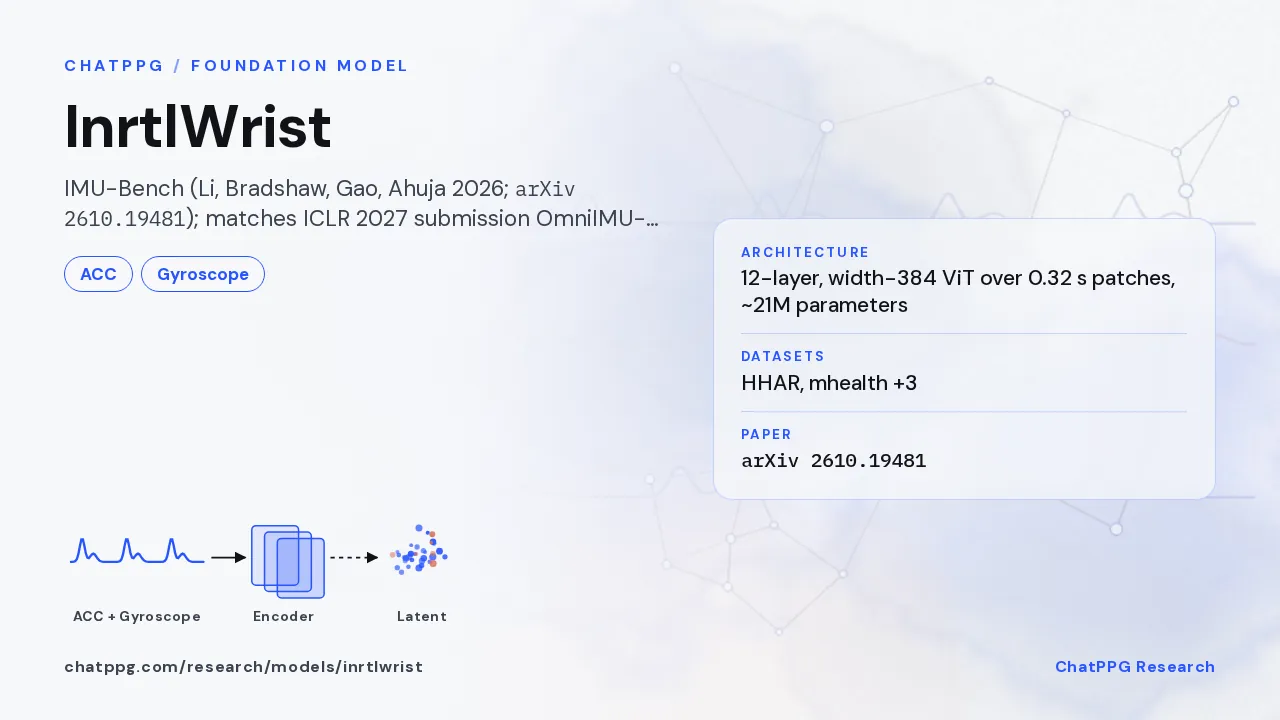
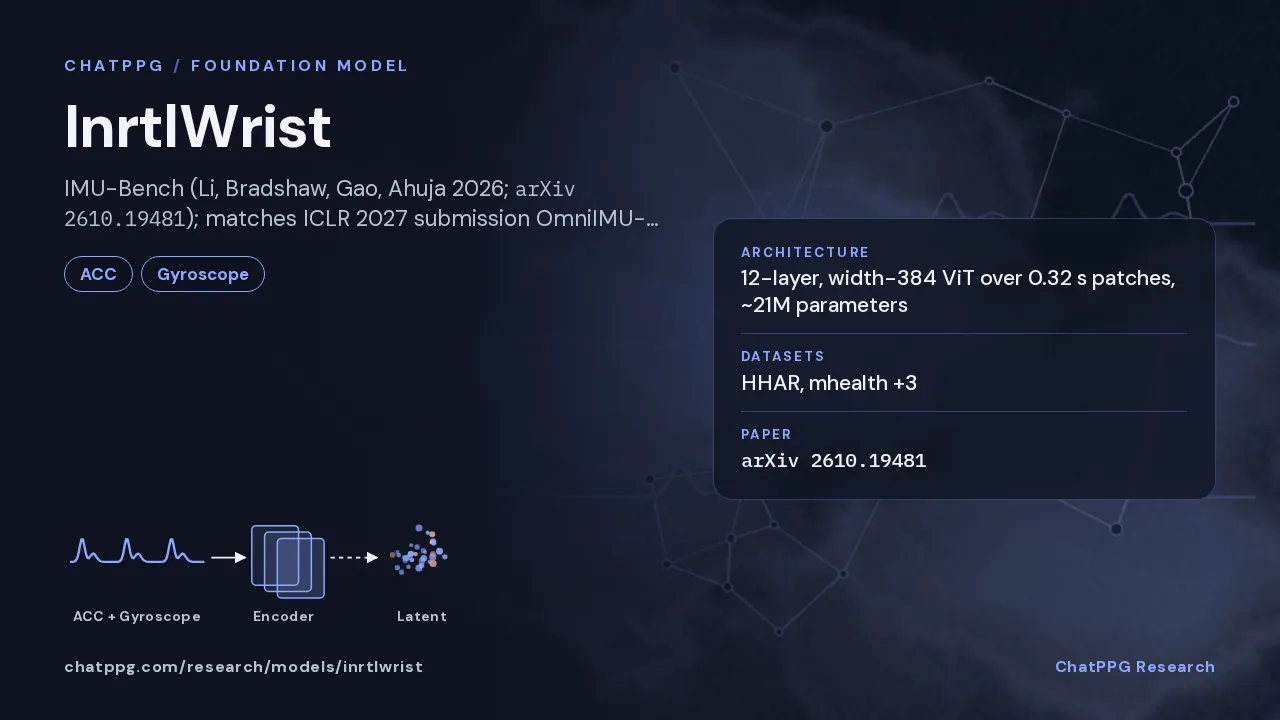
InrtlWrist is an open-weights masked-autoencoder encoder for six-channel wrist IMU data (accelerometer plus gyroscope), released by Northwestern University's SPICE Lab as the reference model of the IMU-Bench benchmark. It is a 12-layer vision-transformer-style encoder over 0.32 s patches with about 21 million parameters, pretrained on 197,094 unlabeled windows from eight public wrist datasets plus simulated wrist motion. IMU-Bench evaluates it on ten kinematic, semantic and clinical tasks, including arm and body pose, odometry, microgestures, Parkinson's disease and activity recognition. Code and weights are MIT licensed.
- Authors: Yiquan Li, Aidan Bradshaw, Chenfeng Gao, Karan Ahuja (Northwestern University)
- Input: 6-channel wrist accelerometer + gyroscope
- Architecture: 12-layer, width-384 ViT over 0.32 s patches, ~21M parameters
- Pretraining: masked reconstruction on 197,094 unlabeled windows (UT-Watch, WISDM, RecoFit, PAMAP2, SAMoSA, Shoaib, OCDetect, EatingSpeed + simulated wrist motion)
- Benchmark: 10 IMU-Bench tasks from 8 datasets, frozen probe / fine-tune / from-scratch protocols
- License: MIT (code and weights)
- Type
- Foundation model
- Modalities
- IMU
- Form factor
- Wrist
- Parameters
- Not reported
- Architecture
- Not reported
- Venue
- IMU-Bench (Li, Bradshaw, Gao, Ahuja 2026; arXiv 2610.19481); matches ICLR 2027 submission OmniIMU-Bench by subtitle and claims
- Year
- 2026
- Authors
- DOI
- Not reported
- Weights
- Open (opens in a new tab)
- Licence
- MIT (code and weights); pretraining datasets keep their own licences
- Papers
- Devices
- Added
- Oct 14, 2026
- Updated
- Oct 15, 2026
Abstract
Wrist-worn inertial measurement units (IMUs) provide a common sensing modality for tasks ranging from activity and gesture recognition to pose estimation, inertial odometry and clinical motor assessment. Existing wearable benchmarks evaluate performance across multiple tasks, but leave open how supervision for one task affects transfer to others and whether these tasks benefit from a shared representation. We present IMU-Bench, a benchmark of ten tasks from eight datasets for studying IMU multi-task performance and cross-task transfer. We compare six self-supervised methods pretrained on unlabeled recorded and simulated wrist motion, evaluating classification, pose and velocity estimation, and IMU-language retrieval. We find that our masked autoencoder, InrtlWrist, achieves the best or joint-best frozen-probe performance on nine of ten tasks, and fine-tuning improves on training from scratch on nine of ten tasks, including full-body pose, odometry and retrieval. Across transfer and joint-training experiments, supervision that benefits one target can reduce performance on others, with supervised sources transferring within kinematic estimation while, under frozen probing, none approaches the pretrained encoder on language retrieval, and joint-training gains that come at a cost to the paired task. These findings distinguish broad downstream usefulness from complementary task supervision. Code, task cards and a leaderboard are publicly available.
Verbatim fromarXiv· arXiv metadata (abstracts are released under CC0)
Key results
How it works
Datasets linked in the hub; pretraining vs evaluation roles follow the paper.
- Pretraining data
- 197,094 unlabeled 10.24 s windows (~280 h) from UT-Watch, WISDM, RecoFit, PAMAP2, SAMoSA, Shoaib, OCDetect, EatingSpeed + wrist motion simulated from Motion-X++ and BONES-SEED
- Inputs
- IMU
- Approach
- IMU FM · wrist · MAE · ViT · accelerometer · gyroscope
Devices· 1
Illustrations by form factor; product photos are added as licences clear.
Leaderboard rows· 2
All leaderboards| Task | Dataset | Metric | Value | Rank |
|---|---|---|---|---|
| Human activity recognition (IMU) | HHAR | Macro-F1 ↑ | 0.621 probe / 0.603 FT | #1 / 1 |
| Human activity recognition (IMU) | mhealth | Macro-F1 ↑ | 68.6 probe / 72.4 FT (%) | #4 / 4 |
Datasets· 5
Papers· 2
Cite
@misc{inrtlwrist2026,
  title = {{InrtlWrist}},
  author = {OpenReview: anonymous (ICLR 2027 double-blind). Public release IMU-Bench: Yiquan Li and Aidan Bradshaw and Chenfeng Gao and Karan Ahuja (Northwestern University; equal contribution) — self-identified in the official repo README},
  year = {2026},
  howpublished = {IMU-Bench (Li, Bradshaw, Gao, Ahuja 2026; arXiv 2610.19481); matches ICLR 2027 submission OmniIMU-Bench by subtitle and claims},
  eprint = {2610.19481},
  url = {https://arxiv.org/abs/2610.19481}
}History
Record updated
Added to the ChatPPG research hub
More on ChatPPG
- HHAR
heterogeneity HAR, smartphones + smartwatches (n=9)
- mhealth
Research dataset
- OpenWatch
smartwatch IMU+PPG hand-gesture benchmark (n=50, >10 h, 59 gesture sequences)
- OmniIMU-Bench: Benchmarking Wrist IMU Representations Across Kinematic, Semantic and Clinical Tasks
Benchmark of ten tasks from eight datasets for wrist IMU multi-task performance and cross-task trans
- TransfHAR: Self-Supervised Wrist Representations for On-Demand Activity Recognition
TransfHAR pretrains on coarse wrist IMU activities like sitting and walking and transfers to fine-gr
- Human activity recognition (IMU) leaderboard
Benchmark results for human activity recognition (imu)