Activity counts measure attention, not model quality. Missing counts are unknown. Publication status follows the linked source; a listed venue alone does not confirm peer review.
EdgeHAR is a compact sensor foundation model for activity recognition designed to run on wearable devices rather than in the cloud. Lightweight adaptation modules help it handle new users, devices, sampling rates and sensor placements within edge limits on compute, memory and latency.
Published
arXiv preprint, 2026
Signals
IMU
Task
human activity recognition under distribution shift
Year
2026
Design
edge-native compact foundation model with lightweight adapters
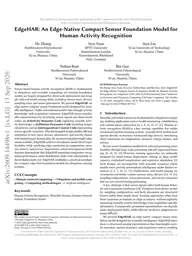
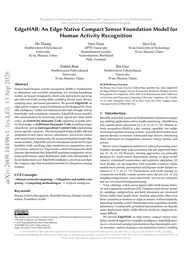
Sensor-based human activity recognition (HAR) is fundamental to ubiquitous and wearable computing, yet existing foundation models are largely designed for cloud-scale deployment and struggle with real-world sensing shifts, including unseen users, devices, sampling rates, and sensor placements. We present EdgeHAR, an edge-native compact sensor foundation model designed for wearable intelligence. Unlike conventional models that entangle activity knowledge with acquisition variations, EdgeHAR learns transferable representations by factorizing sensor signals into three latent codes: an (i)Activity-Semantic Code capturing reusable activity knowledge, a (ii)Motion-Dynamics Code modeling temporal patterns, and an (iii)Acquisition-Context Code representing sensor-specific variations. This disentangled design enables efficient adaptation to new users, devices, placements, and activity classes with limited target-domain data. By incorporating lightweight adaptation modules, EdgeHAR achieves foundation-model-level transferability while satisfying edge constraints in computation, memory, latency, and privacy. Experiments across heterogeneous HAR datasets demonstrate that EdgeHAR maintains competitive recognition performance under distribution shifts with substantially reduced deployment cost. EdgeHAR establishes a practical paradigm for compact, edge-first foundation models for ubiquitous sensing systems.
Verbatim fromarXiv· arXiv metadata (abstracts are released under CC0)
How it works
Datasets linked in the hub; pretraining vs evaluation roles follow the paper.
Architecture
Shared encoder -> three factor heads (semantic / dynamics / acquisition) + lightweight adapters; encoder type not stated
Inputs
IMU
Approach
IMU · HAR · foundation model · edge · compact · UbiComp
Cite the publication recorded for this model. Check it against the publisher before submitting.
Zhang, H., Yuan, S., Liu, S., Bian, S., & Guo, B. (2026). EdgeHAR: An Edge-Native Compact Sensor Foundation Model for Human Activity Recognition. arXiv preprint. https://arxiv.org/abs/2609.14498
Zhang, He, Siyu Yuan, Siyu Liu, Sizhen Bian, and Bin Guo. 2026. "EdgeHAR: An Edge-Native Compact Sensor Foundation Model for Human Activity Recognition." arXiv preprint. https://arxiv.org/abs/2609.14498.
Zhang, H., Yuan, S., Liu, S., Bian, S. and Guo, B. (2026) 'EdgeHAR: An Edge-Native Compact Sensor Foundation Model for Human Activity Recognition', arXiv preprint. Available at: https://arxiv.org/abs/2609.14498
Zhang, He, et al. "EdgeHAR: An Edge-Native Compact Sensor Foundation Model for Human Activity Recognition." arXiv preprint, 2026. https://arxiv.org/abs/2609.14498.
H. Zhang, S. Yuan, S. Liu, S. Bian, and B. Guo, "EdgeHAR: An Edge-Native Compact Sensor Foundation Model for Human Activity Recognition," arXiv preprint, 2026, [Online]. Available: https://arxiv.org/abs/2609.14498.
@misc{zhang2026edgehar,
  title         = {{EdgeHAR: An Edge-Native Compact Sensor Foundation Model for Human Activity Recognition}},
  author        = {Zhang, He and Yuan, Siyu and Liu, Siyu and Bian, Sizhen and Guo, Bin},
  year          = {2026},
  howpublished  = {arXiv preprint},
  eprint        = {2609.14498},
  archivePrefix = {arXiv}
}
History
Added to the ChatPPG research hub
Newsletter
Get new PPG datasets, papers and models
Get alerts when EdgeHAR is benchmarked on new datasets, plus the weekly digest.
New datasets, papers and models
Practical guides from the hub
Unsubscribe anytime
The waveform is an illustration of a PPG pulse, not a recording.