
Cite this dataset
OPPORTUNITY [Data set]. (n.d.). uci-ml-repository. https://doi.org/10.24432/C5M027
@misc{opportunityopportunity,
  title         = {{OPPORTUNITY}},
  howpublished  = {uci-ml-repository},
  doi           = {10.24432/C5M027}
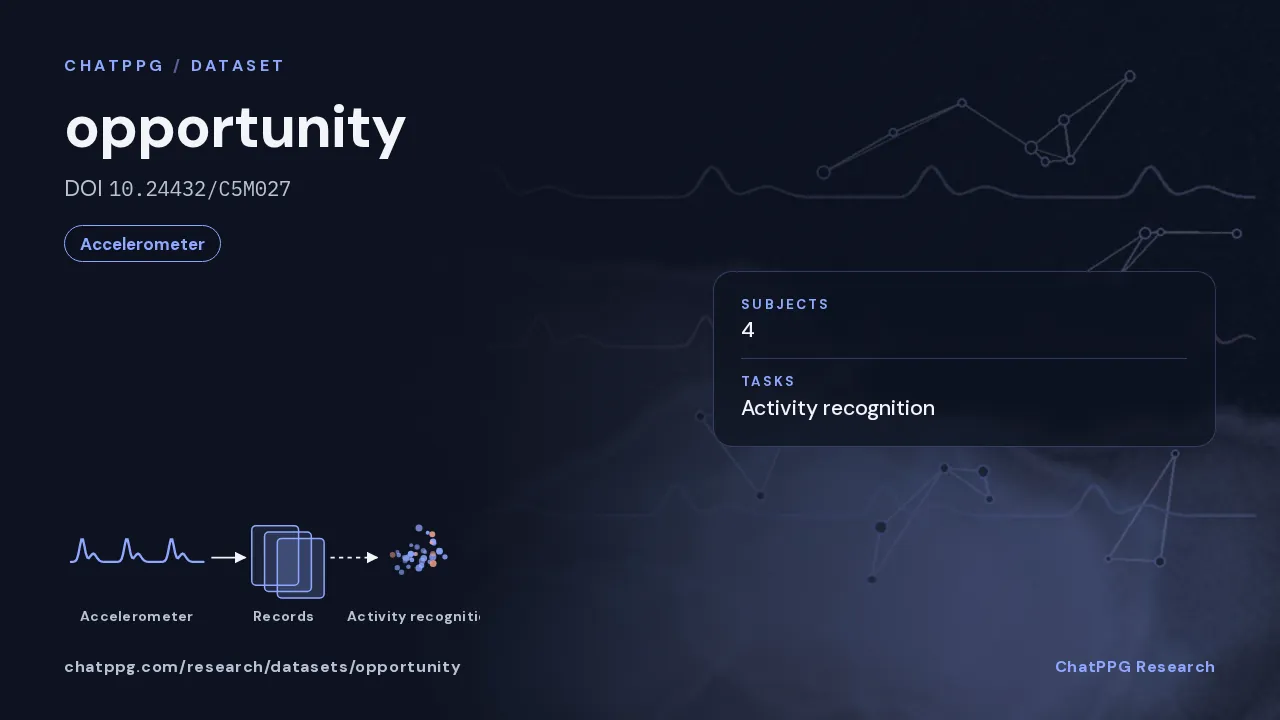
}OPPORTUNITY is a benchmark for activity recognition from body-worn, object and ambient sensors, recorded while users carried out daily activities. Body sensors include 7 IMUs and 12 3D accelerometers, alongside sensors on 12 objects and in the room. Four users each did 6 runs, five natural daily-living runs and one scripted drill, with labels at several levels from locomotion to fine actions; a subset was used for the 2011 OPPORTUNITY challenge.
The OPPORTUNITY Dataset for Human Activity Recognition from Wearable, Object, and Ambient Sensors is a dataset devised to benchmark human activity recognition algorithms (classification, automatic data segmentation, sensor fusion, feature extraction, etc).
The OPPORTUNITY Dataset for Human Activity Recognition from Wearable, Object, and Ambient Sensors is a dataset devised to benchmark human activity recognition algorithms (classification, automatic data segmentation, sensor fusion, feature extraction, etc).
A subset of this dataset was used for the "OPPORTUNITY Activity Recognition Challenge" organized for the 2011 IEEE conf on Systems, Man and Cybernetics Workshop on "Robust machine learning techniques for human activity recognition".
The dataset comprises the readings of motion sensors recorded while users executed typical daily activities: * Body-worn sensors: 7 inertial measurement units, 12 3D acceleration sensors, 4 3D localization information * Object sensors: 12 objects with 3D acceleration and 2D rate of turn * Ambient sensors: 13 switches and 8 3D acceleration sensors * Recordings: 4 users, 6 runs per users. Of these, 5 are Activity of Daily Living runs characterized by a natural execution of daily activities. The 6th run is a "drill" run, where users execute a scripted sequence of activities. * Annotations/classes: the activities of the user in the scenario are annotated on different levels: "modes of locomotion" classes; low-level actions relating 13 actions to 23 objects; 17 mid-level gesture classes; and 5 high-level activity classes
** Recording scenario **
The activity recognition environment and scenario has been designed to generate many activity primitives, yet in a realistic manner. Subjects operated in a room simulating a studio flat with a deckchair, a kitchen, doors giving access to the outside, a coffee machine, a table and a chair.
We achieved a natural execution of activities by instructing users to follow a high-level script but leaving them free interpretation as how to achieve the high-level goals. We furthermore encouraged them to perform as naturally as possible with all the variations they were used to.
For each subject we recorded 6 different runs. Five of them, termed activity of daily living (ADL), followed a given scenario as detailed below. The remaining one, a drill run, was designed to generate a large number of activity instances. The ADL run consists of temporally unfolding situations. In each situation (e.g. preparing sandwich), a large number of action primitives occur (e.g. reach for bread, move to bread cutter, operate bread cutter).
* ADL run *
The ADL run consists of temporally unfolding situations:
Start: lying on the deckchair, get up Groom: move in the room, check that all the objects are in the right places in the drawers and on shelves Relax: go outside and have a walk around the building Prepare coffee: prepare a coffee with milk and sugar using the coffee machine Drink coffee: take coffee sips, move around in the environment Prepare sandwich: include bread, cheese and salami, using the bread cutter and various knifes and plates Eat sandwich Cleanup: put objects used to original place or dish washer, cleanup the table Break: lie on the deckchair
* Drill run *
The drill run consists of 20 repetitions of the following sequence of activities:
Open then close the fridge Open then close the dishwasher Open then close 3 drawers (at different heights) Open then close door 1 Open then close door 2 Toggle the lights on then off Clean the table Drink while standing Drink while seated
** Annotations **
The annotations are done on five ‘tracks’. One track contains modes of locomotion (e.g. sitting, standing, walking). Two other tracks indicate the actions of the left and right hand (e.g. reach, grasp, release), and to which object they apply (e.g. milk, switch, door). The fourth track indicates the high level activities (e.g. prepare sandwich). The high level activities relate to the situations indicated in the description of the ADL runs as follows (in parenthesis the number of the situations indicated above): relaxing (1, 9), early morning (2, 3), coffee time (4, 5), sandwich time (6, 7), cleanup (8).
The mid-level gesture annotations is generated automatically from the low-level hand actions. It comprises coarser characterization of the user's activities. For instance the low-level annotations 'reach door' and 'open door' are combined into a single 'open door' mid-level annotation. Here, the mid-level annotations comprise actions of the left and right hand indiscriminately. However, in practice, the users mostly interacted with the environment with their right hand. We recommend to use the mid-level annotations in first attempts to use this dataset.
** Applications **
This dataset offers a rich playground to assess methods such as, e.g:
* Classification, (semi-) supervised machine learning * Automatic segmentation * Unsupervised structure discovery * Data imputation * Multi-modal sensor fusion * Sensor network research * Transfer learning, multitask learning * Sensor selection * Feature extraction * Classifier calibration and adaptation * ...
** Baseline benchmarks **
Baseline benchmarks for the OPPORTUNITY Activity Recognition Challenge subset of the dataset are available in reference [2]. Scripts to replicate the benchmarks are provided in the package.
Verbatim fromUCI Machine Learning Repository· Licence: CC BY 4.0 (UCI default)
OPPORTUNITY (Roggen et al., 2010) records daily activities in a sensor-rich room simulating a studio flat. Four users each did five natural activity-of-daily-living runs and one scripted drill run while wearing 7 IMUs, 12 3D accelerometers and 4 location tags, alongside sensors on 12 objects and in the furniture. Annotations cover modes of locomotion, 17 mid-level gestures, low-level hand actions and 5 high-level activities. A subset was used in the 2011 OPPORTUNITY Activity Recognition Challenge (Chavarriaga et al., 2013), and it remains a standard benchmark for gesture recognition.
Host: UCI Machine Learning Repository
Licence: Creative Commons Attribution 4.0 International (CC BY 4.0)
What it allows: Sharing and adaptation for any purpose, including commercial, with credit.
pip install pandasimport re
import pandas as pd
root = "OpportunityUCIDataset/dataset"
# column_names.txt repeats some sensor names, so keep the column number in each name
names = [f"{m.group(1)} {m.group(2).strip()}" for l in open(f"{root}/column_names.txt")
if (m := re.match(r"Column: (\d+) ([^;]+)", l))]
df = pd.read_csv(f"{root}/S1-ADL1.dat", sep=" ", header=None, names=names) # ~30 Hz; NaN = missing
locomotion = df["244 Locomotion"] # 1 stand, 2 walk, 4 sit, 5 lie, 0 null
gestures = df["250 ML_Both_Arms"] # 17 mid-level gestures, 0 null
print(df.shape, round(df.isna().mean().mean(), 3), sorted(locomotion.unique()), gestures.nunique())Run on the UCI download on 16 Oct 2026: S1-ADL1 has 51,116 rows × 250 columns, about 3% missing values.
| Dataset | Subjects | Signals | Licence |
|---|---|---|---|
| PAMAP2 | 9 | accel, gyro, magnetometer, skin-temp, hr | CC BY 4.0 |
| MHEALTH | 10 | accel | Creative Commons Attribution 4.0 International (CC BY 4.0) |
| UCI Human Activity Recognition Using Smartphones (UCI-HAR) | 30 | imu | Creative Commons Attribution 4.0 International (CC BY 4.0) |
| RealWorld HAR | 15 | accel, gyro, magnetometer, audio, gps, light | Not stated |
| CAPTURE-24 | 151 | accel | CC BY 4.0 |
Sources: OPPORTUNITY on UCI · Roggen et al. 2010 · Chavarriaga et al. 2013 · Updated 2026-10-16
| Task | Dataset | Metric | Value | Rank |
|---|---|---|---|---|
| Human activity recognition (IMU) | OPPORTUNITY | Macro-F1 ↑ | 59.5 ± 8.5 (%) | #1 / 3 |
| Human activity recognition (IMU) | OPPORTUNITY | Macro-F1 ↑ | 41.6 ± 18.5 (%) | #2 / 3 |
| Human activity recognition (IMU) | OPPORTUNITY | Macro-F1 ↑ | 38.3 ± 12.4 (%) | #3 / 3 |
| Human activity recognition (IMU) | OPPORTUNITY | Macro-F1 ↑ | 92.5 (%) | #1 / 3 |
| Human activity recognition (IMU) | OPPORTUNITY | Macro-F1 ↑ | 91.5 ± 1.6 (%) | #2 / 3 |
| Human activity recognition (IMU) | OPPORTUNITY | Macro-F1 ↑ | 85.13 (%) | #3 / 3 |
 AnyMo: Geometry-Aware Setup-Agnostic Modeling of Human Motion in the WildarXiv preprint · 2026
 CHEAR: Confusion-Hierarchy Evidence-Aware Reasoning for Cost-Efficient Human Activity RecognitionEvaluationarXiv 2610.15298 · 2026
 HALO: A Heterogeneity-Aware Language-Aligned IMU Foundation Model for Open-Set Human Activity RecognitionEvaluationarXiv preprint · 2026
 IMUDINO: Self-distilled Foundation Model for Inertial SensingEvaluationICLR 2027 submission · 2026
 Inertia-1: An Open Exploration of Wearable Motion Foundation ModelsarXiv preprint · 2026
 OntoAR-HAR: Ontology-Guided Agentic RAG with Personalized Memory for Human Activity RecognitionEvaluationarXiv 2610.15292 · 2026
 REFIT: Recognize, Fix, and Test Wearable Sensor Placement Shifts without LabelsarXiv 2610.08991 · 2026
 ZARA: Training-Free Motion Time-Series Reasoning via Evidence-Grounded LLM AgentsEvaluationarXiv preprint · 2025
#19 of 186 most-used datasets by published papers and models · #10 of 84 IMU
Browse these 10 papers in the research explorer (filtered to OPPORTUNITY)
4 users, each with 5 activity-of-daily-living runs and 1 drill run.
Locomotion (stand, walk, sit, lie), 17 mid-level gestures such as opening doors or drawers, low-level hand actions with objects, and 5 high-level activities.
About 30 Hz across the synchronised sensor streams in the UCI release.
CC BY 4.0 on the UCI Machine Learning Repository.
OPPORTUNITY [Data set]. (n.d.). uci-ml-repository. https://doi.org/10.24432/C5M027
@misc{opportunityopportunity,
title = {{OPPORTUNITY}},
howpublished = {uci-ml-repository},
doi = {10.24432/C5M027}
}Cite the dated snapshot 2026-10 for a fixed, reproducible version. Please also cite the original publications listed above.
ChatPPG. (2026). OPPORTUNITY: dataset record (Version 2026-10) [Data set]. ChatPPG Research Hub. https://chatppg.com/research/datasets/opportunity
@misc{chatppg_dataset_opportunity,
  author       = {{ChatPPG}},
  title        = {{OPPORTUNITY: dataset record}},
  year         = {2026},
  month        = nov,
  version      = {2026-10},
  howpublished = {\url{https://chatppg.com/research/datasets/opportunity}},
  note         = {ChatPPG Research Hub, Snapshot 2026-10, https://chatppg.com/research/snapshots/2026-10}
}cff-version: 1.2.0 message: "If you use this resource, please cite it as below." type: dataset title: "OPPORTUNITY: dataset record" authors: - name: "ChatPPG" url: "https://chatppg.com/research/datasets/opportunity" repository-artifact: "https://chatppg.com/research/snapshots/2026-10" version: "2026-10" date-released: "2026-11-16"
Record updated
CHEAR: Confusion-Hierarchy Evidence-Aware Reasoning for Cost-Efficient Human Activity RecognitionUses OPPORTUNITYarXiv 2610.15298 · 2026OntoAR-HAR: Ontology-Guided Agentic RAG with Personalized Memory for Human Activity RecognitionUses OPPORTUNITYarXiv 2610.15292 · 2026ZARA: Training-Free Motion Time-Series Reasoning via Evidence-Grounded LLM AgentsUses OPPORTUNITYarXiv preprint · 2025