Activity counts measure attention, not model quality. Missing counts are unknown. Publication status follows the linked source; a listed venue alone does not confirm peer review.
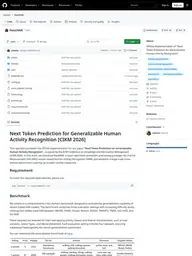
NextHAR treats IMU streams like language: a frequency-space tokenizer turns windows into motion-semantic tokens, and the model is pretrained to predict the next group of tokens across channels and time. The paper also releases a cross-domain HAR benchmark over nine public datasets in 4-, 7- and 8-activity settings (Zenodo 17498195). It reports +13.83% accuracy and +15.00% F1 over the state of the art and 0.033 s average inference latency on wearable devices.
Signals
IMU
Form factor
phone/wrist/body (benchmark mix)
License
Paper CC BY 4.0; repo has NO licence file; no weights
Year
2026
Architecture
Frequency-space sensor tokenizer → motion-semantic tokens; autoregressive pretraining that predicts the next token group, jointly modelling inter-channel correlation and temporal dependency; fine-tuned on a small labelled source set
Pretraining data
Self-supervised next-token-group prediction on the source datasets of the NextHAR cross-domain benchmark (9 public HAR datasets)
Frequency-space sensor tokenizer → motion-semantic tokens; autoregressive pretraining that predicts the next token group, jointly modelling inter-channel correlation and temporal dependency; fine-tuned on a small labelled source set
Venue
CIKM 2026 (Proc. 35th ACM CIKM, published 2026-11-06), CC BY 4.0
One major challenge of sensor-based Human Activity Recognition (HAR) is data heterogeneity, where domain shifts between training and testing data could significantly degrade recognition performance. Recently, large language models (LLMs) have demonstrated strong cross-domain generalization capabilities by modeling language with next-token prediction, offering a promising paradigm for mitigating domain shifts in HAR. In this paper, we propose NextHAR, a novel self-supervised sensor pretraining framework for generalizable HAR. NextHAR first tokenizes sensor data in the frequency space, converting them into motion-semantic tokens. Then, to learn human motion dynamics, NextHAR jointly models inter-channel correlations and temporal dependencies by predicting the next sensor token groups. Furthermore, we introduce a comprehensive cross-domain HAR benchmark to enable systematic evaluation. Extensive experiments on this benchmark show that NextHAR outperforms state-of-the-art methods by 13.83% in accuracy and 15.00% in F1-score. Moreover, NextHAR achieves an average inference latency of 0.033 seconds on wearable devices, highlighting its efficiency for real-world applications. Our code and organized benchmark are publicly available at https://github.com/saiketa/NextHAR.
It reports +13.83% accuracy and +15.00% F1 over the state of the art and 0.033 s average inference latency on wearable devices.
How it works
Datasets linked in the hub; pretraining vs evaluation roles follow the paper.
Pretraining data
Self-supervised next-token-group prediction on the source datasets of the NextHAR cross-domain benchmark (9 public HAR datasets)
Architecture
Frequency-space sensor tokenizer → motion-semantic tokens; autoregressive pretraining that predicts the next token group, jointly modelling inter-channel correlation and temporal dependency; fine-tuned on a small labelled source set
Inputs
IMU
Approach
HAR · IMU · next token prediction · tokenizer · cross domain · benchmark
Cite the publication recorded for this model. Check it against the publisher before submitting.
Cai, Y., Yu, A., Guo, B., Liu, Y., & Hong, Z. (2026). Next Token Prediction for Generalizable Human Activity Recognition (NextHAR; CIKM 2026). CIKM 2026 , CC BY 4.0. https://doi.org/10.1145/3799682.3840756
Cai, Yize, Anlan Yu, Baoshen Guo, Yunhuai Liu, and Zhiqing Hong. 2026. "Next Token Prediction for Generalizable Human Activity Recognition (NextHAR; CIKM 2026)." CIKM 2026 , CC BY 4.0. https://doi.org/10.1145/3799682.3840756.
Cai, Y., Yu, A., Guo, B., Liu, Y. and Hong, Z. (2026) 'Next Token Prediction for Generalizable Human Activity Recognition (NextHAR; CIKM 2026)', CIKM 2026 , CC BY 4.0. doi: 10.1145/3799682.3840756.
Cai, Yize, et al. "Next Token Prediction for Generalizable Human Activity Recognition (NextHAR; CIKM 2026)." CIKM 2026 , CC BY 4.0, 2026. https://doi.org/10.1145/3799682.3840756.
Y. Cai, A. Yu, B. Guo, Y. Liu, and Z. Hong, "Next Token Prediction for Generalizable Human Activity Recognition (NextHAR; CIKM 2026)," CIKM 2026 , CC BY 4.0, 2026, doi: 10.1145/3799682.3840756.
@article{cai2026next,
  title         = {{Next Token Prediction for Generalizable Human Activity Recognition (NextHAR; CIKM 2026)}},
  author        = {Cai, Yize and Yu, Anlan and Guo, Baoshen and Liu, Yunhuai and Hong, Zhiqing},
  year          = {2026},
  journal       = {CIKM 2026 , CC BY 4.0},
  doi           = {10.1145/3799682.3840756}
}
History
Added to the ChatPPG research hub
Newsletter
Get new PPG datasets, papers and models
Get alerts when NextHAR is benchmarked on new datasets, plus the weekly digest.
New datasets, papers and models
Practical guides from the hub
Unsubscribe anytime
The waveform is an illustration of a PPG pulse, not a recording.