Activity counts measure attention, not model quality. Missing counts are unknown. Publication status follows the linked source; a listed venue alone does not confirm peer review.
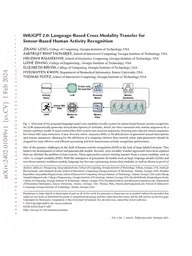
IMUGPT generates virtual IMU data from text, using large language models and text-to-motion synthesis, to train activity recognition models. This paper runs a large evaluation of the approach and adds a motion filter that drops irrelevant generated sequences and diversity metrics that show when to stop generating. The metrics cut generation effort by at least 50%.
Signals
IMU
License
CC BY 4.0
Year
2024
Published
Proceedings of the ACM on Interactive, Mobile, Wearable and Ubiquitous Technologies, 2024
Result
The authors demonstrate that their diversity metrics can reduce the effort needed for the generation of virtual IMU data by at least 50%, which opens up IMUGPT for practical use cases beyond a mere proof of concept.
One of the primary challenges in the field of human activity recognition (HAR) is the lack of large labeled datasets. This hinders the development of robust and generalizable models. Recently, cross modality transfer approaches have been explored that can alleviate the problem of data scarcity. These approaches convert existing datasets from a source modality, such as video, to a target modality (IMU). With the emergence of generative AI models such as large language models (LLMs) and text-driven motion synthesis models, language has become a promising source data modality as well as shown in proof of concepts such as IMUGPT. In this work, we conduct a large-scale evaluation of language-based cross modality transfer to determine their effectiveness for HAR. Based on this study, we introduce two new extensions for IMUGPT that enhance its use for practical HAR application scenarios: a motion filter capable of filtering out irrelevant motion sequences to ensure the relevance of the generated virtual IMU data, and a set of metrics that measure the diversity of the generated data facilitating the determination of when to stop generating virtual IMU data for both effective and efficient processing. We demonstrate that our diversity metrics can reduce the effort needed for the generation of virtual IMU data by at least 50%, which open up IMUGPT for practical use cases beyond a mere proof of concept.
Verbatim fromarXiv· arXiv metadata (abstracts are released under CC0)
How it works
Datasets linked in the hub; pretraining vs evaluation roles follow the paper.
Inputs
IMU
Approach
IMU · HAR · synthetic data · IMUGPT · LLM · Georgia Tech
Cite the publication recorded for this model. Check it against the publisher before submitting.
Leng, Z., Bhattacharjee, A., Rajasekhar, H., Zhang, L., Bruda, E., Kwon, H., & Plötz, T. (2024). IMUGPT 2.0: Language-Based Cross Modality Transfer for Sensor-Based Human Activity Recognition. Proceedings of the ACM on Interactive, Mobile, Wearable and Ubiquitous Technologies. https://doi.org/10.1145/3678545
Leng, Zikang, Amitrajit Bhattacharjee, Hrudhai Rajasekhar, Lizhe Zhang, Elizabeth Bruda, Hyeokhyen Kwon, and Thomas Plötz. 2024. "IMUGPT 2.0: Language-Based Cross Modality Transfer for Sensor-Based Human Activity Recognition." Proceedings of the ACM on Interactive, Mobile, Wearable and Ubiquitous Technologies. https://doi.org/10.1145/3678545.
Leng, Z., Bhattacharjee, A., Rajasekhar, H., Zhang, L., Bruda, E., Kwon, H. and Plötz, T. (2024) 'IMUGPT 2.0: Language-Based Cross Modality Transfer for Sensor-Based Human Activity Recognition', Proceedings of the ACM on Interactive, Mobile, Wearable and Ubiquitous Technologies. doi: 10.1145/3678545.
Leng, Zikang, et al. "IMUGPT 2.0: Language-Based Cross Modality Transfer for Sensor-Based Human Activity Recognition." Proceedings of the ACM on Interactive, Mobile, Wearable and Ubiquitous Technologies, 2024. https://doi.org/10.1145/3678545.
Z. Leng et al., "IMUGPT 2.0: Language-Based Cross Modality Transfer for Sensor-Based Human Activity Recognition," Proceedings of the ACM on Interactive, Mobile, Wearable and Ubiquitous Technologies, 2024, doi: 10.1145/3678545.
@inproceedings{leng2024imugpt,
  title         = {{IMUGPT 2.0: Language-Based Cross Modality Transfer for Sensor-Based Human Activity Recognition}},
  author        = {Leng, Zikang and Bhattacharjee, Amitrajit and Rajasekhar, Hrudhai and Zhang, Lizhe and Bruda, Elizabeth and Kwon, Hyeokhyen and Plötz, Thomas},
  year          = {2024},
  booktitle     = {Proceedings of the ACM on Interactive, Mobile, Wearable and Ubiquitous Technologies},
  doi           = {10.1145/3678545},
  eprint        = {2402.01049},
  archivePrefix = {arXiv}
}
History
Record updated
Added to the ChatPPG research hub
Newsletter
Get new PPG datasets, papers and models
Get alerts when IMUGPT is benchmarked on new datasets, plus the weekly digest.
New datasets, papers and models
Practical guides from the hub
Unsubscribe anytime
The waveform is an illustration of a PPG pulse, not a recording.