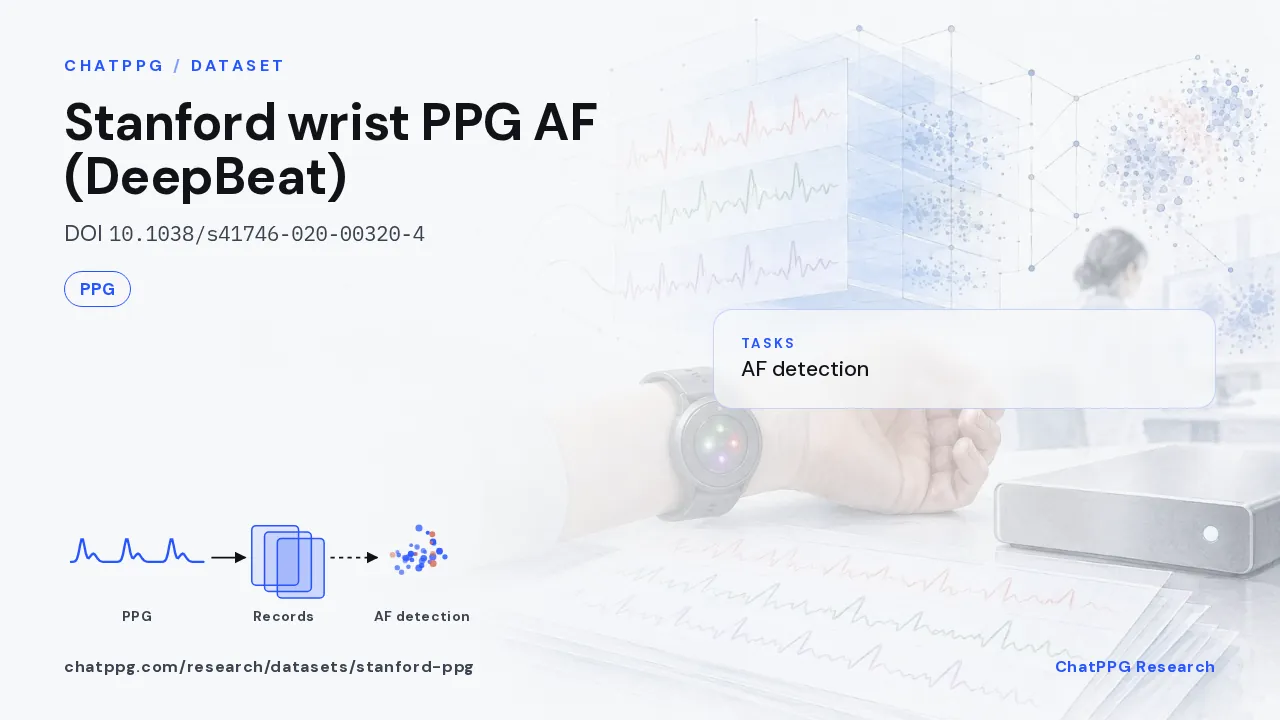
The Stanford DeepBeat dataset is a wrist PPG dataset for atrial fibrillation detection and signal quality assessment. It was released with "Multi-task deep learning for cardiac rhythm detection in wearable devices" by Jessica Torres-Soto and Euan A. Ashley in npj Digital Medicine 3:116 (2020).
The paper starts from a gap in commercial wearables. AF detection from the wrist has great potential, but commercial algorithms are proprietary and tend to rely on heart rate variability from green LED sensors, where noise remains a problem. DeepBeat is a multitask deep learning model that judges signal quality and detects AF at the same time from wearable PPG.
The real-world data was collected at Stanford University from two groups who wore a wrist-based PPG device: patients with AF undergoing elective direct current cardioversion, and adults scheduled for an elective exercise stress test. Of 132 cardioversion participants recruited, 107 had data of sufficient duration and quality, with about 20 minutes of monitoring before and after the procedure. All signals were sampled at 128 Hz. The public IEEE Signal Processing Cup 2015 dataset was added to supplement these. Data from each person was split into 25-second non-overlapping windows.
The model was pretrained on approximately one million simulated unlabeled signals and then fine-tuned on over 500 K labeled signals from over 100 individuals and 3 different wearable devices. Compared with a single-task model, unsupervised transfer learning through convolutional denoising autoencoders raised AF detection F1 from 0.54 to 0.96. In a prospective replication cohort of ambulatory participants, the model reached sensitivity 0.98, specificity 0.99 and F1 0.93. That ambulatory cohort is not public.
The train, validate and test partitions used for DeepBeat are shared on Synapse (ID syn21985690) under a non-commercial data use agreement. The code and trained models, with Jupyter notebooks for reproducibility, are on GitHub (AshleyLab/deepbeat) under GPL-3.0.
The hub lists this dataset on its AF leaderboard. It is one of the few public wrist PPG sets with expert rhythm labels and quality labels together, which makes it a standard comparison for wearable AF detection.
Sampling
128 Hz; 25-second windows
Labeled data
over 500 K signals from over 100 individuals, 3 devices
Wearable devices enable theoretically continuous, longitudinal monitoring of physiological measurements such as step count, energy expenditure, and heart rate. Although the classification of abnormal cardiac rhythms such as atrial fibrillation from wearable devices has great potential, commercial algorithms remain proprietary and tend to focus on heart rate variability derived from green spectrum LED sensors placed on the wrist, where noise remains an unsolved problem. Here we develop DeepBeat, a multitask deep learning method to jointly assess signal quality and arrhythmia event detection in wearable photoplethysmography devices for real-time detection of atrial fibrillation. The model is trained on approximately one million simulated unlabeled physiological signals and fine-tuned on a curated dataset of over 500 K labeled signals from over 100 individuals from 3 different wearable devices. We demonstrate that, in comparison with a single-task model, our architecture using unsupervised transfer learning through convolutional denoising autoencoders dramatically improves the performance of atrial fibrillation detection from a F1 score of 0.54 to 0.96. We also include in our evaluation a prospectively derived replication cohort of ambulatory participants where the algorithm performed with high sensitivity (0.98), specificity (0.99), and F1 score (0.93). We show that two-stage training can help address the unbalanced data problem common to biomedical applications, where large-scale well-annotated datasets are hard to generate due to the expense of manual annotation, data acquisition, and participant privacy.
This Synapse release supports Torres-Soto and Ashley’s DeepBeat work (npj Digital Medicine, 2020): multi-task deep learning for cardiac rhythm detection from wearable PPG. The public test windows are bandpass-filtered and downsampled to 32 Hz as 25 s × 800-sample arrays in test.npz. Source recordings were 128 Hz in the Stanford cohorts (125 Hz for an IEEE SPC 2015 supplement). Data use is non-commercial under a Synapse agreement; code is GPL-3.0.
What's inside
Task
Atrial fibrillation / rhythm detection from wrist PPG
Source 128 Hz (Stanford cohorts) / 125 Hz (IEEE SPC 2015 supplement); released windows bandpass-filtered and downsampled by 4 — 25 s × 800 samples (32 Hz) in test.npz
How it works
Sampling
Source 128 Hz (Stanford cohorts) / 125 Hz (IEEE SPC 2015 supplement); released windows bandpass-filtered and downsampled by 4 — 25 s × 800 samples (32 Hz) in test.npz
Where do I download the Stanford DeepBeat PPG dataset?
From Synapse project syn21985690 after accepting the non-commercial data use agreement.
What paper describes this dataset?
Torres-Soto J, Ashley EA. Multi-task deep learning for cardiac rhythm detection in wearable devices. npj Digital Medicine 3, 116 (2020). DOI 10.1038/s41746-020-00320-4.
Can I use the Stanford PPG AF data commercially?
No under the published Synapse non-commercial data use agreement. The accompanying code is GPL-3.0.
What is the Stanford DeepBeat dataset?
It is a wrist PPG dataset for AF detection and signal quality, built from Stanford cardioversion and exercise stress test cohorts at 128 Hz plus the IEEE Signal Processing Cup 2015 data.
How do I download the DeepBeat dataset?
The train, validate and test partitions are on Synapse (ID syn21985690) under a non-commercial data use agreement. Code is at https://github.com/AshleyLab/deepbeat.
Stanford DeepBeat vs MIMIC-III-Ext-PPG for AF?
DeepBeat data comes from wrist wearables with quality labels. MIMIC-III-Ext-PPG comes from ICU bedside monitors and is much larger, with 597,769 AF segments.
What are DeepBeat benchmark results?
DeepBeat raised AF detection F1 from 0.54 for a single-task model to 0.96, and reached sensitivity 0.98, specificity 0.99 and F1 0.93 in a prospective ambulatory cohort.
Cite this dataset
This citation is the paper recorded with this dataset. Check it against the publisher before submitting.
Torres-Soto, J., & Ashley, E. A. (2020). Multi-task deep learning for cardiac rhythm detection in wearable devices. npj Digital Medicine, 3(1). https://doi.org/10.1038/s41746-020-00320-4
Torres-Soto, Jessica and Euan A. Ashley. 2020. "Multi-task deep learning for cardiac rhythm detection in wearable devices." npj Digital Medicine 3 (1). https://doi.org/10.1038/s41746-020-00320-4.
Torres-Soto, J. and Ashley, E. A. (2020) 'Multi-task deep learning for cardiac rhythm detection in wearable devices', npj Digital Medicine, 3(1). doi: 10.1038/s41746-020-00320-4.
Torres-Soto, Jessica, and Euan A. Ashley "Multi-task deep learning for cardiac rhythm detection in wearable devices." npj Digital Medicine, vol. 3, no. 1, 2020. https://doi.org/10.1038/s41746-020-00320-4.
J. Torres-Soto and E. A. Ashley, "Multi-task deep learning for cardiac rhythm detection in wearable devices," npj Digital Medicine, vol. 3, no. 1, 2020, doi: 10.1038/s41746-020-00320-4.
@article{torressoto2020multitask,
  title         = {{Multi-task deep learning for cardiac rhythm detection in wearable devices}},
  author        = {Torres-Soto, Jessica and Ashley, Euan A.},
  year          = {2020},
  journal       = {npj Digital Medicine},
  volume        = {3},
  number        = {1},
  publisher     = {Springer Science and Business Media LLC},
  doi           = {10.1038/s41746-020-00320-4}
}
Cite the ChatPPG record
Cite the dated snapshot 2026-10 for a fixed, reproducible version. Please also cite the original publications listed above.
APA
ChatPPG. (2026). Stanford wrist PPG AF (DeepBeat): dataset record (Version 2026-10) [Data set]. ChatPPG Research Hub. https://chatppg.com/research/datasets/stanford-ppg
BibTeX
@misc{chatppg_dataset_stanford_ppg,
  author       = {{ChatPPG}},
  title        = {{Stanford wrist PPG AF (DeepBeat): dataset record}},
  year         = {2026},
  month        = nov,
  version      = {2026-10},
  howpublished = {\url{https://chatppg.com/research/datasets/stanford-ppg}},
  note         = {ChatPPG Research Hub, Snapshot 2026-10, https://chatppg.com/research/snapshots/2026-10}
}
CITATION.cff
cff-version: 1.2.0
message: "If you use this resource, please cite it as below."
type: dataset
title: "Stanford wrist PPG AF (DeepBeat): dataset record"
authors:
  - name: "ChatPPG"
url: "https://chatppg.com/research/datasets/stanford-ppg"
repository-artifact: "https://chatppg.com/research/snapshots/2026-10"
version: "2026-10"
date-released: "2026-11-26"
History
Record updated
Newsletter
Get new PPG datasets, papers and models
Get alerts when new models are benchmarked on Stanford wrist PPG AF (DeepBeat), plus the weekly digest.
New datasets, papers and models
Practical guides from the hub
Unsubscribe anytime
The waveform is an illustration of a PPG pulse, not a recording.