Dataset

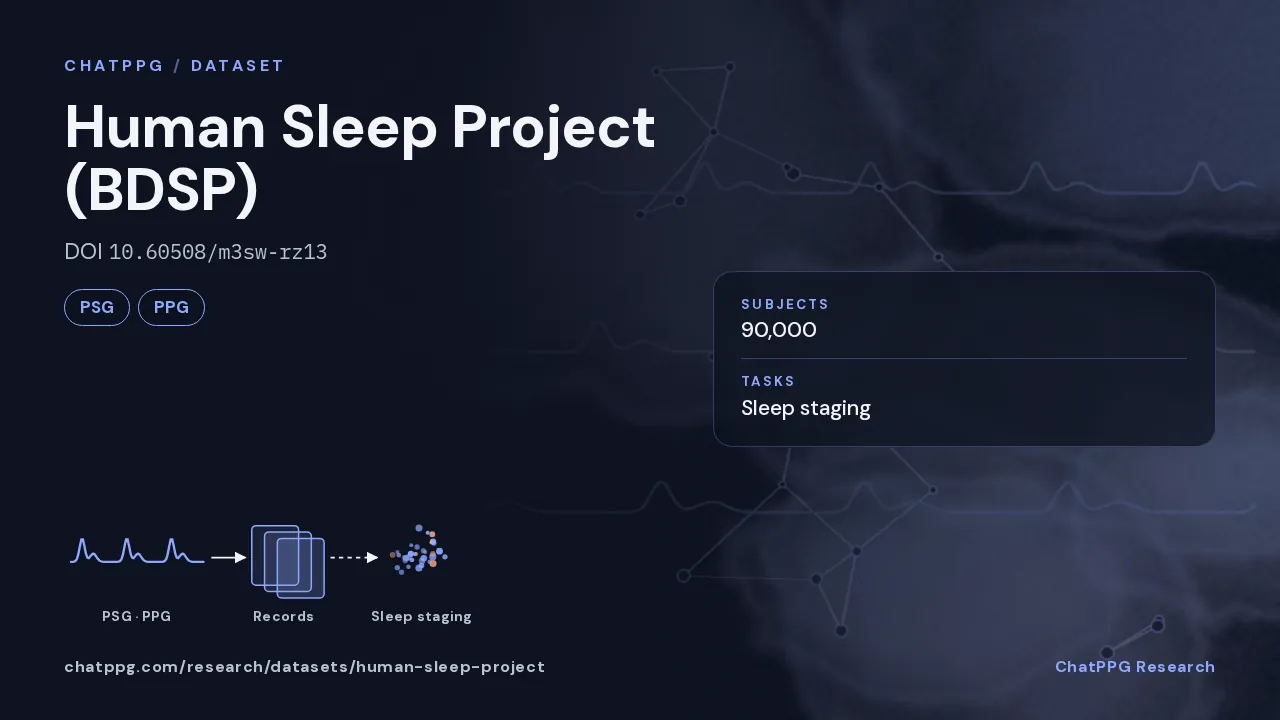
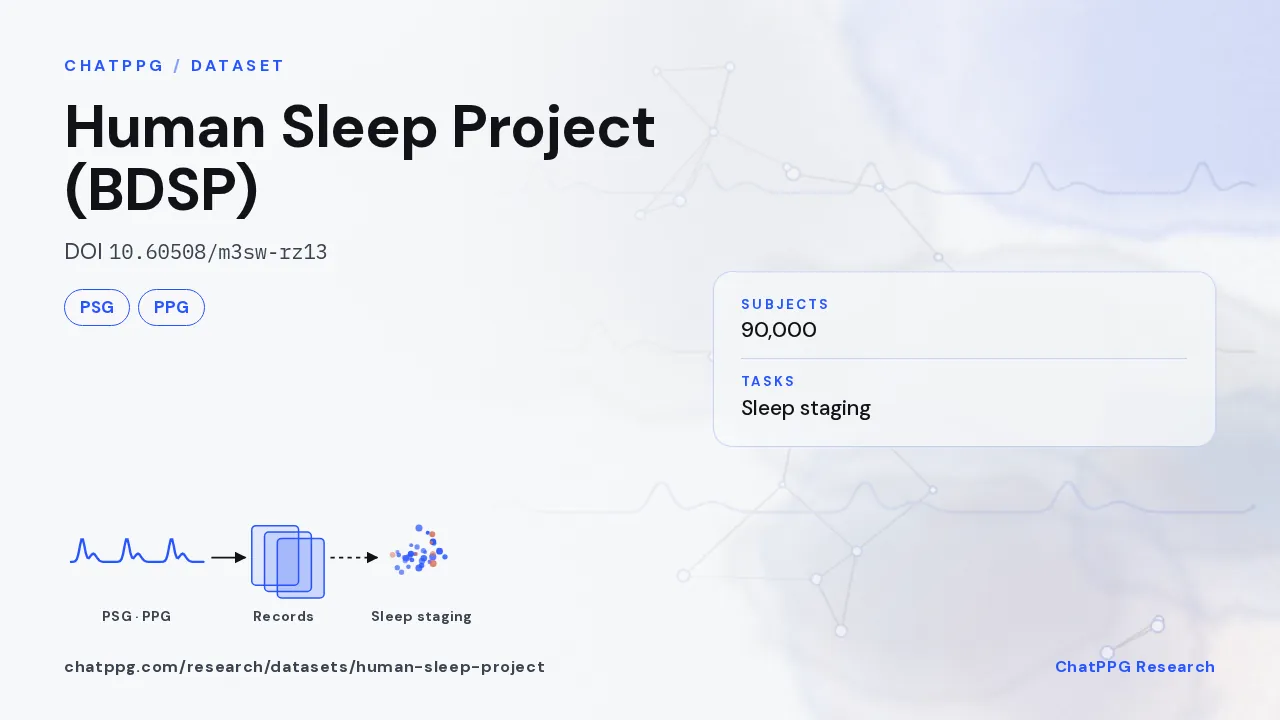
Human Sleep Project (BDSP)

multi-site clinical PSG

Restricted BDSP dataset; access needs BDSP credentialing plus the Credentialed Health DUA. v3.0 published 2026-06-02 (Li, Wen, Sun, Ganglberger, … Westover), DOI 10.60508/m3sw-rz13; earlier v2.0 DOI 10.60508/qjbv-hg78 (cited by AnyPPG). Data in BIDS layout with HDF5 signals, linked to de-identified demographics and EHR (22 ICD-10 categories).

At a glance
Type
Dataset
Licence
Not reported
Access
Not reported
Subjects
90,000
Signals
PPGPSG
PPG sites
Finger
Setting
Sleep lab
Wrist
No
Raw waveforms
Yes
Models
Updated
Nov 26, 2026

Original description

Study objectives: Sleep research has been hindered by existing polysomnography (PSG) datasets being typically single-center, age-specific, or epidemiological data with limited scale and health-relevant diversity, reducing generalizability. The goal here is to assemble a large multi-center clinical PSG dataset, enabling scalable and generalizable research in sleep medicine and clinical neuroscience.

Methods: The Human Sleep Project (HSP) dataset, 119,234 overnight sleep recordings from more than 90,000 unique patients, integrates clinical PSG data collected from five major academic medical centers across the United States (sites are de-identified and referenced by cohort ID). The studies include a standard attended polysomnography montage at a minimum, as well as both clinical annotations and automatically generated standard annotations. The data are organized according to the Brain Imaging Data Structure (BIDS) standard and linked with de-identified demographic and electronic health record (EHR) information.

Results: The resulting HSP dataset spans the full human lifespan (infancy to age >90 years), and links PSG data to diagnoses across 22 distinct ICD-10 clinical categories, including neurology, cardiology, and endocrinology. The aggregated data reveal consistent, age-dependent changes in sleep architecture, e.g., with increased age, a decrease in total sleep time and N3, and an increase in the stage shift derived Sleep Fragmentation Index (SFI). The standardization process successfully harmonized technical and scoring heterogeneity across sites, providing a consistent resource for large-scale analysis.

Conclusions: The Human Sleep Project releases harmonized signals, manual and automated annotations, and per-session quality metadata for 119,234 overnight sleep recordings (115,129 full polysomnograms and 4,105 home sleep apnea tests) across five centers, enabling reproducible sleep research at a scale not previously available.

Verbatim fromDataCite· Description as registered with DataCite

Human Sleep Project (BDSP): ChatPPG research summary card

Key numbers

90,000
Subjects
1
Reference labels
SLEEP STAGING
200 Hz
Released sampling rate
Native site-dependent rates preserved in EDF headers; planned HDF5 derivative resampled to 200 Hz

How it works

How Human Sleep Project (BDSP) works: Devices & body sites → Signals recorded → TasksDevices & body sites: Finger (PPG site). Signals recorded: Human Sleep Project (BDSP), 90,000 subjects · 200 Hz, signals PPG, PSG. Tasks: Sleep staging.Devices & body sitesFinger: PPG siteFingerPPG siteSignals recordedHuman Sleep Project (BDSP)90,000 subjects · 200 HzPPGPSGTasksSleep stagingSleep staging
Sampling
Native site-dependent rates preserved in EDF headers; planned HDF5 derivative resampled to 200 Hz
Reference labels
sleep staging

Papers and models using this dataset· 2

#95 of 186 most-used datasets by published papers and models · #48 of 88 PPG

FAQ

How many subjects are in Human Sleep Project?

Human Sleep Project has data from 90,000 subjects, as listed in its research record.

What signals does Human Sleep Project include?

Human Sleep Project includes polysomnography (PSG) and PPG data. Raw waveforms are included.

What can Human Sleep Project be used for?

Research tasks it supports: sleep staging. Reference labels: sleep staging.

How do I get Human Sleep Project, and what is its licence?

It is available from https://bdsp.io/content/hsp/3.0/. No licence is recorded for it here, so check the terms on the source page before you use it.

Which models and papers in the ChatPPG research hub use Human Sleep Project?

The hub links it to models: AnyPPG; 1 paper, including "AnyPPG: An ECG-Guided PPG Foundation Model Trained on Over 100,000 Hours of Recordings for Holistic Health Profiling". They are listed under Related on this page.

Cite this dataset

Cite this dataset with the fields recorded here. Check it against the publisher before submitting.

Human Sleep Project (BDSP) [Data set]. (n.d.). bdsp. https://doi.org/10.60508/m3sw-rz13
@misc{humansleepprojechuman,
  title         = {{Human Sleep Project (BDSP)}},
  howpublished  = {bdsp},
  doi           = {10.60508/m3sw-rz13}
}

Cite the ChatPPG record

Cite the dated snapshot 2026-10 for a fixed, reproducible version. Please also cite the original publications listed above.

APA

ChatPPG. (2026). Human Sleep Project (BDSP): dataset record (Version 2026-10) [Data set]. ChatPPG Research Hub. https://chatppg.com/research/datasets/human-sleep-project

BibTeX
@misc{chatppg_dataset_human_sleep_project,
  author       = {{ChatPPG}},
  title        = {{Human Sleep Project (BDSP): dataset record}},
  year         = {2026},
  month        = nov,
  version      = {2026-10},
  howpublished = {\url{https://chatppg.com/research/datasets/human-sleep-project}},
  note         = {ChatPPG Research Hub, Snapshot 2026-10, https://chatppg.com/research/snapshots/2026-10}
}
CITATION.cff
cff-version: 1.2.0
message: "If you use this resource, please cite it as below."
type: dataset
title: "Human Sleep Project (BDSP): dataset record"
authors:
  - name: "ChatPPG"
url: "https://chatppg.com/research/datasets/human-sleep-project"
repository-artifact: "https://chatppg.com/research/snapshots/2026-10"
version: "2026-10"
date-released: "2026-11-26"

History

  1. Record updated