PaperarXiv:2509.10151
BenchECG and xECG: a benchmark and baseline for ECG foundation models (xLSTM)
npj Digital Medicine
TL;DR
BenchECG is an open, standardised benchmark for ECG foundation models built from eight public datasets covering 421,171 patients and 1,674,704 recordings. It tests ten kinds of task, including classification, detection, regression, survival analysis and segmentation, with explicit out-of-distribution tests. The paper also introduces xECG, an xLSTM-based baseline model.
- Benchmark: 8 public datasets, 421,171 patients, 1,674,704 recordings
- Tasks: 10 (classification, detection, regression, survival, segmentation)
- Baseline: xECG (xLSTM)
- xECG fine-tuned 0.928, linear probe 0.879.
Abstract
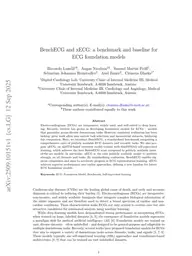
Electrocardiograms (ECGs) are inexpensive, widely used, and well-suited to deep learning. Recently, interest has grown in developing foundation models for ECGs - models that generalise across diverse downstream tasks. However, consistent evaluation has been lacking: prior work often uses narrow task selections and inconsistent datasets, hindering fair comparison. Here, we introduce BenchECG, a standardised benchmark comprising a comprehensive suite of publicly available ECG datasets and versatile tasks. We also propose xECG, an xLSTM-based recurrent model trained with SimDINOv2 self-supervised learning, which achieves the best BenchECG score compared to publicly available state-of-the-art models. In particular, xECG is the only publicly available model to perform strongly on all datasets and tasks. By standardising evaluation, BenchECG enables rigorous comparison and aims to accelerate progress in ECG representation learning. xECG achieves superior performance over earlier approaches, defining a new baseline for future ECG foundation models.
Verbatim from arXiv (opens in a new tab) · arXiv metadata (abstracts are released under CC0)
Results on ChatPPG leaderboards · 3
All leaderboards| Leaderboard | Method | Result | Rank |
|---|---|---|---|
| Stanford wrist PPG AF (DeepBeat) AUROCAtrial fibrillation detection | xECG | 0.883AUROC, higher is better | #1 of 2 |
| Stanford wrist PPG AF (DeepBeat) AUROCAtrial fibrillation detection | xECG | 0.751AUROC, higher is better | #2 of 2 |
| Sleep apnea task, long context AUROCSleep apnea (OSA) screening | ECG-CPCCaveat: xECG fine-tuned 0.928, linear probe 0.879. | 0.935AUROC, higher is better | Unranked |
3 rows are credited to this paper. Ranks apply within each leaderboard only, as reported by the source.
Tasks & signals
Tasks
Signals
Keywords
Datasets used
- CPSC2018 (China Physiological Signal Challenge 2018): 12-lead ECG arrhythmia set, redistributed in PhysioNet Challenge 2020ECG
 St Petersburg INCART 12-lead Arrhythmia Database (PhysioNet)ECG
 MIMIC-IV-ECGDiagnostic Electrocardiogram Matched Subset (v1.0)160,000 subjects · ECG
 PTB-XL21,799 clinical 12-lead ECGs (PhysioNet)18,869 subjects · ECG
 Stanford wrist PPG AF (DeepBeat)Torres-Soto & Ashley 2020, Synapse syn21985690PPG
Models
How it works
Cite this paper
Lunelli, R., Nicolson, A., Pröll, S. M., Reinstadler, S. J., Bauer, A., & Dlaska, C. (2026). BenchECG and xECG: a benchmark and baseline for ECG foundation models (xLSTM). npj Digital Medicine. https://doi.org/10.1038/s41746-026-03196-y
Lunelli, Riccardo, Angus Nicolson, Samuel Martin Pröll, Sebastian Johannes Reinstadler, Axel Bauer, and Clemens Dlaska. 2026. "BenchECG and xECG: a benchmark and baseline for ECG foundation models (xLSTM)." npj Digital Medicine. https://doi.org/10.1038/s41746-026-03196-y.
Lunelli, R., Nicolson, A., Pröll, S. M., Reinstadler, S. J., Bauer, A. and Dlaska, C. (2026) 'BenchECG and xECG: a benchmark and baseline for ECG foundation models (xLSTM)', npj Digital Medicine. doi: 10.1038/s41746-026-03196-y.
Lunelli, Riccardo, et al. "BenchECG and xECG: a benchmark and baseline for ECG foundation models (xLSTM)." npj Digital Medicine, 2026. https://doi.org/10.1038/s41746-026-03196-y.
R. Lunelli, A. Nicolson, S. M. Pröll, S. J. Reinstadler, A. Bauer, and C. Dlaska, "BenchECG and xECG: a benchmark and baseline for ECG foundation models (xLSTM)," npj Digital Medicine, 2026, doi: 10.1038/s41746-026-03196-y.
@article{lunelli2026benchecg,
  title         = {{BenchECG and xECG: a benchmark and baseline for ECG foundation models (xLSTM)}},
  author        = {Lunelli, Riccardo and Nicolson, Angus and Pröll, Samuel Martin and Reinstadler, Sebastian Johannes and Bauer, Axel and Dlaska, Clemens},
  year          = {2026},
  journal       = {npj Digital Medicine},
  doi           = {10.1038/s41746-026-03196-y},
  eprint        = {2509.10151},
  archivePrefix = {arXiv}
}Record updated
Added to the ChatPPG research hub