PaperarXiv:2504.02735
Reliable Physiological Monitoring on the Wrist Using Generative Deep Learning to Address Poor Skin-Sensor Contact
arXiv preprint (cs.HC, cs.LG)
 (opens in a new tab)
Hung, Manh Pham et al., "Reliable Physiological Monitoring on the Wrist Using Generative Deep Learning to Address Poor Skin-Sensor Contact", arXiv:2504.02735, CC BY 4.0
TL;DR
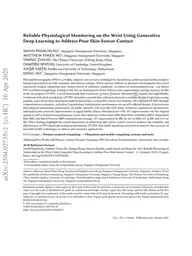
Photoplethysmography (PPG) is a widely adopted, non-invasive technique for monitoring cardiovascular health and physiological parameters in both consumer and clinical settings. While motion artifacts in dynamic environments have been extensively studied, suboptimal skin-sensor contact in sedentary conditions - a critical yet underexplored issue - can distort PPG waveform morphology, leading to the loss or misalignment of key features and compromising sensing accuracy. CP-PPG integrates a custom data collection protocol, a carefully designed signal processing pipeline, and a novel deep adversarial model trained with a custom PPG-aware loss function.
- Form factor: wrist
Abstract
Photoplethysmography (PPG) is a widely adopted, non-invasive technique for monitoring cardiovascular health and physiological parameters in both consumer and clinical settings. While motion artifacts in dynamic environments have been extensively studied, suboptimal skin-sensor contact in sedentary conditions - a critical yet underexplored issue - can distort PPG waveform morphology, leading to the loss or misalignment of key features and compromising sensing accuracy. In this work, we propose CP-PPG, a novel framework that transforms Contact Pressure-distorted PPG signals into high-fidelity waveforms with ideal morphology. CP-PPG integrates a custom data collection protocol, a carefully designed signal processing pipeline, and a novel deep adversarial model trained with a custom PPG-aware loss function. We validated CP-PPG through comprehensive evaluations, including 1) morphology transformation performance on our self-collected dataset, 2) downstream physiological monitoring performance on public datasets, and 3) in-the-wild study. Extensive experiments demonstrate substantial and consistent improvements in signal fidelity (Mean Absolute Error: 0.09, 40% improvement over the original signal) as well as downstream performance across all evaluations in Heart Rate (HR), Heart Rate Variability (HRV), Respiration Rate (RR), and Blood Pressure (BP) estimation (on average, 21% improvement in HR; 41-46% in HRV; 6% in RR; and 4-5% in BP). These findings highlight the critical importance of addressing skin-sensor contact issues to enhance the reliability and effectiveness of PPG-based physiological monitoring. CP-PPG thus holds significant potential to improve the accuracy of wearable health technologies in clinical and consumer applications.
Verbatim from arXiv (opens in a new tab) · arXiv metadata (abstracts are released under CC0)
Results on ChatPPG leaderboards
All leaderboardsNo results from this paper on ChatPPG leaderboards yet. Browse the leaderboards.
Tasks & signals
Tasks
Signals
Keywords
How it works
Cite this paper
APA
Hung, M. P., Ho, M. Y., Zhang, Y., Spathis, D., Saeed, A., & Ma, D. (2025). Reliable Physiological Monitoring on the Wrist Using Generative Deep Learning to Address Poor Skin-Sensor Contact. arXiv preprint. https://doi.org/10.48550/arXiv.2504.02735
BibTeX
@misc{hung2025reliable,
  title         = {{Reliable Physiological Monitoring on the Wrist Using Generative Deep Learning to Address Poor Skin-Sensor Contact}},
  author        = {Hung, Manh Pham and Ho, Matthew Yiwen and Zhang, Yiming and Spathis, Dimitris and Saeed, Aaqib and Ma, Dong},
  year          = {2025},
  howpublished  = {arXiv preprint},
  doi           = {10.48550/arXiv.2504.02735},
  eprint        = {2504.02735},
  archivePrefix = {arXiv}
}
Built from the hub record. Check it against the publisher before submitting.
Added to the ChatPPG research hub