Cite this dataset
MOODS [Data set]. (n.d.). private. https://doi.org/10.1145/3613904.3642662
@misc{moodsfieldstressmoods,
  title         = {{MOODS}},
  howpublished  = {private},
  doi           = {10.1145/3613904.3642662}
}Mobile Open Observation of Daily Stressors (Fossil Sport WearOS watch, 100-day field study; private)
Neupane et al., "Momentary Stressor Logging and Reflective Visualizations", CHI '24 (DOI 10.1145/3613904.3642662; arXiv 2401.16307). Participants wore a Fossil Sport WearOS watch for 100 days; the watch triggered stress prompts when physiology suggested stress, and participants logged stressors and rated stress. IRB approved.
Commercial wearables from Fitbit, Garmin, and Whoop have recently introduced real-time notifications based on detecting changes in physiological responses indicating potential stress. In this paper, we investigate how these new capabilities can be leveraged to improve stress management. We developed a smartwatch app, a smartphone app, and a cloud service, and conducted a 100-day field study with 122 participants who received prompts triggered by physiological responses several times a day. They were asked whether they were stressed, and if so, to log the most likely stressor. Each week, participants received new visualizations of their data to self-reflect on patterns and trends. Participants reported better awareness of their stressors, and self-initiating fourteen kinds of behavioral changes to reduce stress in their daily lives. Repeated self-reports over 14 weeks showed reductions in both stress intensity (in 26,521 momentary ratings) and stress frequency (in 1,057 weekly surveys).
Verbatim fromSemantic Scholar· Abstract via Semantic Scholar; © the authors/publisher
 ProtoMM: Shared Prototypes for a Multimodal Pulse-Motion Foundation ModelarXiv preprint · 2025
 Pulse-PPG: An Open-Source Field-Trained PPG Foundation Model for Wearable Applications Across Lab and Field SettingsProceedings of the ACM on Interactive, Mob · 2025
#41 of 186 most-used datasets by published papers and models · #19 of 88 PPG · #20 of 84 IMU
Browse these 3 papers in the research explorer (filtered to MOODS)
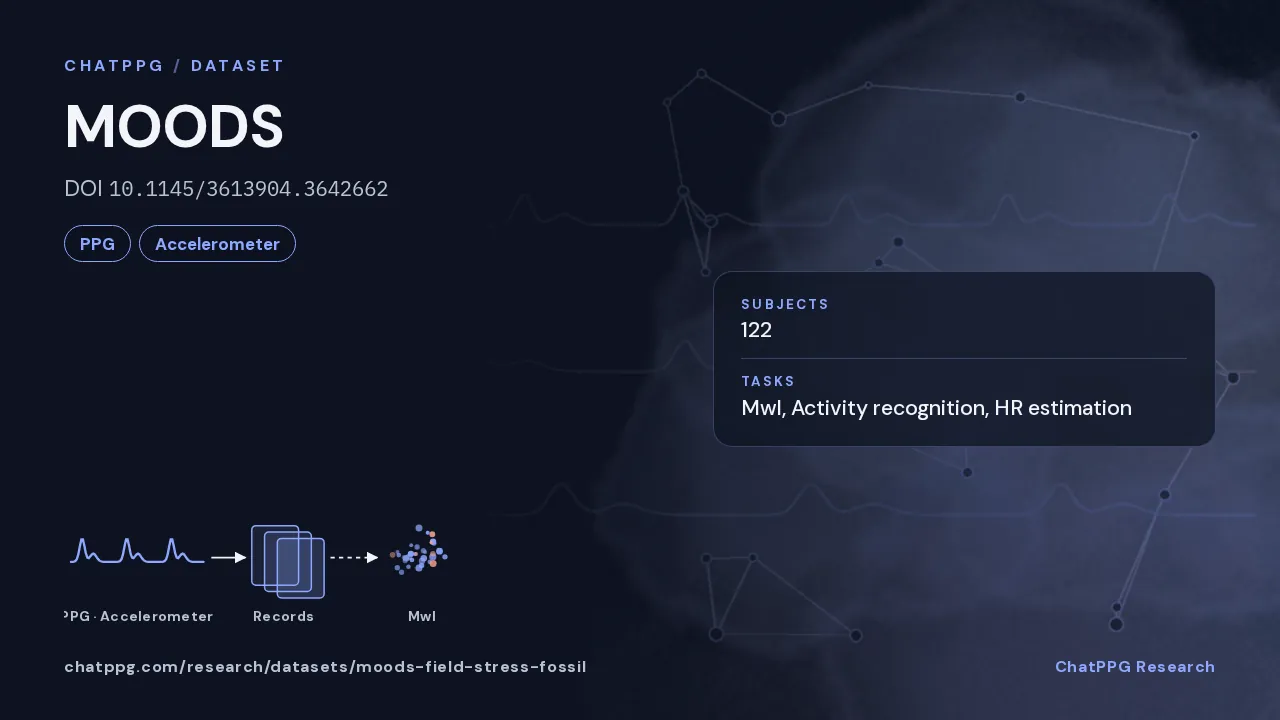
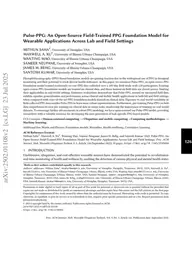
MOODS has data from 122 subjects, as listed in its research record.
MOODS includes PPG and accelerometer data. Sampling rate as recorded: PPG 100 Hz raw (Pulse-PPG uses it at 50 Hz); accel rate not stated. Raw waveforms are included.
Research tasks it supports: mental workload assessment, human activity recognition, heart rate estimation and stress detection. Reference labels: stress, ema and activity.
It is available from https://doi.org/10.1145/3613904.3642662. No licence is recorded for it here, so check the terms on the source page before you use it.
The hub links it to models: ProtoMM (Pulse-Motion), Pulse-PPG and TEX-MEX; 2 papers, including "Pulse-PPG: An Open-Source Field-Trained PPG Foundation Model for Wearable Applications Across Lab and Field Settings". They are listed under Related on this page.
MOODS [Data set]. (n.d.). private. https://doi.org/10.1145/3613904.3642662
@misc{moodsfieldstressmoods,
title = {{MOODS}},
howpublished = {private},
doi = {10.1145/3613904.3642662}
}Cite the dated snapshot 2026-10 for a fixed, reproducible version. Please also cite the original publications listed above.
ChatPPG. (2026). MOODS: dataset record (Version 2026-10) [Data set]. ChatPPG Research Hub. https://chatppg.com/research/datasets/moods-field-stress-fossil
@misc{chatppg_dataset_moods_field_stress_fossil,
  author       = {{ChatPPG}},
  title        = {{MOODS: dataset record}},
  year         = {2026},
  month        = nov,
  version      = {2026-10},
  howpublished = {\url{https://chatppg.com/research/datasets/moods-field-stress-fossil}},
  note         = {ChatPPG Research Hub, Snapshot 2026-10, https://chatppg.com/research/snapshots/2026-10}
}cff-version: 1.2.0 message: "If you use this resource, please cite it as below." type: dataset title: "MOODS: dataset record" authors: - name: "ChatPPG" url: "https://chatppg.com/research/datasets/moods-field-stress-fossil" repository-artifact: "https://chatppg.com/research/snapshots/2026-10" version: "2026-10" date-released: "2026-11-20"
Record updated