Activity counts measure attention, not model quality. Missing counts are unknown. Publication status follows the linked source; a listed venue alone does not confirm peer review.
Two views per signal (long/high-rate and short/low-rate via crop + downsample); masked reconstruction within each view plus a cross-resolution objective (long-view visible tokens predict short-view masked tokens). Matches or beats controlled FM baselines on eight HAR datasets (OpenWatch, WatchHand, MotionSense, MobiAct, HARTH, RealWorld, PAAWS-SimFL, Capture-24) with one encoder. Sizes: Small 0.7M params; scaled 3.82M; Medium/Large variants in the paper.
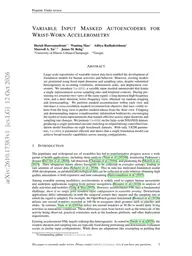
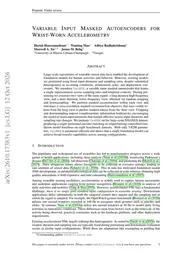
Large-scale repositories of wearable sensor data have enabled the development of foundation models for human activities and behavior. However, existing models are pretrained using fixed input durations and sampling rates, despite substantial heterogeneity in recording conditions, downstream tasks, and deployment constraints. We introduce VarMAE, a variable input masked autoencoder that learns a single representation across sampling rates and temporal contexts. During pretraining we construct two views of the same signal: a long duration high frequency view, and a short duration lower frequency view, obtained via random cropping and downsampling. We perform masked reconstruction within each view and introduce a cross-resolution masked reconstruction objective that uses visible tokens from the long view to predict masked tokens from the short view. Cropping and downsampling impose complementary information bottlenecks, encouraging the model to learn representations that remain effective across input durations and sampling rate changes. We pretrain VarMAE on the large-scale NHANES dataset, producing a single pretrained encoder matching or outperforming controlled foundation model baselines on eight benchmark datasets. With only 3.82M parameters, VarMAE is parameter efficient and shows that a single foundation model can achieve broad transfer capabilities across sensing configurations.
Verbatim fromarXiv· arXiv metadata (abstracts are released under CC0)
How it works
Datasets linked in the hub; pretraining vs evaluation roles follow the paper.
Cite the publication recorded for this model. Check it against the publisher before submitting.
Haresamudram, H., Mao, W., Radhakrishnan, A., Xu, M. A., & Rehg, J. M. (2026). Variable Input Masked Autoencoders for Wrist-Worn Accelerometry (VarMAE). ICLR 2027 submission. https://arxiv.org/abs/2610.17383
Haresamudram, Harish, Wanting Mao, Aditya Radhakrishnan, Maxwell A. Xu, and James M. Rehg. 2026. "Variable Input Masked Autoencoders for Wrist-Worn Accelerometry (VarMAE)." ICLR 2027 submission. https://arxiv.org/abs/2610.17383.
Haresamudram, H., Mao, W., Radhakrishnan, A., Xu, M. A. and Rehg, J. M. (2026) 'Variable Input Masked Autoencoders for Wrist-Worn Accelerometry (VarMAE)', ICLR 2027 submission. Available at: https://arxiv.org/abs/2610.17383
Haresamudram, Harish, et al. "Variable Input Masked Autoencoders for Wrist-Worn Accelerometry (VarMAE)." ICLR 2027 submission, 2026. https://arxiv.org/abs/2610.17383.
H. Haresamudram, W. Mao, A. Radhakrishnan, M. A. Xu, and J. M. Rehg, "Variable Input Masked Autoencoders for Wrist-Worn Accelerometry (VarMAE)," ICLR 2027 submission, 2026, [Online]. Available: https://arxiv.org/abs/2610.17383.
@misc{haresamudram2026variable,
  title         = {{Variable Input Masked Autoencoders for Wrist-Worn Accelerometry (VarMAE)}},
  author        = {Haresamudram, Harish and Mao, Wanting and Radhakrishnan, Aditya and Xu, Maxwell A. and Rehg, James M.},
  year          = {2026},
  howpublished  = {ICLR 2027 submission},
  eprint        = {2610.17383},
  archivePrefix = {arXiv}
}
History
Record updated
Added to the ChatPPG research hub
Newsletter
Get new PPG datasets, papers and models
Get alerts when VarMAE is benchmarked on new datasets, plus the weekly digest.
New datasets, papers and models
Practical guides from the hub
Unsubscribe anytime
The waveform is an illustration of a PPG pulse, not a recording.