HHAR
heterogeneity HAR, smartphones + smartwatches (n=9)
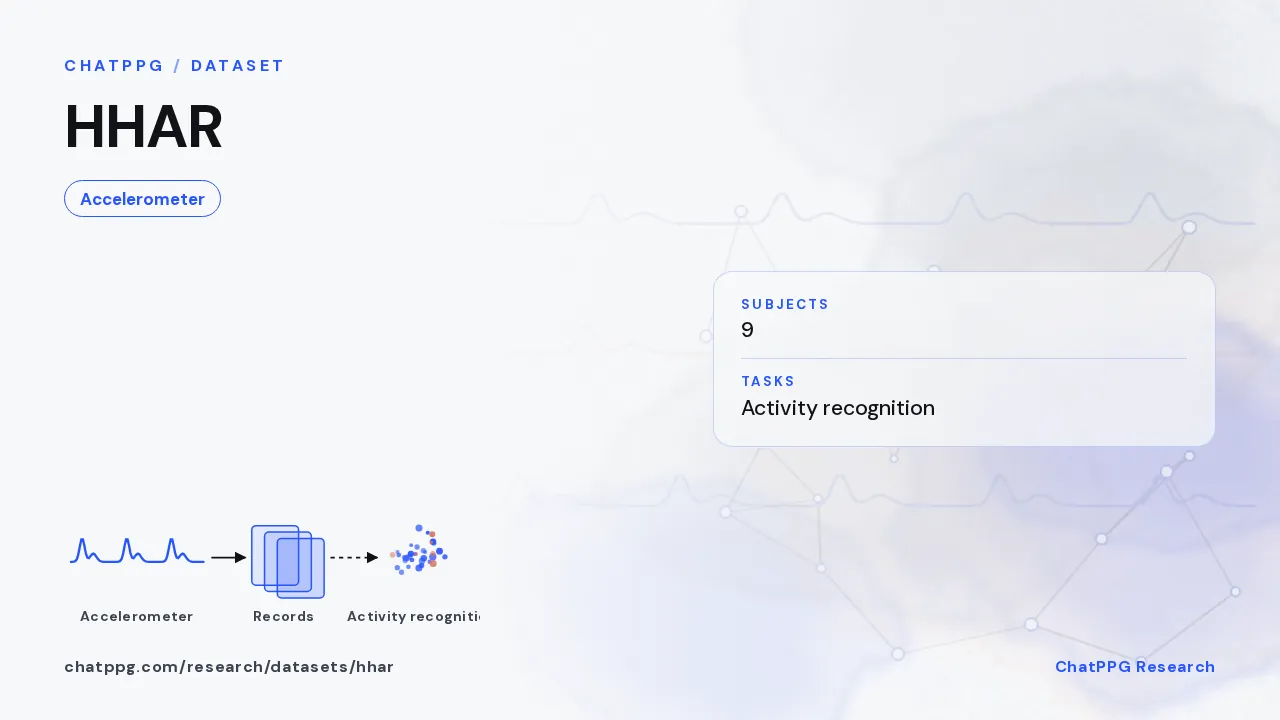
The Heterogeneity Human Activity Recognition (HHAR) dataset was built to benchmark activity recognition when the same activities are recorded on many different smartphone and smartwatch models. It contains accelerometer and gyroscope readings captured while users biked, sat, stood, walked and climbed stairs, and it is meant for testing classification, segmentation, sensor fusion and feature extraction under real device differences. It was donated to the UCI repository in 2015 and has about 43.9 million instances.
- Labels
- biking, sitting, standing, walking, stairs up/down
- Size
- 43,930,257 instances
- Hosted
- UCI ML Repository (2015)
- Type
- Dataset
- DOI
- Not reported
- Code & repos
- Access
- Open
- Subjects
- 9
- Signals
- IMU
- PPG sites
- None
- Setting
- Lab
- Wrist
- Not reported
- Raw waveforms
- Not reported
- Papers
- Updated
- Nov 23, 2026

Original description
The Heterogeneity Human Activity Recognition (HHAR) dataset from Smartphones and Smartwatches is a dataset devised to benchmark human activity recognition algorithms (classification, automatic data segmentation, sensor fusion, feature extraction, etc.) in real-world contexts; specifically, the dataset is gathered with a variety of different device models and use-scenarios, in order to reflect sensing heterogeneities to be expected in real deployments.
The Heterogeneity Dataset for Human Activity Recognition from Smartphone and Smartwatch sensors consists of two datasets devised to investigate sensor heterogeneities' impacts on human activity recognition algorithms (classification, automatic data segmentation, sensor fusion, feature extraction, etc). The datasets were used for the results and analyses produced in [1]. Activity recognition data set
The dataset contains the readings of two motion sensors commonly found in smartphones. Reading were recorded while users executed activities scripted in no specific order carrying smartwatches and smartphones. Activities: ‘Biking’, ‘Sitting’, ‘Standing’, ‘Walking’, ‘Stair Up’ and ‘Stair down’. Sensors: Sensors: Two embedded sensors, i.e., Accelerometer and Gyroscope, sampled at the highest frequency the respective device allows. Devices: 4 smartwatches (2 LG watches, 2 Samsung Galaxy Gears) 8 smartphones (2 Samsung Galaxy S3 mini, 2 Samsung Galaxy S3, 2 LG Nexus 4, 2 Samsung Galaxy S+) Recordings: 9 users
Recording scenario ===============
The activity recognition environment and scenario has been designed to generate many activity primitives, yet in a realistic manner. Users took 2 different routes for the biking and walking, and 2 different set of stairs were used for the stairs up and down.
Still experiment data set ===================
Accelerometer recordings as above but with devices lying still, in 6 different orientations. Devices used comprise 31 smartphones, 4 smartwatches and 1 tablet, representing 13 different models from 4 manufacturers, running variants of Android and iOS.
Verbatim fromUCI Machine Learning Repository· Licence: CC BY 4.0 (UCI default)
HHAR: overview
HHAR (Stisen et al., 2015) was built to study how device differences affect activity recognition. Nine users biked, sat, stood, walked and used stairs while carrying 8 smartphones and wearing 4 smartwatches (two LG and two Samsung Galaxy Gear), with each device recording its accelerometer and gyroscope at the highest rate it allowed. A separate still experiment logged accelerometers on 36 devices lying in six orientations. It is a common benchmark for cross-device and cross-user generalisation.
What's inside
- Users
- 9
- Activities
- 6: biking, sitting, standing, walking, stairs up, stairs down (+ null)
- Devices
- 4 smartwatches (2 LG, 2 Samsung Galaxy Gear); 8 smartphones (Galaxy S3 mini, Galaxy S3, LG Nexus 4, Galaxy S+; 2 each)
- Sensors
- Accelerometer and gyroscope at each device's highest rate (median intervals in the released watch files: about 100 Hz for Gear, 200 Hz for LG)
- Still experiment
- 31 smartphones, 4 smartwatches and 1 tablet lying still in 6 orientations
- Format
- CSV per device type and sensor: Index, Arrival_Time, Creation_Time, x, y, z, User, Model, Device, gt
- Size
- 784 MB download (activity part 741.1 MB zip; phone CSVs about 1.3 GB each unzipped)
How to access it
Host: UCI Machine Learning Repository
- Download from the UCI page (784 MB); no registration.
- Unzip 'Activity recognition exp.zip' for Phones_/Watch_ accelerometer and gyroscope CSVs.
- Use 'Still exp.zip' only for device-bias studies.
Licence: Creative Commons Attribution 4.0 International (CC BY 4.0)
What it allows: Sharing and adaptation for any purpose, including commercial, with credit.
Load HHAR in Python
pip install pandasimport pandas as pd
df = pd.read_csv("Activity recognition exp/Watch_accelerometer.csv") # phones: Phones_accelerometer.csv (1.3 GB)
df = df[df["gt"].notna() & (df["gt"] != "null")] # drop the null class
df["t_s"] = (df.Creation_Time - df.groupby("Device").Creation_Time.transform("min")) / 1e9 # per device; Creation_Time is in ns
df = df.sort_values(["Device", "Creation_Time"])
print(df.shape, df.User.nunique(), df.Device.unique().tolist(), df["gt"].unique().tolist())Run on the UCI download on 16 Oct 2026: 3,020,605 labelled watch-accelerometer rows from 9 users and 4 watches.
Caveats
- Sampling rates differ by device and are irregular; resample each device to a common rate before windowing.
- Creation_Time is in nanoseconds on the device clock, while Arrival_Time is in milliseconds; do not mix them.
- Rows with gt 'null' are unlabelled; drop them for classification.
- Phone CSVs are large (about 1.3 GB each); read in chunks or filter by device.
- Splits matter: leave-one-user-out and leave-one-device-out answer different questions, so say which one you use.
Similar datasets
| Dataset | Subjects | Signals | Licence |
|---|---|---|---|
| UCI Human Activity Recognition Using Smartphones (UCI-HAR) | 30 | imu | Creative Commons Attribution 4.0 International (CC BY 4.0) |
| WISDM AR v1.1 | 36 | accel | Not stated |
| RealWorld HAR | 15 | accel, gyro, magnetometer, audio, gps, light | Not stated |
| USC-HAD | 14 | accel | Not stated |
| PAMAP2 | 9 | accel, gyro, magnetometer, skin-temp, hr | CC BY 4.0 |
Sources: HHAR on UCI · Stisen et al. 2015 · Updated 2026-10-16
Key numbers
How it works
- Reference labels
- activity
- Device roles
- Study wearable (IMU)
Leaderboard rows· 1
All leaderboards| Task | Dataset | Metric | Value | Rank |
|---|---|---|---|---|
| Human activity recognition (IMU) | HHAR | Macro-F1 ↑ | 0.621 probe / 0.603 FT | #1 / 1 |
Papers and models using this dataset· 15
Papers
 CHORD: Multi-resolution Compression for Multimodal Time SeriesEvaluationarXiv preprint · 2026
 HeteroWear: Sensor-Aware Self-Supervised Learning for Heterogeneous Wearable Activity RecognitionPretrainingEvaluationIEEE BigData 2026 · 2026
 IMUDINO: Self-distilled Foundation Model for Inertial SensingEvaluationICLR 2027 submission · 2026
 Inertia-1: An Open Exploration of Wearable Motion Foundation ModelsarXiv preprint · 2026
 Next Token Prediction for Generalizable Human Activity Recognition (NextHAR; CIKM 2026)PretrainingEvaluationCIKM 2026 · 2026
 OmniIMU-Bench: Benchmarking Wrist IMU Representations Across Kinematic, Semantic and Clinical TasksICLR 2027 submission · 2026
- Quantifying the Sampling Frequency Invariance of Time-Series Foundation Models for Sensor Data ApplicationsEvaluationarXiv preprint · 2026
- LLaSA: A Sensor-Aware LLM for Natural Language Reasoning of Human Activity from IMU DataCompanion of the 2025 ACM International Jo · 2025
 LIMU-BERT: Unleashing the Potential of Unlabeled Data for IMU Sensing ApplicationsSenSys 2021 · 2021
Models
 EdgeHARFoundation modelIMU2026
 HALOFoundation modelIMU2026
 HeteroWear (sensor-aware SSL encoder for heterogeneous wearable HAR)Foundation modelPPGIMU2026
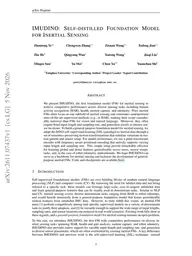 IMUDINOself-distilled foundation model for inertial sensingEvaluationFoundation modelIMU2026 · Open weights
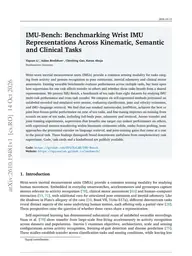 InrtlWristmasked-autoencoder wrist IMU encoder (IMU-Bench reference model)EvaluationFoundation modelIMU2026 · Open weights
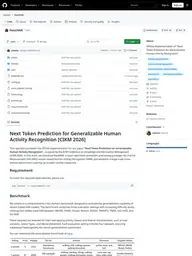 NextHARnext-token-group prediction over frequency-space IMU tokens for cross-domain HARPretrainingEvaluationFoundation modelIMU2026
#15 of 186 most-used datasets by published papers and models · #8 of 84 IMU
Browse these 9 papers in the research explorer (filtered to HHAR)
FAQ
What does HHAR stand for?
Heterogeneity Human Activity Recognition: a dataset designed to measure how differences between phones and watches affect recognition.
How many users and devices are in HHAR?
9 users with 4 smartwatches and 8 smartphones in the activity experiment.
What sampling rate does HHAR use?
Each device recorded at its highest rate, so rates differ; resample before training.
What is the HHAR licence?
CC BY 4.0 on the UCI Machine Learning Repository.
Cite
No citation metadata yet.
Cite the ChatPPG record
Cite the dated snapshot 2026-10 for a fixed, reproducible version. Please also cite the original publications listed above.
APA
ChatPPG. (2026). HHAR: dataset record (Version 2026-10) [Data set]. ChatPPG Research Hub. https://chatppg.com/research/datasets/hhar
BibTeX
@misc{chatppg_dataset_hhar,
  author       = {{ChatPPG}},
  title        = {{HHAR: dataset record}},
  year         = {2026},
  month        = nov,
  version      = {2026-10},
  howpublished = {\url{https://chatppg.com/research/datasets/hhar}},
  note         = {ChatPPG Research Hub, Snapshot 2026-10, https://chatppg.com/research/snapshots/2026-10}
}
CITATION.cff
cff-version: 1.2.0
message: "If you use this resource, please cite it as below."
type: dataset
title: "HHAR: dataset record"
authors:
  - name: "ChatPPG"
url: "https://chatppg.com/research/datasets/hhar"
repository-artifact: "https://chatppg.com/research/snapshots/2026-10"
version: "2026-10"
date-released: "2026-11-23"
History
Record updated
Papers
- CHORD: Multi-resolution Compression for Multimodal Time SeriesUses HHARarXiv preprint · 2026
- HeteroWear: Sensor-Aware Self-Supervised Learning for Heterogeneous Wearable Activity RecognitionUses HHARIEEE BigData 2026 · 2026
- IMUDINO: Self-distilled Foundation Model for Inertial SensingUses HHARICLR 2027 submission · 2026