Cite this dataset
KU-HAR [Data set]. (n.d.). mendeley.com. https://doi.org/10.17632/45f952y38r.5
@misc{kuharkuhar,
  title         = {{KU-HAR}},
  howpublished  = {mendeley.com},
  doi           = {10.17632/45f952y38r.5}
}Khulna University smartphone accel+gyro HAR (n=90, 18 activities, 100 Hz)
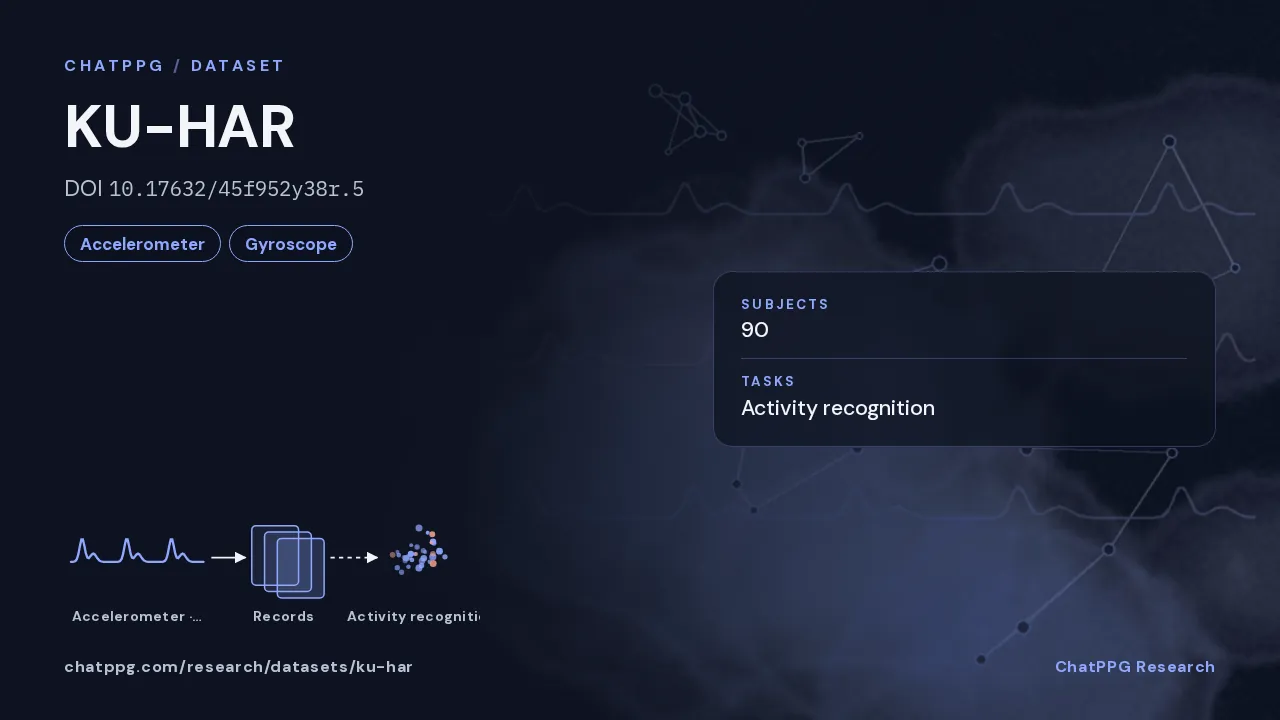
Open smartphone HAR set from Khulna University: 90 participants (75 male, 15 female; ages 18–34), 18 activity classes, built-in accelerometer + gyroscope. Release includes 1,945 raw time-domain samples and 20,750 non-overlapping 3-second subsamples interpolated to 100 Hz. Licence CC BY 4.0 (DataCite).
(Always use the latest version of the dataset. ) Human Activity Recognition (HAR) refers to the capacity of machines to perceive human actions. This dataset contains information on 18 different activities collected from 90 participants (75 male and 15 female) using smartphone sensors (Accelerometer and Gyroscope). It has 1945 raw activity samples collected directly from the participants, and 20750 subsamples extracted from them. The activities are: Stand➞ Standing still (1 min) Sit➞ Sitting still (1 min) Talk-sit➞ Talking with hand movements while sitting (1 min) Talk-stand➞ Talking with hand movements while standing or walking(1 min) Stand-sit➞ Repeatedly standing up and sitting down (5 times) Lay➞ Laying still (1 min) Lay-stand➞ Repeatedly standing up and laying down (5 times) Pick➞ Picking up an object from the floor (10 times) Jump➞ Jumping repeatedly (10 times) Push-up➞ Performing full push-ups (5 times) Sit-up➞ Performing sit-ups (5 times) Walk➞ Walking 20 meters (≈12 s) Walk-backward➞ Walking backward for 20 meters (≈20 s) Walk-circle➞ Walking along a circular path (≈ 20 s) Run➞ Running 20 meters (≈7 s) Stair-up➞ Ascending on a set of stairs (≈1 min) Stair-down➞ Descending from a set of stairs (≈50 s) Table-tennis➞ Playing table tennis (1 min) Contents of the attached .zip files are: 1.Raw_time_domian_data.zip➞ Originally collected 1945 time-domain samples in separate .csv files. The arrangement of information in each .csv file is: Column 1, 5➞ exact time (elapsed since the start) when the Accelerometer & Gyro output was recorded (in ms) Col. 2, 3, 4➞ Acceleration along X,Y,Z axes (in m/s^2) Col. 6, 7, 8➞ Rate of rotation around X,Y,Z axes (in rad/s) 2.Trimmed_interpolated_raw_data.zip➞ Unnecessary parts of the samples were trimmed (only from the beginning and the end). The samples were interpolated to keep a constant sampling rate of 100 Hz. The arrangement of information is the same as above. 3.Time_domain_subsamples.zip➞ 20750 subsamples extracted from the 1945 collected samples provided in a single .csv file. Each of them contains 3 seconds of non-overlapping data of the corresponding activity. Arrangement of information: Col. 1–300, 301–600, 601–900➞ Acc.meter X, Y, Z axes readings Col. 901–1200, 1201–1500, 1501–1800➞ Gyro X, Y, Z axes readings Col. 1801➞ Class ID (0 to 17, in the order mentioned above) Col. 1802➞ length of the each channel data in the subsample Col. 1803➞ serial no. of the subsample Gravity acceleration was omitted from the Acc.meter data, and no filter was applied to remove noise. The dataset is free to download, modify, and use. More information is provided in the data paper which is currently under review: N. Sikder, A.-A. Nahid, KU-HAR: An open dataset for heterogeneous human activity recognition, Pattern Recognit. Lett. (submitted). A preprint will be available soon. Backup: drive.google.com/drive/folders/1yrG8pwq3XMlyEGYMnM-8xnrd6js0oXA7
Verbatim fromDataCite· Licence: info:eu-repo/semantics/openAccess
#70 of 158 most-used datasets by published papers and models · #30 of 70 IMU
KU-HAR [Data set]. (n.d.). mendeley.com. https://doi.org/10.17632/45f952y38r.5
@misc{kuharkuhar,
title = {{KU-HAR}},
howpublished = {mendeley.com},
doi = {10.17632/45f952y38r.5}
}Cite the dated snapshot 2026-10 for a fixed, reproducible version. Please also cite the original publications listed above.
ChatPPG. (2026). KU-HAR: dataset record (Version 2026-10) [Data set]. ChatPPG Research Hub. https://chatppg.com/research/datasets/ku-har
@misc{chatppg_dataset_ku_har,
  author       = {{ChatPPG}},
  title        = {{KU-HAR: dataset record}},
  year         = {2026},
  month        = nov,
  version      = {2026-10},
  howpublished = {\url{https://chatppg.com/research/datasets/ku-har}},
  note         = {ChatPPG Research Hub, Snapshot 2026-10, https://chatppg.com/research/snapshots/2026-10}
}cff-version: 1.2.0 message: "If you use this resource, please cite it as below." type: dataset title: "KU-HAR: dataset record" authors: - name: "ChatPPG" url: "https://chatppg.com/research/datasets/ku-har" repository-artifact: "https://chatppg.com/research/snapshots/2026-10" version: "2026-10" date-released: "2026-11-10"
Record updated
 Next Token Prediction for Generalizable Human Activity Recognition (NextHAR; CIKM 2026)Uses KU-HARCIKM 2026 · 2026
 ActiNet: an open-source tool for activity intensity classification of wrist-worn accelerometry using self-supervised deep learningSame task: Activity recognitionScientific Reports · 2026