USC-HAD
hip MotionNode acc/gyro/mag daily activities (n=14)
USC-SIPI Human Activity Dataset (UbiComp SAGAware 2012). Page states no licence. MotionNode IMU at hip; N=14 per Awesome-IMU-Sensing (paper not re-read).
- Type
- Dataset
- DOI
- Not reported
- Licence
- Not reported
- Access
- Open
- Subjects
- 14
- Signals
- IMU
- PPG sites
- None
- Setting
- Lab
- Wrist
- Not reported
- Raw waveforms
- Not reported
- Papers
- Updated
- Nov 15, 2026
USC-HAD: overview
USC-HAD (Zhang and Sawchuk, 2012) is a daily-activity dataset from the University of Southern California's Signal and Image Processing Institute. Fourteen subjects wore a MotionNode IMU on the front right hip and performed 12 activities, including walking in three directions, stairs, running, jumping, sleeping and riding an elevator, five trials each. The 3-axis accelerometer (±6 g) and gyroscope (±500 dps) were sampled at 100 Hz. Each trial is a MATLAB file that also stores the subject's age, height and weight.
What's inside
- Subjects
- 14
- Activities
- 12: walking forward, left, right, upstairs, downstairs, running forward, jumping up, sitting, standing, sleeping, elevator up, elevator down
- Trials
- 5 per activity per subject
- Sensor
- MotionNode on the front right hip: accelerometer ±6 g, gyroscope ±500 dps, 100 Hz
- Format
- One .mat per trial (aMtN.mat) with sensor_readings (acc in g, gyro in deg/s) and subject metadata
- Size
- About 45 MB zip
How to access it
Host: USC Signal and Image Processing Institute
- Download USC-HAD.zip from the dataset page; no registration.
- Each SubjectN folder holds aMtN.mat files (activity M, trial N).
- Readme.txt describes fields, units and activity numbers.
Licence: No licence stated by the host. The page asks users to refer to Zhang & Sawchuk (2012).
What it allows: No licence is stated, so reuse terms beyond research citation are unclear; contact USC SIPI before redistributing or using commercially.
Load USC-HAD in Python
pip install pandas scipyimport glob, re
import pandas as pd
from scipy.io import loadmat
frames = []
for path in glob.glob("USC-HAD/Subject*/a*t*.mat"):
m = loadmat(path)
subject = int(re.search(r"Subject(\d+)", path).group(1))
activity, trial = map(int, re.search(r"a(\d+)t(\d+)\.mat$", path).groups())
df = pd.DataFrame(m["sensor_readings"], columns=["acc_x", "acc_y", "acc_z", "gyro_x", "gyro_y", "gyro_z"]) # g, deg/s
frames.append(df.assign(subject=subject, activity=activity, trial=trial))
data = pd.concat(frames, ignore_index=True)
print(data.shape, data.subject.nunique(), data.activity.nunique())Run on the download on 16 Oct 2026: 2,811,490 samples, 14 subjects, 12 activities, 5 trials each.
Caveats
- One hip sensor only: no wrist data and no PPG.
- Accelerometer is in g and gyroscope in deg/s, unlike many datasets that use m/s² and rad/s.
- Elevator up/down and standing look almost the same to an IMU; expect confusion there.
- Split by subject; trials from the same subject are highly similar.
- Metadata fields are stored as strings in the .mat files (for example '164cm').
Similar datasets
| Dataset | Subjects | Signals | Licence |
|---|---|---|---|
| UCI Human Activity Recognition Using Smartphones (UCI-HAR) | 30 | imu | Creative Commons Attribution 4.0 International (CC BY 4.0) |
| MHEALTH | 10 | accel | Creative Commons Attribution 4.0 International (CC BY 4.0) |
| PAMAP2 | 9 | accel, gyro, magnetometer, skin-temp, hr | CC BY 4.0 |
| WISDM AR v1.1 | 36 | accel | Not stated |
| HHAR | 9 | accel | Creative Commons Attribution 4.0 International (CC BY 4.0) |
Sources: USC-HAD page · Zhang & Sawchuk 2012 · Updated 2026-10-19
Key numbers
How it works
- Reference labels
- activity
- Device roles
- Study wearable (IMU)
Leaderboard rows· 3
All leaderboards| Task | Dataset | Metric | Value | Rank |
|---|---|---|---|---|
| Human activity recognition (IMU) | USC-HAD | f1_har_unspecified ↑ | 83.9 | #1 / 3 |
| Human activity recognition (IMU) | USC-HAD | f1_har_unspecified ↑ | 76.17 | #2 / 3 |
| Human activity recognition (IMU) | USC-HAD | f1_har_unspecified ↑ | 75.69 | #3 / 3 |
Papers and models using this dataset· 12
Papers
 AnyMo: Geometry-Aware Setup-Agnostic Modeling of Human Motion in the WildEvaluationarXiv preprint · 2026
 CHEAR: Confusion-Hierarchy Evidence-Aware Reasoning for Cost-Efficient Human Activity RecognitionarXiv 2610.15298 · 2026
 Coverage-Aware Virtual IMU Augmentation for Low-Resource Human Activity RecognitionarXiv preprint · 2026
 Next Token Prediction for Generalizable Human Activity Recognition (NextHAR; CIKM 2026)PretrainingEvaluationCIKM 2026 · 2026
 OntoAR-HAR: Ontology-Guided Agentic RAG with Personalized Memory for Human Activity RecognitionarXiv 2610.15292 · 2026
 REFIT: Recognize, Fix, and Test Wearable Sensor Placement Shifts without LabelsarXiv 2610.08991 · 2026
 TSFFormer: A Frequency-Domain Spike Transformer for Green Human Activity RecognitionarXiv preprint, v1 2026-11-09 · 2026
 ZARA: Training-Free Motion Time-Series Reasoning via Evidence-Grounded LLM AgentsEvaluationarXiv preprint · 2025
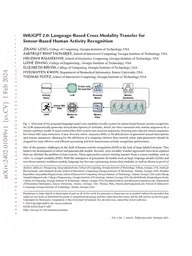
 IMUGPT 2.0: Language-Based Cross Modality Transfer for Sensor-Based Human Activity RecognitionProceedings of the ACM on Interactive, Mob · 2024
Models
#22 of 186 most-used datasets by published papers and models · #12 of 84 IMU
Browse these 9 papers in the research explorer (filtered to USC-HAD)
FAQ
How many subjects and activities are in USC-HAD?
14 subjects and 12 activities, with 5 trials of each activity per subject.
What sensor does USC-HAD use?
A MotionNode IMU on the front right hip, recording 3-axis acceleration and rotation at 100 Hz.
What format is USC-HAD in?
MATLAB .mat files, one per trial, with a 6-column sensor_readings array and subject metadata.
What is the USC-HAD licence?
No licence is stated on the host page; cite Zhang & Sawchuk (2012).
How do I download the USC-HAD dataset?
From the USC SIPI page (https://sipi.usc.edu/had/), about 45 MB zip. No licence is stated; the page asks users to cite Zhang & Sawchuk (2012).
Cite
No citation metadata yet.
Cite the ChatPPG record
Cite the dated snapshot 2026-10 for a fixed, reproducible version. Please also cite the original publications listed above.
APA
ChatPPG. (2026). USC-HAD: dataset record (Version 2026-10) [Data set]. ChatPPG Research Hub. https://chatppg.com/research/datasets/usc-had
BibTeX
@misc{chatppg_dataset_usc_had,
  author       = {{ChatPPG}},
  title        = {{USC-HAD: dataset record}},
  year         = {2026},
  month        = nov,
  version      = {2026-10},
  howpublished = {\url{https://chatppg.com/research/datasets/usc-had}},
  note         = {ChatPPG Research Hub, Snapshot 2026-10, https://chatppg.com/research/snapshots/2026-10}
}
CITATION.cff
cff-version: 1.2.0
message: "If you use this resource, please cite it as below."
type: dataset
title: "USC-HAD: dataset record"
authors:
  - name: "ChatPPG"
url: "https://chatppg.com/research/datasets/usc-had"
repository-artifact: "https://chatppg.com/research/snapshots/2026-10"
version: "2026-10"
date-released: "2026-11-15"
History
Record updated
Papers
- CHEAR: Confusion-Hierarchy Evidence-Aware Reasoning for Cost-Efficient Human Activity RecognitionUses USC-HADarXiv 2610.15298 · 2026
- OntoAR-HAR: Ontology-Guided Agentic RAG with Personalized Memory for Human Activity RecognitionUses USC-HADarXiv 2610.15292 · 2026
- ZARA: Training-Free Motion Time-Series Reasoning via Evidence-Grounded LLM AgentsUses USC-HADarXiv preprint · 2025