PaperarXiv:2610.19481
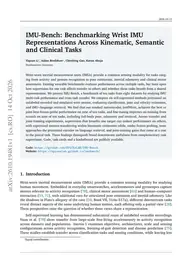
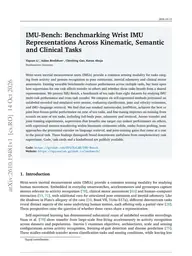
OmniIMU-Bench: Benchmarking Wrist IMU Representations Across Kinematic, Semantic and Clinical Tasks
ICLR 2027 submission (under review); public release as IMU-Bench (Li, Bradshaw, Gao, Ahuja 2026; arXiv 2610.19481, submitted 2026-10-14)
TL;DR
Benchmark of ten tasks from eight datasets for wrist IMU multi-task performance and cross-task transfer (activity, gesture, pose & velocity estimation, odometry, clinical motor assessment, IMU–language retrieval). Compares six SSL methods pretrained on unlabelled recorded and simulated wrist motion. Masked autoencoding is best/joint-best frozen-probe on 9/10 tasks; fine-tuning beats scratch on 9/10.
- Form factor: wrist
Abstract
Wrist-worn inertial measurement units (IMUs) provide a common sensing modality for tasks ranging from activity and gesture recognition to pose estimation, inertial odometry and clinical motor assessment. Existing wearable benchmarks evaluate performance across multiple tasks, but leave open how supervision for one task affects transfer to others and whether these tasks benefit from a shared representation. We present IMU-Bench, a benchmark of ten tasks from eight datasets for studying IMU multi-task performance and cross-task transfer. We compare six self-supervised methods pretrained on unlabeled recorded and simulated wrist motion, evaluating classification, pose and velocity estimation, and IMU-language retrieval. We find that our masked autoencoder, InrtlWrist, achieves the best or joint-best frozen-probe performance on nine of ten tasks, and fine-tuning improves on training from scratch on nine of ten tasks, including full-body pose, odometry and retrieval. Across transfer and joint-training experiments, supervision that benefits one target can reduce performance on others, with supervised sources transferring within kinematic estimation while, under frozen probing, none approaches the pretrained encoder on language retrieval, and joint-training gains that come at a cost to the paired task. These findings distinguish broad downstream usefulness from complementary task supervision. Code, task cards and a leaderboard are publicly available.
Verbatim from arXiv (opens in a new tab) · arXiv metadata (abstracts are released under CC0)
Results on ChatPPG leaderboards · 2
All leaderboards| Leaderboard | Method | Result | Rank |
|---|---|---|---|
| HHAR macro-F1Human activity recognition | InrtlWristvia model InrtlWrist | 0.621 probe / 0.603 FTmacro-F1, higher is better | #1 of 1 |
| MHEALTH macro-F1 (IMU-Bench protocol)Human activity recognition | InrtlWristvia model InrtlWrist | 68.6 probe / 72.4 FT (%)macro-F1, higher is better | #1 of 1 |
No row is credited to the paper itself; 2 more belong to models it introduces or evaluates. Ranks apply within each leaderboard only, as reported by the source.
Tasks & signals
Tasks
Signals
Devices
Keywords
Datasets used
 HHARheterogeneity HAR, smartphones + smartwatches (n=9)9 subjects · IMU
 MHEALTH10 subjects · IMU
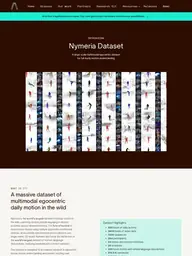 Nymeriaegocentric multimodal daily-motion dataset (Project Aria glasses + two miniAria wristbands + XSens full-body mocap; 264 participants, CC BY-NC 4.0)264 subjects · IMU · Barometer · Audio
 OpenWatchsmartwatch IMU+PPG hand-gesture benchmark (n=50, >10 h, 59 gesture sequences)50 subjects · PPG · IMU
Models
How it works
Cite this paper
OmniIMU-Bench: Benchmarking Wrist IMU Representations Across Kinematic, Semantic and Clinical Tasks. (2026). ICLR 2027 submission. https://arxiv.org/abs/2610.19481
@misc{omniimubenchwris2026omniimubench,
  title         = {{OmniIMU-Bench: Benchmarking Wrist IMU Representations Across Kinematic, Semantic and Clinical Tasks}},
  year          = {2026},
  howpublished  = {ICLR 2027 submission},
  eprint        = {2610.19481},
  archivePrefix = {arXiv}
}Record updated
Added to the ChatPPG research hub