Learn · Beyond PPG

How wearables measure the body: a field guide to sensing methods

Wearable biosensors read light, electricity, motion, heat, sound, radio and chemistry. This guide compares every method, from the PPG LEDs on your wrist to Raman lasers and microneedles, with what each can and can't measure and its verified FDA status.

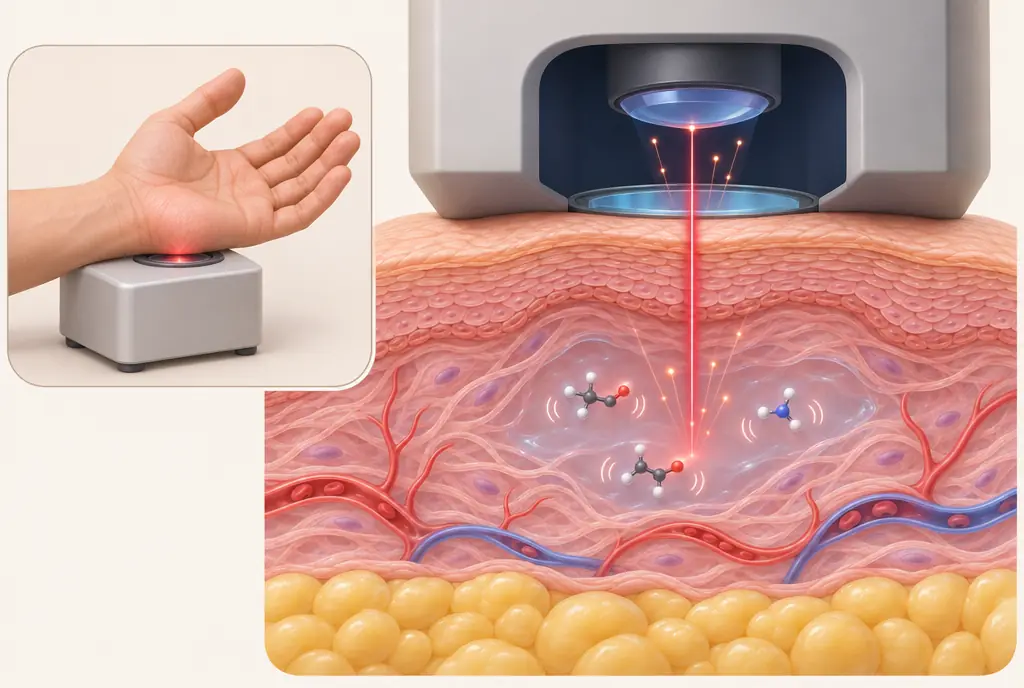
skinlaserspectrumrare shifted photons
Raman, the method behind most needle-free glucose research.A schematic, not to scale.

What a wearable can sense

Wearable biosensors fall into five families: optical, electrical, mechanical, thermal-acoustic-radio, and biochemical. Most wrist devices lean on the first three. The optical heart-rate sensor on a watch is photoplethysmography (PPG): a few LEDs and photodiodes that follow how much light pulsing blood absorbs (Allen, 2007). Add red and infrared LEDs and careful design, and the same idea estimates blood oxygen. That makes multi-wavelength PPG the simplest spectroscopy already on the wrist.

It is also where the limits start. A few LEDs measuring absorption tell you a lot about blood volume and oxygen and almost nothing about which small molecules are dissolved in the blood. Glucose and alcohol need methods that read molecular fingerprints, such as Raman or mid-infrared spectroscopy, or a sensor that sits in the fluid under the skin. The FDA has authorized no smartwatch or ring that measures glucose on its own (FDA, 2024).

The explorer below covers 27 methods. Each row says what the method measures, what it can't do, how deep it reaches, its wavelength or band, how mature it is, where it is worn and its FDA status. Every FDA entry is either verified against FDA's own database, marked "none found" after a search, or marked "not verified".

Explorer: every method compared

Filter by family, maturity, body site or FDA status, or tap a body site on the figure. Choose a method to open its diagram, devices and papers. Filters live in the address bar, so a filtered view can be shared with Copy link.

97416542
Family
Maturity
27 of 27 methods
Wearable sensing methods: what each measures, how it works, limits, depth, wavelength or band, maturity, body site and FDA status
MethodWhat it measuresHow it worksWhat it can't doTissue depthWavelength or bandMaturityBody siteFDA status
Optical
OpticalPulse rate, beat-to-beat intervals and pulse irregularity, from blood-volume changesLEDs shine into the skin and a photodiode records how much light pulsing blood absorbsIdentify molecules such as glucose or alcohol; measure blood pressure directlySkin microvasculature; green light stays shallower than red or infraredGreen LEDs on most watches; red and infrared on someIn consumer wearablesWrist, Finger or handSome features cleared
OpticalArterial blood oxygen saturation and pulse rateCompares the pulsing part of red and infrared light, which oxygenated and deoxygenated hemoglobin absorb differentlyRead oxygen inside muscle or brain; stay equally accurate in every case: FDA lists skin pigmentation, poor circulation and skin temperature among factors that affect readingsArterial pulse in skin and finger tissueRed 660 nm and infrared 940 nm in one cleared designIn consumer wearablesFinger or hand, WristCleared (Masimo W1, K232512)
OpticalChanges in oxy- and deoxyhemoglobin in tissue; regional oxygen saturation; brain activation (fNIRS)Near-infrared light travels between a source and detectors set further apart than in PPG, sampling deeper tissueSee deep brain structures; read glucoseDeeper than wrist PPG: outer cortex through scalp and skull, or tissue under the sensorNear-infraredMedical or specialist devicesHeadCleared (hospital oximeters)
OpticalMaps of superficial tissue oxygen saturation and hemoglobin; tissue compositionRecords the spectrum of light returning from tissue at several wavelengths, or at every pixelFit on a wristband today in cleared form; read glucoseSuperficial tissueSix wavelengths between 600 and 1000 nm in one cleared imagerMedical or specialist devicesSkin patchCleared (SnapshotNIR, K201976)
OpticalA molecular fingerprint of skin and interstitial fluid, including glucose (research)A laser excites the skin and a tiny share of scattered light returns shifted by molecular vibrationsFit in a watch yet; the glucose signal is very weak; no FDA clearanceSkin and its interstitial fluid830 nm laser in the RSP and MIT devicesResearch prototypesFinger or hand, ArmNone found
OpticalGlucose's own infrared absorption, read through heat or sound (research)A mid-infrared laser is absorbed in the skin and the resulting heat or pressure wave is detectedReach below a very thin skin layer, because water absorbs mid-infrared strongly; no FDA clearanceVery shallowMid-infrared (quantum cascade lasers)Research prototypesFinger or handNone found
OpticalArtery diameter and blood-pressure waveform; blood-vessel maps (research)Short light pulses heat blood slightly, which emits ultrasound that a detector timesRun from a watch-sized light source yet; claim validation beyond two volunteersMillimetres: the radial artery near the wrist800 nm pulsed laser in the SPADE studyResearch prototypesWristNot verified
OpticalBuild-up of fluorescent advanced glycation end products in skin over months to yearsUltraviolet to blue light excites the skin and a longer-wavelength glow is measuredRead today's glucose; it reflects long-term accumulationSkin300–420 nm excitation, 420–600 nm emissionResearch prototypesArmNot verified
OpticalA relative blood-flow index, beat by beatA coherent laser makes a grainy speckle pattern that blurs faster when red cells move fasterGive absolute flow without extra modelling; work with ordinary LEDsSkin microvessels; diffuse versions reach the brainNarrow-linewidth lasers, visible to near-infraredMedical or specialist devicesFinger or hand, HeadCleared (FlowMet-R, K182494)
OpticalMicrovascular blood flow, notably in the brainTimes how fast near-infrared light intensity fluctuates after scattering off moving red cellsRun on a consumer wearable todayDeep tissue, including cortexNear-infraredResearch prototypesHeadNot verified
OpticalPulse rate and breathing rate from videoA camera picks up tiny colour changes in the face with each heartbeatMatch contact sensors in poor light or with motion; read blood pressure reliablySkin surface reflectionsAmbient visible light; the green channel carries most pulse signalMedical or specialist devicesFace (camera)Some cleared (e.g. K253650)
Electrical
ElectricalThe heart's electrical activity: rhythm, including atrial fibrillation, and heart rateElectrodes on the skin record voltage differences; a watch closes the circuit when you touch its crown or bezelReplace a 12-lead ECG for most diagnoses from a single lead; record continuously on a watch without touchSurface potentials from the whole heartBiopotential (electrical)In consumer wearablesWrist, ChestCleared (many, e.g. DEN180044)
ElectricalChanges in skin conductance driven by sympathetic nerve input to sweat glandsTwo electrodes apply a tiny voltage and measure how easily current passes through the skinTell which emotion caused arousal; diagnose stress on its ownSkin and sweat ductsLow-level DC or AC electricalMedical or specialist devicesWristCleared (Embrace, K172935)
ElectricalEstimates of body water and fat-free mass; fluid shifts; breathing from chest impedanceA tiny alternating current passes through the body and the voltage drop gives impedance, at one or many frequenciesGive accurate body fat without equations matched to the population; read reliably when hydration changesBulk tissue between the electrodesAlternating current, single or multi-frequencyIn consumer wearablesFinger or hand, Arm, ChestSome cleared (e.g. K180126)
ElectricalThe brain's electrical activity; sleep stagesScalp electrodes record microvolt-level voltage changes from the cortexLocate activity precisely or see deep structures; work well with poor electrode contactCortical surface potentials through the scalpBiopotential (electrical)Medical or specialist devicesHeadCleared (Dreem 3S, K223539)
ElectricalElectrical activity of musclesElectrodes over a muscle record the voltage from its contracting fibresMeasure muscles far from the electrode; avoid skin irritation from adhesive patches over long wearMuscle under the electrodesBiopotential (electrical)Medical or specialist devicesArmCleared (SPEAC, K182180)
Mechanical
MechanicalMovement, steps, activity and sleep-wake estimatesA tiny proof mass measures acceleration on three axes many times a secondMatch polysomnography for sleep stages; know why you are stillWhole-limb motionInertial (mechanical)In consumer wearablesWristCleared (e.g. Actiwatch, K983533)
MechanicalRotation rate and, with the accelerometer, orientation and gaitA vibrating micro-structure senses rotation through the Coriolis effectMeasure physiology directly; it describes movementLimb or body rotationInertial (mechanical)In consumer wearablesWristNot verified
MechanicalThe body's recoil and chest-wall vibration with each heartbeatAccelerometers on the chest (SCG) or force sensors that feel the whole body recoil (BCG) pick up the mechanical heartbeatWork well during movement; give standardised clinical metrics yetWhole-body or chest-wall motionMechanical vibrationResearch prototypesChest, Contactless (room or bed)Not verified
MechanicalThe arterial pressure waveform at a superficial arteryA sensor presses an artery against bone until its wall flattens, then records the pulse pressureReach deep central arteries; hold position easily in a wearableSuperficial arteries such as the radial arteryMechanical pressureMedical or specialist devicesWristNot verified for wearables
Thermal, acoustic, RF and ultrasound
Thermal, acoustic, RF and ultrasoundSkin temperature trends; estimated core temperature from heat flowA thermistor reads skin temperature; a heat-flux sensor also measures heat leaving the body to estimate core temperatureEqual core temperature from skin alone; heat-flux estimates did not validate in one heat-stress studySkin surfaceThermal (infrared emission or contact)In consumer wearablesFinger or hand, Wrist, ChestSome cleared (BioButton, K241101)
Thermal, acoustic, RF and ultrasoundLung and heart soundsContact microphones on the chest record sounds for later reviewInterpret sounds without a clinician or validated algorithmChestAudible soundMedical or specialist devicesChestCleared (Strados RESP, K201077)
Thermal, acoustic, RF and ultrasoundHeart and breathing rate from tiny chest movements, without contactRadio pulses bounce off the body and their timing shifts with chest motionRead blood glucose: we found no peer-reviewed clinical accuracy or FDA clearance for RF glucose claimsBody surface motionRadio and microwave (impulse radio ultra-wideband in the cleared example)Medical or specialist devicesContactless (room or bed)Cleared (Xandar Kardian XK300, K202464)
Thermal, acoustic, RF and ultrasoundArtery diameter and blood-pressure waveforms in deep vessels; tissue imagesA thin transducer sends sound pulses and times the echoes from vessel wallsBe called a cleared wearable yet; it is a mechanical wave, not lightDeep: centimetres, including the carotid arteryUltrasound (mechanical wave)Research prototypesChest, ArmNot verified for wearables
Biochemical
BiochemicalSweat electrolytes and metabolites such as sodium, potassium, lactate and glucoseElectrochemical sensors on a flexible patch react with compounds in sweatStand in for blood glucose; work without enough sweatSkin surfaceElectrochemicalResearch prototypesSkin patchNot verified
BiochemicalGlucose trends in interstitial fluid, shown as a colour-changing lightAn array of tiny electrochemical sensors sits in the outer skin and reads interstitial glucoseServe people on insulin under its authorization; show a number on the sensor itselfIntradermalElectrochemicalMedical or specialist devicesSkin patchAuthorized (Biolinq Shine, DEN240080)
BiochemicalInterstitial glucose every few minutesA thin sensor filament under the skin reads glucose electrochemicallyAvoid piercing the skin; claims of an 'optical CGM' in a watch are not FDA authorizedSubcutaneous interstitial fluidElectrochemicalIn consumer wearablesSkin patchCleared (e.g. DEN170088, K234070)
  • Optical · Wrist, Finger or hand

    Measures: Pulse rate, beat-to-beat intervals and pulse irregularity, from blood-volume changes

    Can't: Identify molecules such as glucose or alcohol; measure blood pressure directly

    In consumer wearablesSome features cleared
  • Optical · Finger or hand, Wrist

    Measures: Arterial blood oxygen saturation and pulse rate

    Can't: Read oxygen inside muscle or brain; stay equally accurate in every case: FDA lists skin pigmentation, poor circulation and skin temperature among factors that affect readings

    In consumer wearablesCleared (Masimo W1, K232512)
  • Optical · Head

    Measures: Changes in oxy- and deoxyhemoglobin in tissue; regional oxygen saturation; brain activation (fNIRS)

    Can't: See deep brain structures; read glucose

    Medical or specialist devicesCleared (hospital oximeters)
  • Optical · Skin patch

    Measures: Maps of superficial tissue oxygen saturation and hemoglobin; tissue composition

    Can't: Fit on a wristband today in cleared form; read glucose

    Medical or specialist devicesCleared (SnapshotNIR, K201976)
  • Optical · Finger or hand, Arm

    Measures: A molecular fingerprint of skin and interstitial fluid, including glucose (research)

    Can't: Fit in a watch yet; the glucose signal is very weak; no FDA clearance

    Research prototypesNone found
  • Optical · Finger or hand

    Measures: Glucose's own infrared absorption, read through heat or sound (research)

    Can't: Reach below a very thin skin layer, because water absorbs mid-infrared strongly; no FDA clearance

    Research prototypesNone found
  • Optical · Wrist

    Measures: Artery diameter and blood-pressure waveform; blood-vessel maps (research)

    Can't: Run from a watch-sized light source yet; claim validation beyond two volunteers

    Research prototypesNot verified
  • Optical · Arm

    Measures: Build-up of fluorescent advanced glycation end products in skin over months to years

    Can't: Read today's glucose; it reflects long-term accumulation

    Research prototypesNot verified
  • Optical · Finger or hand, Head

    Measures: A relative blood-flow index, beat by beat

    Can't: Give absolute flow without extra modelling; work with ordinary LEDs

    Medical or specialist devicesCleared (FlowMet-R, K182494)
  • Optical · Head

    Measures: Microvascular blood flow, notably in the brain

    Can't: Run on a consumer wearable today

    Research prototypesNot verified
  • Optical · Face (camera)

    Measures: Pulse rate and breathing rate from video

    Can't: Match contact sensors in poor light or with motion; read blood pressure reliably

    Medical or specialist devicesSome cleared (e.g. K253650)
  • Electrical · Wrist, Chest

    Measures: The heart's electrical activity: rhythm, including atrial fibrillation, and heart rate

    Can't: Replace a 12-lead ECG for most diagnoses from a single lead; record continuously on a watch without touch

    In consumer wearablesCleared (many, e.g. DEN180044)
  • Electrical · Wrist

    Measures: Changes in skin conductance driven by sympathetic nerve input to sweat glands

    Can't: Tell which emotion caused arousal; diagnose stress on its own

    Medical or specialist devicesCleared (Embrace, K172935)
  • Electrical · Finger or hand, Arm, Chest

    Measures: Estimates of body water and fat-free mass; fluid shifts; breathing from chest impedance

    Can't: Give accurate body fat without equations matched to the population; read reliably when hydration changes

    In consumer wearablesSome cleared (e.g. K180126)
  • Electrical · Head

    Measures: The brain's electrical activity; sleep stages

    Can't: Locate activity precisely or see deep structures; work well with poor electrode contact

    Medical or specialist devicesCleared (Dreem 3S, K223539)
  • Electrical · Arm

    Measures: Electrical activity of muscles

    Can't: Measure muscles far from the electrode; avoid skin irritation from adhesive patches over long wear

    Medical or specialist devicesCleared (SPEAC, K182180)
  • Mechanical · Wrist

    Measures: Movement, steps, activity and sleep-wake estimates

    Can't: Match polysomnography for sleep stages; know why you are still

    In consumer wearablesCleared (e.g. Actiwatch, K983533)
  • Mechanical · Wrist

    Measures: Rotation rate and, with the accelerometer, orientation and gait

    Can't: Measure physiology directly; it describes movement

    In consumer wearablesNot verified
  • Mechanical · Chest, Contactless (room or bed)

    Measures: The body's recoil and chest-wall vibration with each heartbeat

    Can't: Work well during movement; give standardised clinical metrics yet

    Research prototypesNot verified
  • Mechanical · Wrist

    Measures: The arterial pressure waveform at a superficial artery

    Can't: Reach deep central arteries; hold position easily in a wearable

    Medical or specialist devicesNot verified for wearables
  • Thermal, acoustic, RF and ultrasound · Finger or hand, Wrist, Chest

    Measures: Skin temperature trends; estimated core temperature from heat flow

    Can't: Equal core temperature from skin alone; heat-flux estimates did not validate in one heat-stress study

    In consumer wearablesSome cleared (BioButton, K241101)
  • Thermal, acoustic, RF and ultrasound · Chest

    Measures: Lung and heart sounds

    Can't: Interpret sounds without a clinician or validated algorithm

    Medical or specialist devicesCleared (Strados RESP, K201077)
  • Thermal, acoustic, RF and ultrasound · Contactless (room or bed)

    Measures: Heart and breathing rate from tiny chest movements, without contact

    Can't: Read blood glucose: we found no peer-reviewed clinical accuracy or FDA clearance for RF glucose claims

    Medical or specialist devicesCleared (Xandar Kardian XK300, K202464)
  • Thermal, acoustic, RF and ultrasound · Chest, Arm

    Measures: Artery diameter and blood-pressure waveforms in deep vessels; tissue images

    Can't: Be called a cleared wearable yet; it is a mechanical wave, not light

    Research prototypesNot verified for wearables
  • Biochemical · Skin patch

    Measures: Sweat electrolytes and metabolites such as sodium, potassium, lactate and glucose

    Can't: Stand in for blood glucose; work without enough sweat

    Research prototypesNot verified
  • Biochemical · Skin patch

    Measures: Glucose trends in interstitial fluid, shown as a colour-changing light

    Can't: Serve people on insulin under its authorization; show a number on the sensor itself

    Medical or specialist devicesAuthorized (Biolinq Shine, DEN240080)
  • Biochemical · Skin patch

    Measures: Interstitial glucose every few minutes

    Can't: Avoid piercing the skin; claims of an 'optical CGM' in a watch are not FDA authorized

    In consumer wearablesCleared (e.g. DEN170088, K234070)

Where each method sits on the spectrum

Wrist optics use a narrow slice of visible and near-infrared light. Raman and photoacoustic research lasers sit in the same near-infrared window, at 830 nm (Pors et al., 2025; Bresci et al., 2026) and 800 nm (Gelbert et al., 2026). Mid-infrared glucose work sits far to the right of that, where water absorbs strongly (Zhang et al., 2026), and radar is out in the radio band. Ultrasound is not light at all.

Wearable sensing methods placed on the electromagnetic spectrum, log scaleUVVisibleNear-IRMid-IRFar-IR / THzMicrowave and radioAutofluorescence excitation, 300–420 nm (Meerwaldt et al., 2004)NIR imaging bands, 600–1000 nm (FDA K201976)Red PPG / SpO2 660 nmPhotoacoustic pulse 800 nmRaman laser 830 nmInfrared PPG / SpO2 940 nmgreen PPGmid-IR glucose researchradar and RFNIRS, fNIRS and DCS use near-infrared lightUltrasound and acoustic sensing: mechanical waves, not light. Shown apart on purpose.shorter wavelengthlonger wavelength (log scale)
Most wrist sensing sits in a narrow slice of visible and near-infrared light. Point wavelengths are marked only where a cited source states them: red 660 nm and infrared 940 nm from FDA summary K232512, the 830 nm Raman lasers from Pors et al. (2025) and Bresci et al. (2026), and the 800 nm photoacoustic pulse from Gelbert et al. (2026). Region names are schematic and the green PPG label marks the visible green band rather than a specific LED. A schematic, not measured data.
How deep different sensing methods reach, schematicepidermisdermissubcutisdeeper tissueMid-IRonly a very thin skin layerGreen PPGsuperficial microvesselsRamanskin interstitial fluidMicroneedleintradermalRed / IR PPGdeeper than greenCGM filamentunder the skinPhotoacousticradial artery, ~4 mmNIRS / DCScortex, through scalp and skullUltrasounddeep vessels such as the carotidsensor side
Molecular methods work in the top layers; volume and flow methods can go deeper. Positions follow each source's own description: mid-infrared reaching only a thin layer (Zhang et al., 2026), green light probing shallower than infrared (Maas et al., 2026), Raman reading interstitial fluid (Pors et al., 2025; Bresci et al., 2026), the intradermal microneedle sensor (FDA DEN240080), the radial artery at about 4 mm in the photoacoustic model (Gelbert et al., 2026), fNIRS on the cortex (Pinti et al., 2020) and ultrasound reaching the carotid (Wang et al., 2018). Not to scale.

Optical methods

PPG and multi-wavelength SpO2

A PPG sensor puts an LED next to a photodiode. Each heartbeat swells the small vessels under the skin, more light is absorbed, and the detected signal dips. The result is a pulsatile waveform riding on a slow baseline (Allen, 2007). Apple's watch uses green LEDs for this (FDA DEN180042), and green light probes shallower skin than infrared (Maas et al., 2026). Our PPG sensor guide and what is photoplethysmography cover the basics, and green vs red vs infrared PPG and LED wavelength selection cover the colour choices.

Pulse oximetry is PPG at two colours. Oxygenated and deoxygenated hemoglobin absorb red and infrared light differently, so the ratio of their pulsing signals tracks arterial oxygen saturation. One cleared wrist device, the Masimo W1, uses red 660 nm and infrared 940 nm and is cleared for spot-check SpO2 (K232512). The FDA lists skin pigmentation, poor circulation and skin temperature among factors that can affect readings (FDA). The SpO2 guide and wearable SpO2 accuracy go further, and the light-transport models are in tissue optical properties and photon diffusion.

PPG has also reached cleared rhythm and blood-pressure-pattern features: Apple's irregular rhythm notification (DEN180042), studied at scale in the Apple Heart Study (Perez et al., 2019), and its hypertension notification (K250507), which flags patterns and does not measure blood pressure. PPG research on hemoglobin, hydration, glucose and alcohol mostly infers these from indirect physiological changes and does not read the molecules.

NIRS and fNIRS vs PPG

Near-infrared spectroscopy (NIRS) uses the same kind of light as the infrared PPG channel but asks a different question. Sources and detectors sit further apart, so detected light has travelled deeper, and the instrument tracks changes in oxy- and deoxyhemoglobin with the modified Beer-Lambert law (Scholkmann et al., 2014). Functional NIRS (fNIRS) maps those changes over the brain's outer cortex to study activation. It is portable and tolerates movement better than MRI, which is why it is used from newborns to older adults (Pinti et al., 2020). In hospitals, regional oximeters such as the Masimo O3 are cleared as adjunct monitors of regional tissue oxygen saturation (K243324). What is NIRS in one line: PPG reads the pulse in the top layers of skin, and NIRS reads oxygenation in the tissue below.

Multispectral and diffuse reflectance

Spectral imaging records a spectrum at every pixel and uses it to map tissue physiology and composition (Lu & Fei, 2014). A cleared clinical example, Kent Imaging's SnapshotNIR, images superficial tissue at six wavelengths between 600 and 1000 nm to estimate oxygen saturation (K201976). It is handheld, not worn. Camera versions of the idea are covered in multispectral rPPG.

Raman: the honest answer to "can my watch do that?"

Raman spectroscopy is the method behind most of the credible needle-free glucose research. A laser excites the skin and a tiny share of the scattered light comes back shifted in colour by molecular vibrations. Those shifts form a fingerprint, so in principle glucose can be told apart from everything else. MIT describes the practical problem plainly: the glucose signal is normally too small to pick out from the other molecules in tissue (MIT News, 2025).

The best human data so far: RSP Systems' portable box, which fires an 830 nm laser at the base of the thumb, reached a MARD of 12.8% against capillary blood in 50 people with type 2 diabetes, with every reading in consensus error grid zones A and B (Pors et al., 2025). MIT and Apollon read only three narrow Raman bands to shrink the hardware. In 6 healthy adults the MARD was 11.34%, close to two needle-based CGMs worn at the same time, and two authors work for Apollon (Bresci et al., 2026). Liom Health reported a calibration-free model with a MARD of 14.5% in 20 adults with insulin-treated diabetes (Rothenbühler et al., 2026).

So can your watch do that? No. None of these devices is a watch, the studies are small, and we found no FDA clearance for any Raman glucose monitor. MIT says a phone-sized wearable prototype is in testing and a watch-sized one is a goal; those results are not published. The glucose monitor watch guide covers what you can use today.

Mid-IR, photothermal and photoacoustic

Mid-infrared light hits glucose's fundamental vibrations with more selectivity than near-infrared, but water absorbs it so strongly that it only reaches a very thin layer of skin (Zhang et al., 2026). Groups detect the heat or sound the absorbed light produces instead of the light itself. DiaMonTech's fingertip prototype put 98.8% of readings in error grid zones A and B in 100 volunteers, with a mean difference from the reference of 12.1%; all authors were company staff (Lubinski et al., 2021). CEA-Leti reports a MARD of about 18% for its Physiolas photoacoustic platform on its own demo page, which is the institute's own claim and not a published result, and Quantune lists an in-vivo clinical phase starting in 2026 without published accuracy.

Photoacoustic sensing also works with near-infrared light for blood vessels. A Technion team fired 800 nm pulses at the radial artery and timed the ultrasound it emitted with a tiny silicon-photonics detector, tracking artery diameter at 100 Hz. Converted to blood pressure, the mean absolute difference from a finger-cuff reference was 2.6 mmHg diastolic and 4.7 mmHg systolic, in two volunteers with table-top lasers (Gelbert et al., 2026). It is a proof of concept. For how cuffless devices are judged, see the ESH validation tests and when cuffless BP will be ready.

Fluorescence and skin AGEs

Some advanced glycation end products (AGEs) glow when lit with ultraviolet to blue light. An autofluorescence reader that excites skin at 300–420 nm and reads 420–600 nm emission correlated with AGEs measured in skin biopsies from people with and without diabetes (Meerwaldt et al., 2004). This reflects accumulation over months to years, not today's glucose. We did not verify an FDA status for these readers.

Speckle, LSCI, SCOS and DCS

Coherent laser light makes a grainy speckle pattern that blurs faster when red cells move faster, which gives a relative flow index (Boas & Dunn, 2010). A single laser through a finger can record PPG and speckle plethysmography together (Ghijsen et al., 2018). FlowMet-R, a toe-worn speckle device, is FDA cleared as a blood flowmeter (K182494). Diffuse correlation spectroscopy times near-infrared fluctuations to measure cerebral blood flow (Durduran & Yodh, 2014). The full story, including SCOS, is in speckle plethysmography explained.

Camera rPPG

A camera can see the pulse too. Ordinary video at more than a metre recorded heart and breathing rate, with the green channel carrying the strongest pulse signal (Verkruysse et al., 2008). FDA now has a product code for camera-based pulse and breathing-rate software, and NuraLogix's Anura Mobile Core SDK was cleared for prescription spot measurements in 2026 (K253650). See the rPPG guide and rPPG FDA status.

Electrical methods

ECG records the heart's electrical activity. On a watch, touching the crown closes a single-lead circuit; Apple's ECG app received De Novo authorization in 2018 (DEN180044), and Fitbit, Garmin, Samsung and Withings followed with cleared apps. In one study of a watch-band ECG, about a third of recordings (57 of 169) could not be read automatically (Bumgarner et al., 2018). Our PPG vs ECG comparison covers when each wins.

Electrodermal activity (EDA), also called galvanic skin response, measures skin conductance, which rises with sympathetic input to sweat glands (Posada-Quintero & Chon, 2020). It signals arousal, not which emotion. Empatica's Embrace, an EDA and motion wristband, is cleared as a prescription seizure-monitoring adjunct (K172935). More in can a smartwatch detect stress?

Bioimpedance (BIA, BIS) passes a tiny alternating current through the body. Single-frequency BIA scales estimate body water and fat-free mass, which a standard review says only holds with population-appropriate equations and standard procedures (Kyle et al., 2004). Multi-frequency bioimpedance spectroscopy is cleared for lymphedema assessment (ImpediMed SOZO, K180126), and chest impedance gives breathing rate in a cleared garment (K232053). We did not verify the regulatory status of consumer BIA scales.

EEG reads the brain's electrical activity. The Dreem 3S headband, with six EEG electrodes and an accelerometer, is cleared for prescription sleep assessment (K223539); its predecessor was compared with polysomnography in 25 people (Arnal et al., 2020). Surface EMG reads muscle activity: a biceps-worn monitor detected 76% of tonic-clonic seizures in 199 patients overall and all 29 when placed over the muscle's midline (Halford et al., 2017), and Brain Sentinel's SPEAC System, a biceps-worn EMG monitor, is cleared as a seizure-monitoring adjunct (K182180).

ECG in smartwatches

An ECG smartwatch needs electrodes that complete a circuit, usually from the wrist to a finger on the crown or a clasp. Optical heart rate is a different measurement: almost every current watch and ring in this inventory has PPG, and only some add ECG hardware. The table is a manufacturer-verified inventory of current or notable models from ChatPPG's brand guides. Yes means the official product or support page lists that sensor. Availability can still depend on country and software.

Sensor inventory

A curated inventory of 24 current or notable models across ChatPPG's 15 brand guides. Yes means an official manufacturer page, checked on 26 November 2026, lists that sensor. Features can still depend on country and software.

DevicePPGECGSpO2Skin tempEDAPlacementSource
Apple Watch Series 12

Blood Oxygen app is for wellness only, not medical use. ECG app is available on Series 4 and later, excluding SE, and on all Ultra models.

YesYesYesYesNowristApple Watch Series 12 tech specs
Apple Watch Ultra 4

Same Health Sensing System family as Series 12: second-generation electrical heart sensor, always-on optical heart sensor, blood oxygen (wellness), and temperature sensor.

YesYesYesYesNowristApple Watch Ultra 4 tech specs
WHOOP MG

Same optical sensor family as 5.0, plus medical-grade ECG taken by placing a thumb and index finger on the conductive clasp. Blood oxygen and skin temperature appear in Health Monitor vitals. ECG availability is regional.

YesYesYesYesNowristWHOOP press: WHOOP 5.0 and MG
Pixel Watch 4

Official specs list a multi-path optical heart rate sensor, red and infrared SpO2 sensors, electrical sensors compatible with the ECG app, a cEDA skin-conductance sensor, and a far-field skin temperature sensor. ECG, SpO2, and temperature are not available in every country.

YesYesYesYesYeswristPixel Watch 4 technical specifications
Fitbit Sense 2

Multi-path optical heart rate, cEDA for body response tracking, electrical sensors compatible with the ECG and EDA apps, red and infrared SpO2, and a skin temperature sensor that reports variation in the Google Health app. ECG and SpO2 are not available in every country.

YesYesYesYesYeswristFitbit Sense 2 technical specs
Fitbit Charge 6

Optical heart rate, red and infrared SpO2, a device temperature sensor that reports skin temperature variation in the Google Health app, and electrical sensors compatible with the ECG app and the on-demand EDA Scan app. ECG and SpO2 are not available in every country.

YesYesYesYesYeswristFitbit Charge 6 technical specs
Galaxy Watch9

Official specifications list an optical heart rate sensor, an electrical heart sensor, and a temperature sensor. Vitals tracks heart rate, skin temperature, and blood oxygen during sleep. No EDA sensor is listed.

YesYesYesYesNowristSamsung UK: Galaxy Watch9 44 mm specifications
Garmin fēnix 8

Official launch materials list wrist-based Pulse Ox and compatibility with the Garmin ECG app (regional, not for people under 22). The fēnix 8 owner's manual Health Status glance includes skin temperature and sleep pulse oximeter data. No EDA sensor is listed.

YesYesYesYesNowristGarmin newsroom: fēnix 8 Series announcement
Polar Vantage V3

Official technical specifications list Polar Elixir sensors: ECG GEN 1, SpO2 GEN 1, skin temperature GEN 1, and optical heart rate GEN 4.

YesYesYesYesNowristPolar Vantage V3 user manual: technical specifications
Polar Grit X2

Official technical specifications list the same Elixir set as Vantage V3: ECG GEN 1, SpO2 GEN 1, skin temperature GEN 1, and optical heart rate GEN 4.

YesYesYesYesNowristPolar Grit X2 user manual: technical specifications
Polar H10

Chest-strap ECG sensor. It does not include wrist PPG, SpO2, skin temperature, or EDA.

NoYesNoNoNochestPolar H10 heart rate sensor system white paper
Withings ScanWatch 2

Official support lists a single-lead ECG, PPG-based heart rate and irregular rhythm detection, on-demand SpO2, and TempTech 24/7 temperature tracking. Some features depend on regional clearance.

YesYesYesYesNowristWithings support: what ScanWatch 2 can track

Showing 12 of 24 listed models with ECG.

Mechanical methods

Every wristband has an accelerometer. Actigraphy turns its record into activity and sleep-wake estimates; it is less accurate than polysomnography for some sleep measures but more reliable than sleep diaries (Ancoli-Israel et al., 2003). The actigraphy guide explains counts, epochs and wear time. A gyroscope adds rotation rate, which helps with orientation, gait and motion artifact handling. Ballistocardiography and seismocardiography pick up the body's recoil and chest-wall vibration with each beat (Inan et al., 2015). Tonometry presses a superficial artery flat to record its pressure waveform; like PPG, it only reaches superficial peripheral vessels (Wang et al., 2018).

Thermal, acoustic, radar and ultrasound

Skin temperature is useful as a trend: nightly finger temperature from a ring was 0.30 °C higher in the luteal than the follicular phase in 22 women (Maijala et al., 2019). Heat-flux core temperature is harder; one sensor was repeatable but about half its readings missed rectal temperature by more than 0.3 °C during cycling in the heat (Verdel et al., 2021). Acoustic wearables record lung sounds for clinician review (Strados RESP, K201077).

Radar measures heart and breathing rate from tiny chest movements without contact; the Xandar Kardian XK300, an impulse radio ultra-wideband radar, is cleared for general-care settings (K202464). We found no peer-reviewed clinical accuracy or FDA clearance behind claims that radio-frequency sensors read glucose. Wearable ultrasound reaches far deeper than light: a 240 µm conformal patch captured blood-pressure waveforms from the carotid artery (Wang et al., 2018). See also radar vital signs.

Biochemical: sweat, microneedles and real CGMs

Sweat sensors can measure several analytes at once; a flexible patch read glucose, lactate, sodium and potassium together with skin temperature (Gao et al., 2016). Sweat glucose is not blood glucose. Microneedle sensors go just into the skin: Biolinq Shine, an intradermal electrochemical sensor with a colour-changing light, received De Novo authorization in 2025 for adults not on insulin (DEN240080). CGMs put a thin filament in the fluid under the skin. Dexcom G6 was authorized in 2018 (DEN170088) and the over-the-counter Stelo was cleared in 2024 (K234070). An "optical CGM" in a watch is not on that list.

Non-invasive glucose: Raman vs NIR vs MIR vs RF vs PPG

Approaches to needle-free glucose. Accuracy figures come from different study designs and are not directly comparable.
ApproachWhat it readsBest published human evidenceFDA
RamanGlucose's vibrational fingerprint in interstitial fluidMARD 12.8%, 50 people with type 2 diabetes, portable box (Pors et al., 2025); 11.34%, 6 healthy adults (Bresci et al., 2026); 14.5%, 20 adults (Rothenbühler et al., 2026)None found
Near-infrared absorptionOvertone absorption, weak and overlapping with waterDescribed as early-stage, with glucose specificity uncertain (Pors et al., 2025)None found
Mid-infrared (photothermal, photoacoustic)Fundamental absorption bands, in a very thin skin layer98.8% in error grid zones A+B, 100 volunteers, fingertip prototype (Lubinski et al., 2021)None found
Radio frequency, radarClaimed dielectric changesNo peer-reviewed clinical accuracy foundNone found
Watch PPG and other wrist signalsIndirect responses: heart rate, sweat, temperature, activityPopulation model error 14.33% with food logs, 16 people (Bent et al., 2021, in the glucose watch guide)FDA warns against such watches

For the PPG side in depth, see PPG glucose monitoring progress and wearable hypoglycemia detection. This guide is educational and is not medical advice; people with diabetes should use an FDA-authorized meter or CGM and make treatment decisions with their care team.

What a typical wristband has and doesn't

The research wristband in a well-known Duke glucose study is a fair template: PPG, electrodermal activity, skin temperature and an accelerometer (Bent et al., 2021, described in our glucose watch guide). Many consumer watches add a gyroscope, ECG electrodes and, on some models, red and infrared LEDs for SpO2. A typical wristband does not carry a spectrometer, a Raman or mid-infrared laser, an ultrasound transducer or a needle. That is why it can follow pulse, rhythm, oxygen trends, movement and temperature, and why it cannot read glucose or alcohol in the blood. The ECG in smartwatches inventory lists which current models include PPG, ECG, SpO2, skin temperature and EDA.
Every method in detail

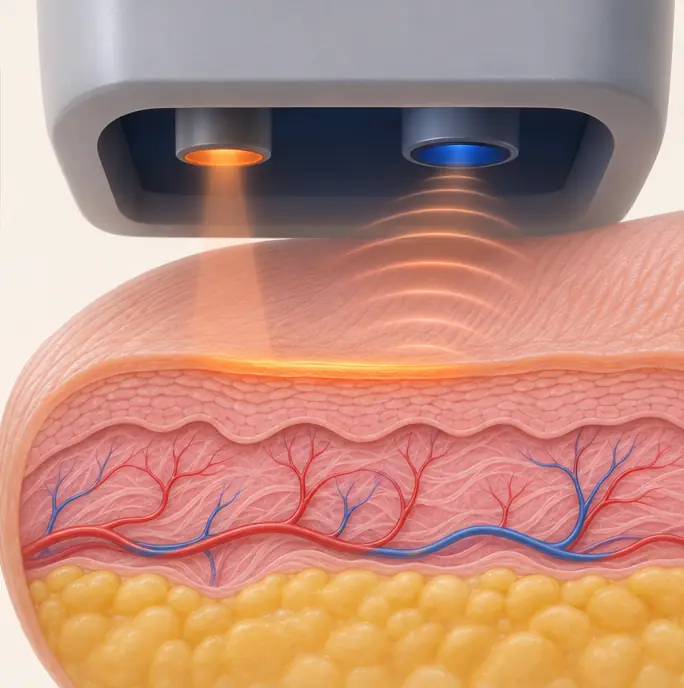
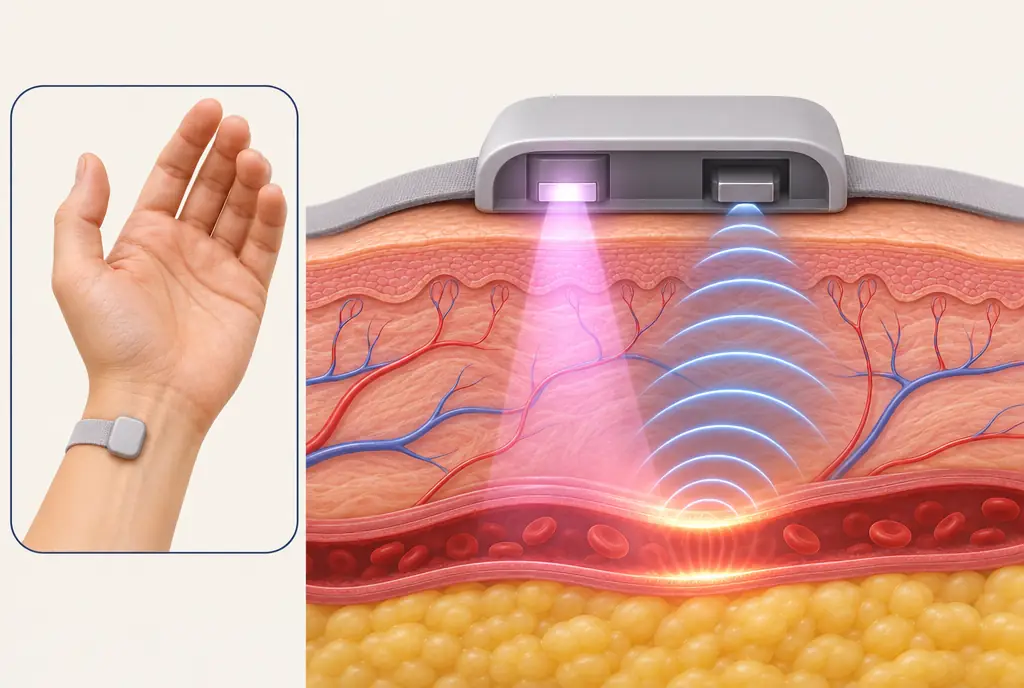
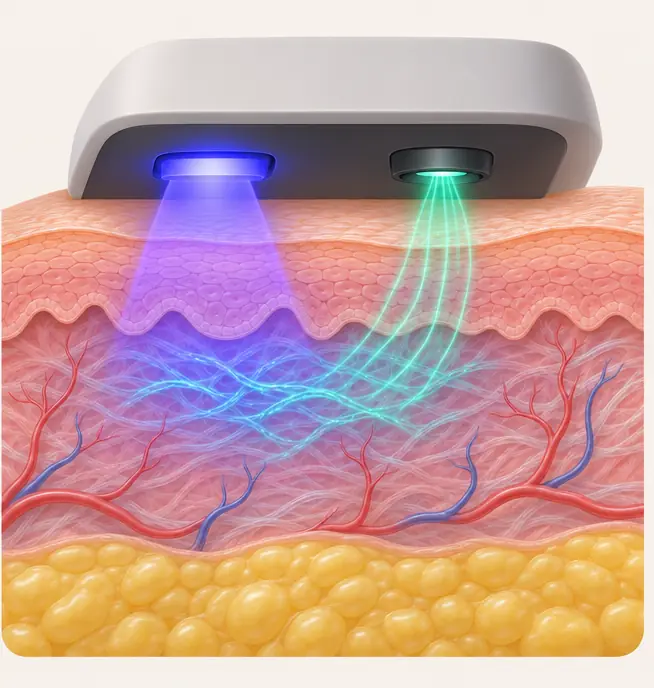
The same data as the explorer, written out for reading and printing. Diagrams are original schematics, not to scale, and contain no measured values. Illustrations are AI-generated teaching images of generic devices, checked for mechanism, and are not photos of real products.

Optical

skinLEDphotodiode
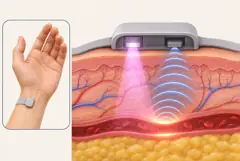
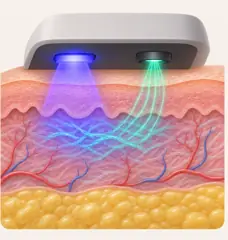
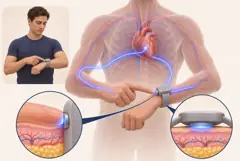
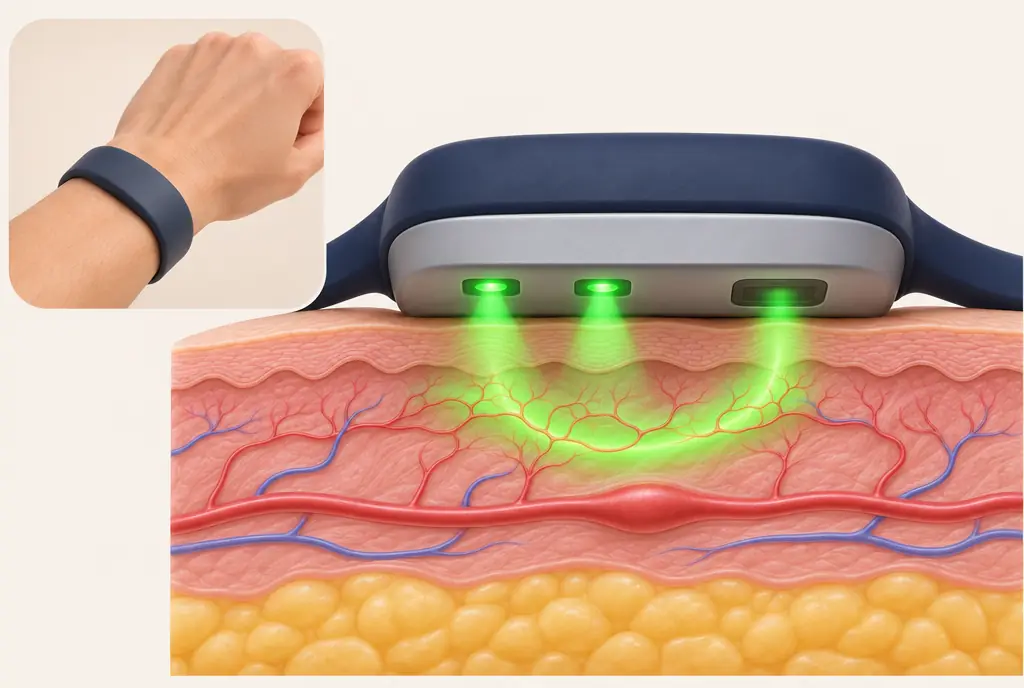
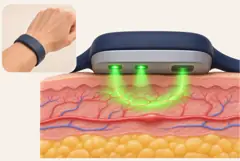
A wristband's underside with two green LEDs and a photodiode on the skin; green light curves through the upper dermis capillaries and back to the detector.
Illustration. A wristband's underside with two green LEDs and a photodiode on the skin; green light curves through the upper dermis capillaries and back to the detector. Generic device, not a real product; not to scale.

Photoplethysmography (PPG)

In consumer wearablesSome features cleared
Measures
Pulse rate, beat-to-beat intervals and pulse irregularity, from blood-volume changes
How
LEDs shine into the skin and a photodiode records how much light pulsing blood absorbs
Can't do
Identify molecules such as glucose or alcohol; measure blood pressure directly
Depth
Skin microvasculature; green light stays shallower than red or infrared
Band
Green LEDs on most watches; red and infrared on some
Worn on
Wrist, Finger or hand
FDA
Apple's PPG-based Irregular Rhythm Notification Feature was granted De Novo authorization on 11 Sep 2018, and its PPG-based Hypertension Notification Feature was cleared on 11 Sep 2025. Most PPG metrics in consumer watches are wellness features without FDA review. (DEN180042, K250507)
Devices
Apple Watch: Green LEDs with photodiodes, per FDA's De Novo summary DEN180042
Papers
Allen, 2007; Perez et al., 2019; Maas et al., 2026
Read next
What is photoplethysmography? · How a PPG sensor works · Green vs red vs infrared PPG · PPG LED wavelength selection · Tissue optical properties · Photon diffusion in PPG
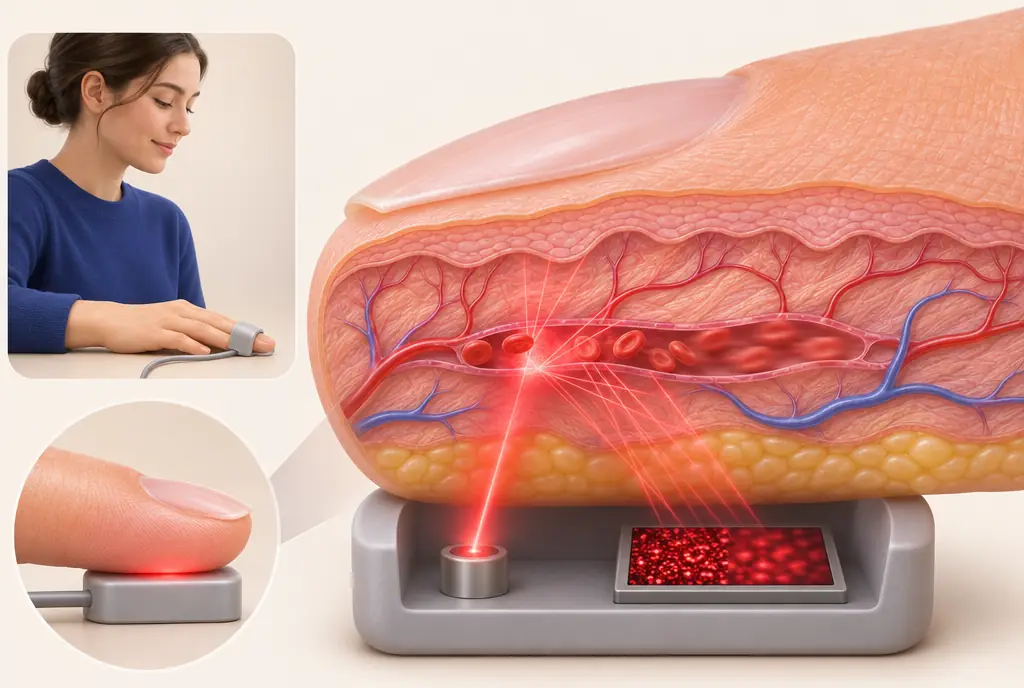
skinred + infrareddetector
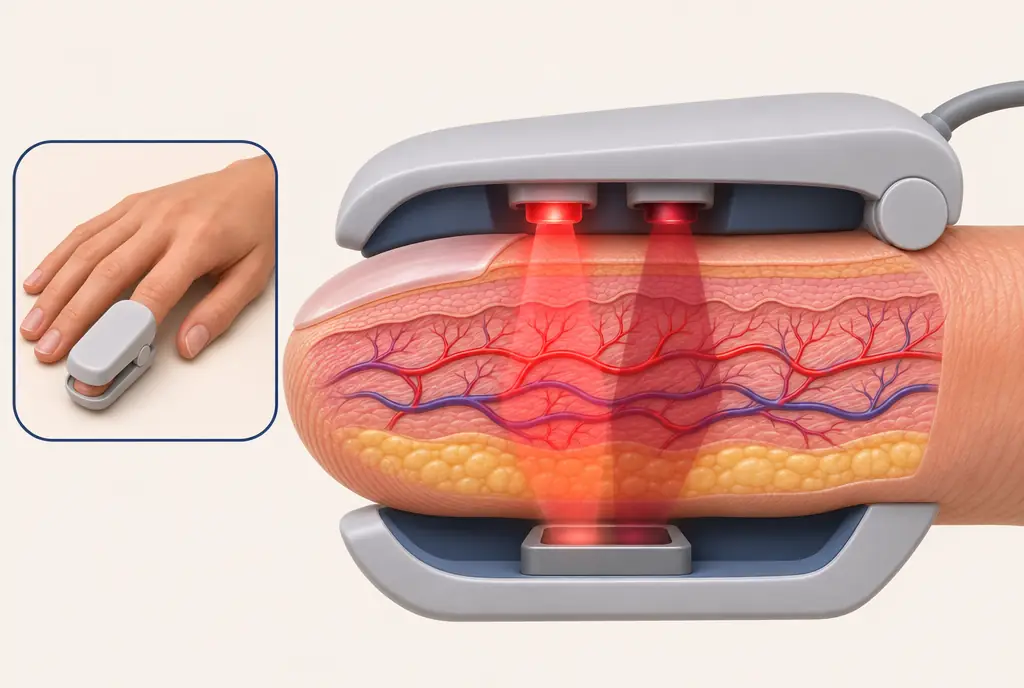
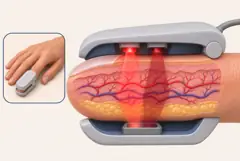
A fingertip clip with red and infrared emitters on top and a detector below; the light passes through the fingertip and its small arteries.
Illustration. A fingertip clip with red and infrared emitters on top and a detector below; the light passes through the fingertip and its small arteries. Generic device, not a real product; not to scale.

Pulse oximetry (SpO2)

In consumer wearablesCleared (Masimo W1, K232512)
Measures
Arterial blood oxygen saturation and pulse rate
How
Compares the pulsing part of red and infrared light, which oxygenated and deoxygenated hemoglobin absorb differently
Can't do
Read oxygen inside muscle or brain; stay equally accurate in every case: FDA lists skin pigmentation, poor circulation and skin temperature among factors that affect readings
Depth
Arterial pulse in skin and finger tissue
Band
Red 660 nm and infrared 940 nm in one cleared design
Worn on
Finger or hand, Wrist
FDA
Masimo W1 was cleared on 17 Nov 2023 for spot-check SpO2 and pulse rate at the wrist, plus heart rate from a single-lead ECG. Many watch SpO2 features are wellness-only. (K232512, FDA on pulse oximeter accuracy)
Devices
Masimo W1: Wrist-worn, cleared for spot-check SpO2
Read next
SpO2: how pulse oximetry works · Wearable pulse oximeter guide · How accurate is wearable SpO2? · Pulse oximeter accuracy and skin tone
skinNIR sourcefar detectorwider spacing reaches deeper
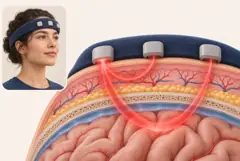
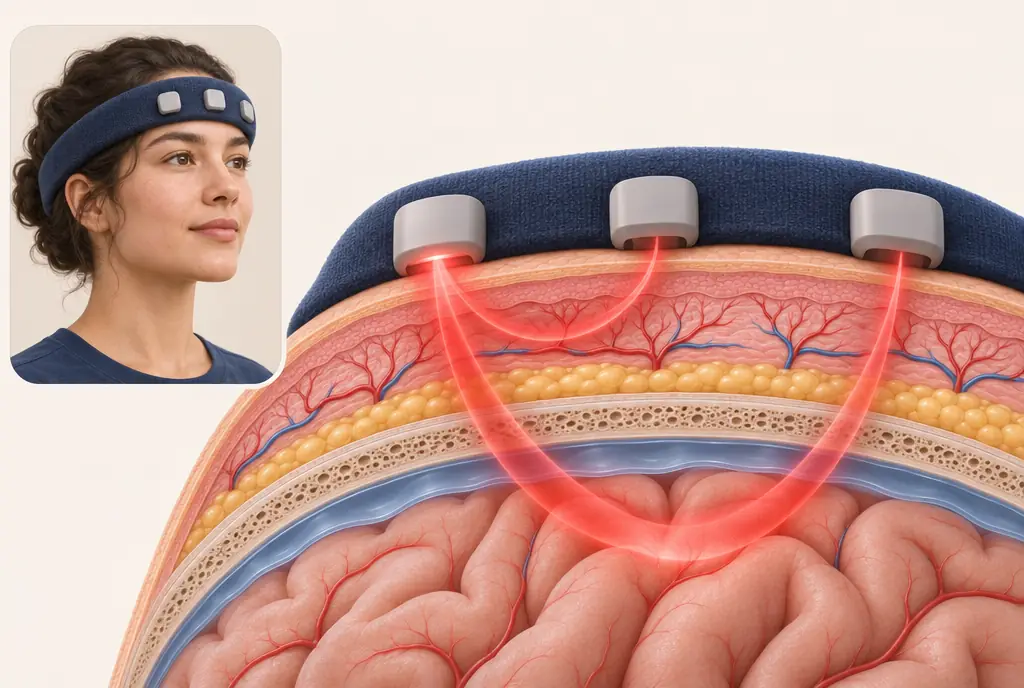
An fNIRS headband on the forehead; near-infrared light from one source arcs to a near and a far detector, the longer arc reaching the outer cortex.
Illustration. An fNIRS headband on the forehead; near-infrared light from one source arcs to a near and a far detector, the longer arc reaching the outer cortex. Generic device, not a real product; not to scale.

NIRS and fNIRS

Medical or specialist devicesCleared (hospital oximeters)
Measures
Changes in oxy- and deoxyhemoglobin in tissue; regional oxygen saturation; brain activation (fNIRS)
How
Near-infrared light travels between a source and detectors set further apart than in PPG, sampling deeper tissue
Can't do
See deep brain structures; read glucose
Depth
Deeper than wrist PPG: outer cortex through scalp and skull, or tissue under the sensor
Band
Near-infrared
Worn on
Head
FDA
Regional (tissue) oximeters such as the Masimo O3 are cleared as adjunct monitors of regional hemoglobin oxygen saturation in healthcare settings, most recently K243324 (17 Jul 2025). We did not verify the status of research fNIRS headsets. (K243324)
Devices
Masimo O3 Regional Oximeter: Hospital rSO2 monitor
Papers
Scholkmann et al., 2014; Pinti et al., 2020
Read next
How light travels in tissue
skinseveral bands
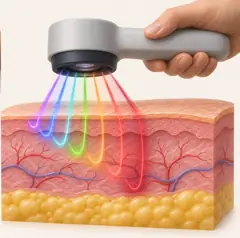
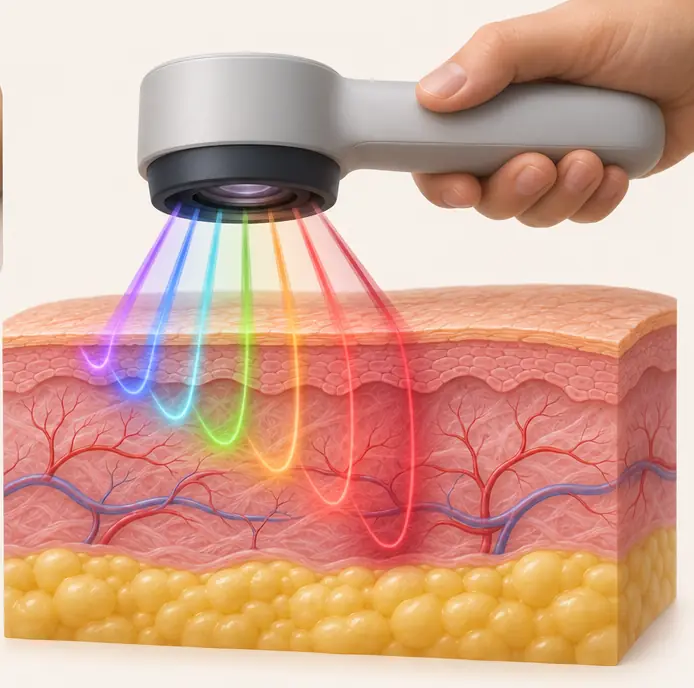
A handheld imager held above the skin; light of several colours enters the skin, with longer wavelengths reaching deeper before returning.
Illustration. A handheld imager held above the skin; light of several colours enters the skin, with longer wavelengths reaching deeper before returning. Generic device, not a real product; not to scale.

Diffuse reflectance, multi- and hyperspectral imaging

Medical or specialist devicesCleared (SnapshotNIR, K201976)
Measures
Maps of superficial tissue oxygen saturation and hemoglobin; tissue composition
How
Records the spectrum of light returning from tissue at several wavelengths, or at every pixel
Can't do
Fit on a wristband today in cleared form; read glucose
Depth
Superficial tissue
Band
Six wavelengths between 600 and 1000 nm in one cleared imager
Worn on
Skin patch
FDA
Kent Imaging's SnapshotNIR handheld imager was cleared on 10 Nov 2020 to estimate StO2 and relative oxy- and deoxyhemoglobin in superficial tissue. (K201976)
Devices
Kent Imaging SnapshotNIR: Handheld near-infrared imager, not a wearable
Papers
Lu & Fei, 2014
Read next
Multispectral rPPG imaging
skinlaserspectrumrare shifted photons
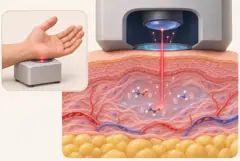
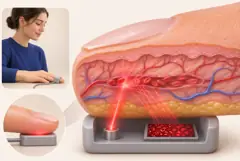
The base of the thumb rests on a small benchtop Raman instrument; a near-infrared laser enters the skin and a few shifted photons scatter back from molecules in the fluid between cells.
Illustration. The base of the thumb rests on a small benchtop Raman instrument; a near-infrared laser enters the skin and a few shifted photons scatter back from molecules in the fluid between cells. Generic device, not a real product; not to scale.

Raman spectroscopy

Research prototypesNone found
Measures
A molecular fingerprint of skin and interstitial fluid, including glucose (research)
How
A laser excites the skin and a tiny share of scattered light returns shifted by molecular vibrations
Can't do
Fit in a watch yet; the glucose signal is very weak; no FDA clearance
Depth
Skin and its interstitial fluid
Band
830 nm laser in the RSP and MIT devices
Worn on
Finger or hand, Arm
FDA
No FDA clearance or authorization for a Raman glucose monitor turned up in FDA's 510(k) and De Novo listings (searched 11 Nov 2026).
Devices
RSP Systems: Portable box, 830 nm at the base of the thumb (Pors et al., 2025); MIT and Apollon: Band-pass Raman benchtop device; phone-sized wearable prototype in testing per MIT News; Liom Health: Calibration-free pilot in 20 adults (Rothenbühler et al., 2026)
Papers
Pors et al., 2025; Bresci et al., 2026; Rothenbühler et al., 2026
Read next
Glucose monitor watch: what works today
skinmid-IR laserheat or soundabsorbed in a very thin layer
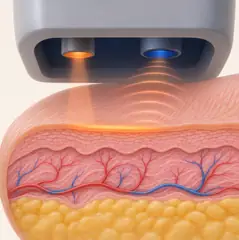
A benchtop sensor under the skin surface; mid-infrared light is absorbed in only a very thin outer layer and the heat it makes travels back to the detector.
Illustration. A benchtop sensor under the skin surface; mid-infrared light is absorbed in only a very thin outer layer and the heat it makes travels back to the detector. Generic device, not a real product; not to scale.

Mid-infrared photothermal and photoacoustic spectroscopy

Research prototypesNone found
Measures
Glucose's own infrared absorption, read through heat or sound (research)
How
A mid-infrared laser is absorbed in the skin and the resulting heat or pressure wave is detected
Can't do
Reach below a very thin skin layer, because water absorbs mid-infrared strongly; no FDA clearance
Depth
Very shallow
Band
Mid-infrared (quantum cascade lasers)
Worn on
Finger or hand
FDA
No FDA clearance or authorization for a mid-infrared glucose monitor found (searched 11 Nov 2026).
Devices
DiaMonTech prototype: Fingertip photothermal detection (Lubinski et al., 2021); CEA-Leti Physiolas: Reports a MARD of about 18% at home; institute claim, not peer reviewed; Quantune: Wrist laser spectroscopy start-up; company-reported in-vivo clinical phase from 2026, no published accuracy
Papers
Lubinski et al., 2021; Zhang et al., 2026
Read next
Glucose monitor watch: what works today
skinlight pulsesound detector
A wrist sensor over the radial artery; a light pulse reaches the artery, which emits ultrasound waves back up to an acoustic detector.
Illustration. A wrist sensor over the radial artery; a light pulse reaches the artery, which emits ultrasound waves back up to an acoustic detector. Generic device, not a real product; not to scale.

Photoacoustic (optoacoustic) sensing

Research prototypesNot verified
Measures
Artery diameter and blood-pressure waveform; blood-vessel maps (research)
How
Short light pulses heat blood slightly, which emits ultrasound that a detector times
Can't do
Run from a watch-sized light source yet; claim validation beyond two volunteers
Depth
Millimetres: the radial artery near the wrist
Band
800 nm pulsed laser in the SPADE study
Worn on
Wrist
FDA
We found no FDA-cleared wearable photoacoustic monitor and did not verify the status of non-wearable photoacoustic imagers.
Devices
Technion SPADE sensor: Proof of concept with table-top lasers (Gelbert et al., 2026)
Papers
Gelbert et al., 2026; Zhang et al., 2026
Read next
How cuffless BP devices are validated
skinUV–blue inlonger glow outfluorescent AGEs in skin
A desktop reader under the forearm; violet-blue light excites proteins in the dermis, which glow blue-green back to a detector.
Illustration. A desktop reader under the forearm; violet-blue light excites proteins in the dermis, which glow blue-green back to a detector. Generic device, not a real product; not to scale.

Skin autofluorescence (AGEs)

Research prototypesNot verified
Measures
Build-up of fluorescent advanced glycation end products in skin over months to years
How
Ultraviolet to blue light excites the skin and a longer-wavelength glow is measured
Can't do
Read today's glucose; it reflects long-term accumulation
Depth
Skin
Band
300–420 nm excitation, 420–600 nm emission
Worn on
Arm
FDA
We found no 510(k) entry for a skin autofluorescence reader and did not confirm its status elsewhere.
Devices
Autofluorescence Reader: The device validated against biopsies by Meerwaldt et al. (2004)
Papers
Meerwaldt et al., 2004
skinlaserspeckle
A fingertip on a sensor with a laser diode; red laser light scatters off moving red cells and forms a grainy speckle pattern on an image sensor.
Illustration. A fingertip on a sensor with a laser diode; red laser light scatters off moving red cells and forms a grainy speckle pattern on an image sensor. Generic device, not a real product; not to scale.

Speckle: SPG, LSCI and SCOS

Medical or specialist devicesCleared (FlowMet-R, K182494)
Measures
A relative blood-flow index, beat by beat
How
A coherent laser makes a grainy speckle pattern that blurs faster when red cells move faster
Can't do
Give absolute flow without extra modelling; work with ordinary LEDs
Depth
Skin microvessels; diffuse versions reach the brain
Band
Narrow-linewidth lasers, visible to near-infrared
Worn on
Finger or hand, Head
FDA
FlowMet-R from Laser Associated Sciences was cleared on 27 Feb 2019 as a blood flowmeter. (K182494)
Devices
FlowMet-R: Toe-worn laser speckle blood-flow device
Papers
Boas & Dunn, 2010; Ghijsen et al., 2018
Read next
Speckle plethysmography (SPG) explained
skincoherent NIRfast detectorflicker rate tracks flow
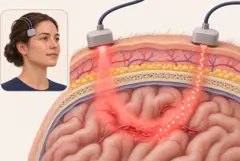
Two optical probes on the head several centimetres apart; near-infrared light travels through the outer cortex, scatters off moving red cells and returns as discrete photons.
Illustration. Two optical probes on the head several centimetres apart; near-infrared light travels through the outer cortex, scatters off moving red cells and returns as discrete photons. Generic device, not a real product; not to scale.

Diffuse correlation spectroscopy (DCS)

Research prototypesNot verified
Measures
Microvascular blood flow, notably in the brain
How
Times how fast near-infrared light intensity fluctuates after scattering off moving red cells
Can't do
Run on a consumer wearable today
Depth
Deep tissue, including cortex
Band
Near-infrared
Worn on
Head
FDA
Not verified
Papers
Durduran & Yodh, 2014
Read next
Speckle and SCOS, a camera cousin of DCS
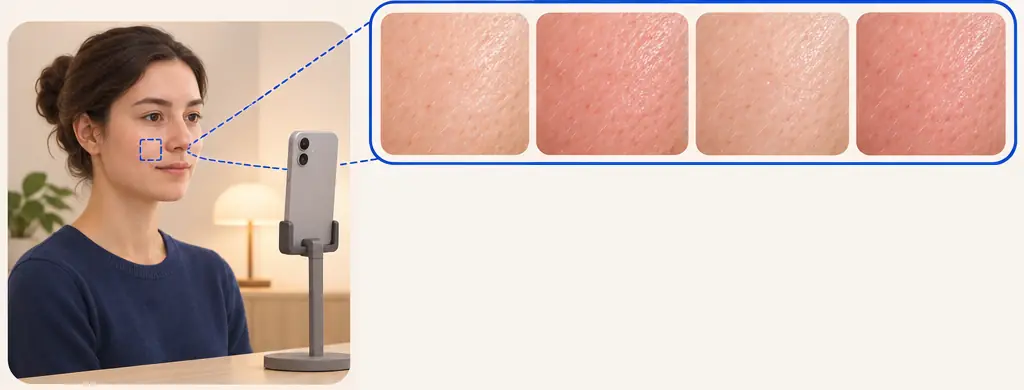
facecameracolour change
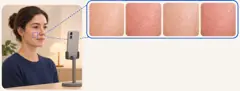
A phone on a stand films a seated person's face; magnified patches of cheek skin alternate between slightly pinker and slightly paler with each heartbeat.
Illustration. A phone on a stand films a seated person's face; magnified patches of cheek skin alternate between slightly pinker and slightly paler with each heartbeat. Generic device, not a real product; not to scale.

Camera rPPG

Medical or specialist devicesSome cleared (e.g. K253650)
Measures
Pulse rate and breathing rate from video
How
A camera picks up tiny colour changes in the face with each heartbeat
Can't do
Match contact sensors in poor light or with motion; read blood pressure reliably
Depth
Skin surface reflections
Band
Ambient visible light; the green channel carries most pulse signal
Worn on
Face (camera)
FDA
FDA has a product code for camera-based pulse and breathing rate software. NuraLogix's Anura Mobile Core SDK was cleared on 11 Jun 2026 for prescription spot measurement of pulse and breathing rate. (K253650)
Devices
NuraLogix Anura Mobile Core SDK: Smartphone camera software
Papers
Verkruysse et al., 2008
Read next
rPPG: the complete guide · Multispectral rPPG · rPPG and FDA status

Electrical

skinelectrodeelectrodevoltage or conductance
A finger touches a watch's side button while the watch sits on the other wrist; the heart's electrical signal runs through both arms to close the circuit.
Illustration. A finger touches a watch's side button while the watch sits on the other wrist; the heart's electrical signal runs through both arms to close the circuit. Generic device, not a real product; not to scale.

Electrocardiography (ECG)

In consumer wearablesCleared (many, e.g. DEN180044)
Measures
The heart's electrical activity: rhythm, including atrial fibrillation, and heart rate
How
Electrodes on the skin record voltage differences; a watch closes the circuit when you touch its crown or bezel
Can't do
Replace a 12-lead ECG for most diagnoses from a single lead; record continuously on a watch without touch
Depth
Surface potentials from the whole heart
Band
Biopotential (electrical)
Worn on
Wrist, Chest
FDA
Apple's ECG app received De Novo authorization on 11 Sep 2018. Later over-the-counter ECG apps include Fitbit (K200948), Garmin (K221774), Samsung (K240909) and Withings (K240795). (DEN180044, K200948, K221774)
Devices
Apple Watch ECG app: Single-lead, on-demand
Papers
Bumgarner et al., 2018
Read next
PPG vs ECG: the full comparison · PPG vs ECG accuracy · ECG vs heart rate monitoring
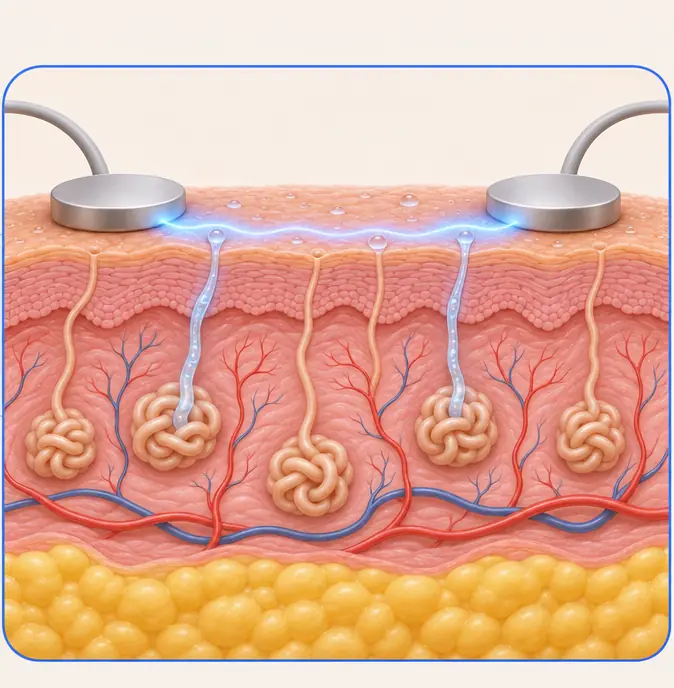
skinelectrodeelectrodevoltage or conductance
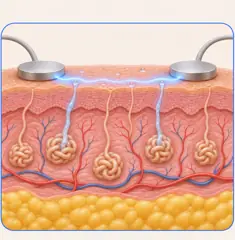
Two flat electrodes on the skin with a small current between them; coiled sweat glands in the dermis fill their ducts, making the skin more conductive.
Illustration. Two flat electrodes on the skin with a small current between them; coiled sweat glands in the dermis fill their ducts, making the skin more conductive. Generic device, not a real product; not to scale.

Electrodermal activity (EDA, galvanic skin response)

Medical or specialist devicesCleared (Embrace, K172935)
Measures
Changes in skin conductance driven by sympathetic nerve input to sweat glands
How
Two electrodes apply a tiny voltage and measure how easily current passes through the skin
Can't do
Tell which emotion caused arousal; diagnose stress on its own
Depth
Skin and sweat ducts
Band
Low-level DC or AC electrical
Worn on
Wrist
FDA
Empatica's Embrace, which senses EDA and motion at the wrist, was cleared on 26 Jan 2018 as a prescription adjunct for detecting patterns that may be associated with generalized tonic-clonic seizures. (K172935)
Devices
Empatica Embrace: Wrist EDA plus accelerometer
Papers
Posada-Quintero & Chon, 2020
Read next
Can a smartwatch detect stress? · Stress detection methods
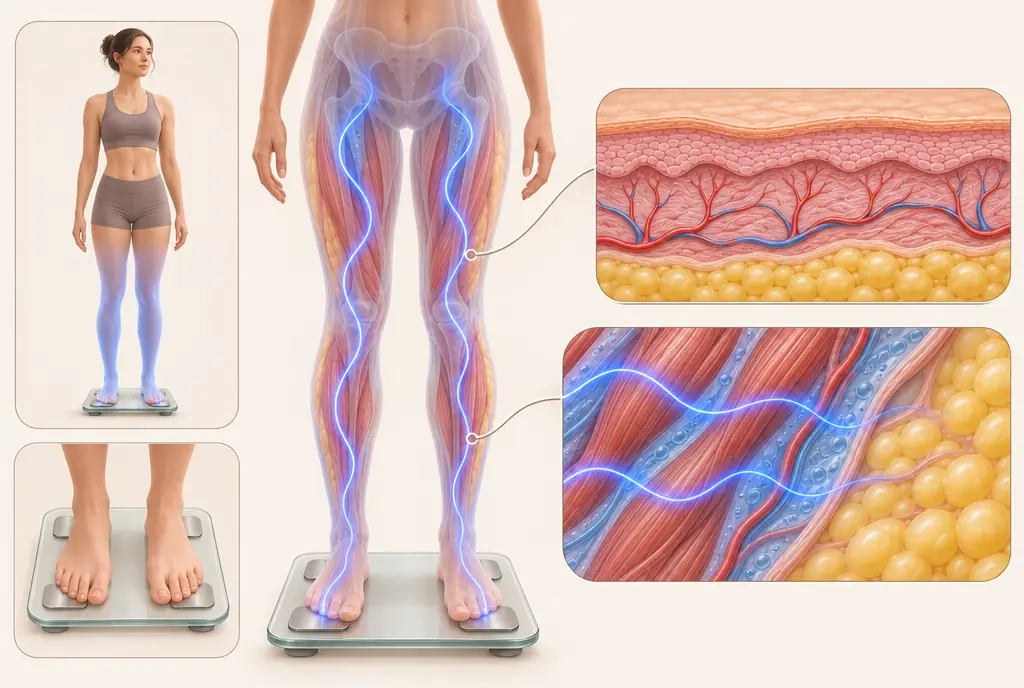
skinI+I−VVtiny AC current, measured voltage
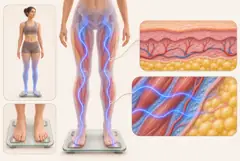
Bare feet on a scale with four metal pads; a small alternating current travels up one leg and down the other, mostly through muscle and water-rich tissue rather than fat.
Illustration. Bare feet on a scale with four metal pads; a small alternating current travels up one leg and down the other, mostly through muscle and water-rich tissue rather than fat. Generic device, not a real product; not to scale.

Bioimpedance (BIA, BIS, impedance plethysmography)

In consumer wearablesSome cleared (e.g. K180126)
Measures
Estimates of body water and fat-free mass; fluid shifts; breathing from chest impedance
How
A tiny alternating current passes through the body and the voltage drop gives impedance, at one or many frequencies
Can't do
Give accurate body fat without equations matched to the population; read reliably when hydration changes
Depth
Bulk tissue between the electrodes
Band
Alternating current, single or multi-frequency
Worn on
Finger or hand, Arm, Chest
FDA
ImpediMed's SOZO bioimpedance spectroscopy device was cleared on 16 Apr 2018 for lymphedema assessment (L-Dex). Nanowear's SimpleSense records respiration through thoracic impedance (K232053, 8 Dec 2023). We did not verify the status of consumer BIA scales. (K180126, K232053)
Devices
ImpediMed SOZO: Bioimpedance spectroscopy for lymphedema; Nanowear SimpleSense: Garment with ECG, thoracic impedance and heart sounds
Papers
Kyle et al., 2004
Read next
Hydration monitoring with PPG
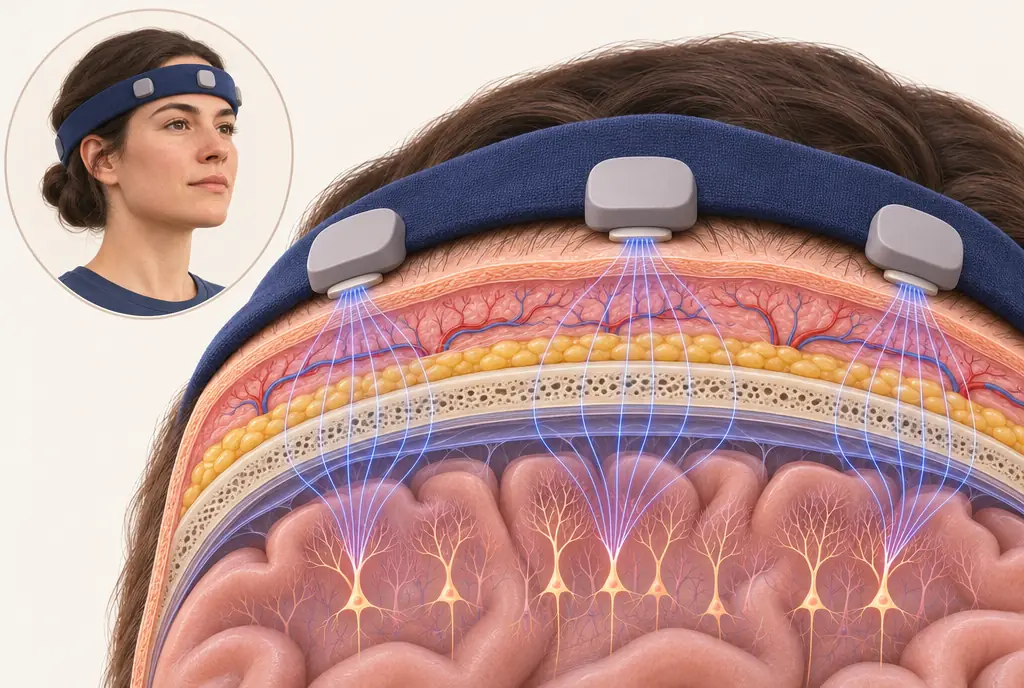
scalp electrodes
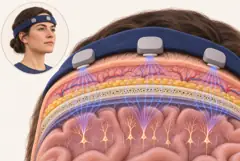
A headband with dry electrodes on the scalp; faint electrical fields from neurons in the outer cortex reach the electrodes through skull and skin.
Illustration. A headband with dry electrodes on the scalp; faint electrical fields from neurons in the outer cortex reach the electrodes through skull and skin. Generic device, not a real product; not to scale.

Electroencephalography (EEG)

Medical or specialist devicesCleared (Dreem 3S, K223539)
Measures
The brain's electrical activity; sleep stages
How
Scalp electrodes record microvolt-level voltage changes from the cortex
Can't do
Locate activity precisely or see deep structures; work well with poor electrode contact
Depth
Cortical surface potentials through the scalp
Band
Biopotential (electrical)
Worn on
Head
FDA
The Dreem 3S headband (6 EEG electrodes and a 3D accelerometer) was cleared on 18 Aug 2023 for prescription use to assess sleep. (K223539)
Devices
Dreem 3S: Dry-electrode sleep headband
Papers
Arnal et al., 2020
Read next
PPG sleep tracking vs polysomnography
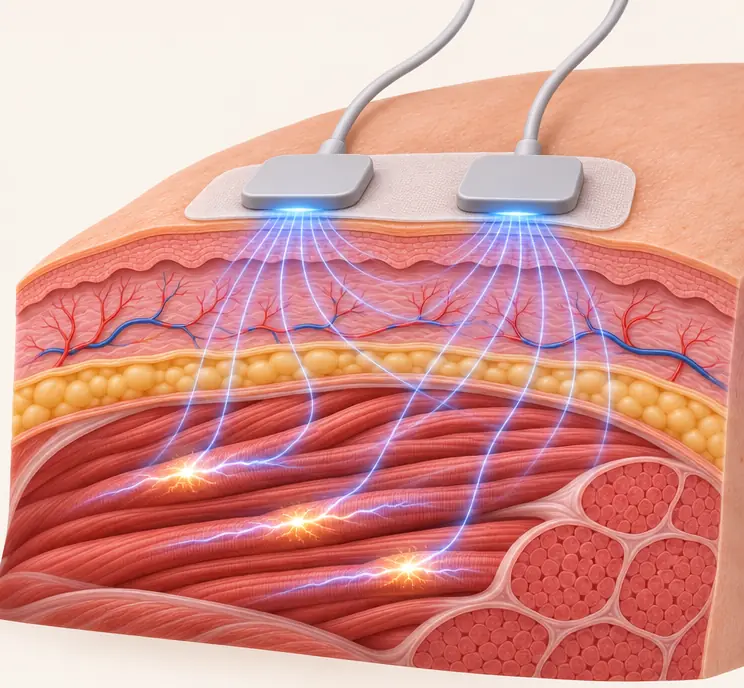
skinelectrodes over musclemuscle fibres
A two-electrode patch over the upper-arm muscle; firing muscle fibres give off small electrical bursts that reach the electrodes.
Illustration. A two-electrode patch over the upper-arm muscle; firing muscle fibres give off small electrical bursts that reach the electrodes. Generic device, not a real product; not to scale.

Surface electromyography (EMG)

Medical or specialist devicesCleared (SPEAC, K182180)
Measures
Electrical activity of muscles
How
Electrodes over a muscle record the voltage from its contracting fibres
Can't do
Measure muscles far from the electrode; avoid skin irritation from adhesive patches over long wear
Depth
Muscle under the electrodes
Band
Biopotential (electrical)
Worn on
Arm
FDA
Brain Sentinel's SPEAC System, a biceps-worn surface EMG seizure monitor, was cleared on 11 May 2019. (K182180)
Devices
SPEAC System: Biceps sEMG for tonic-clonic seizure alerts
Papers
Halford et al., 2017

Mechanical

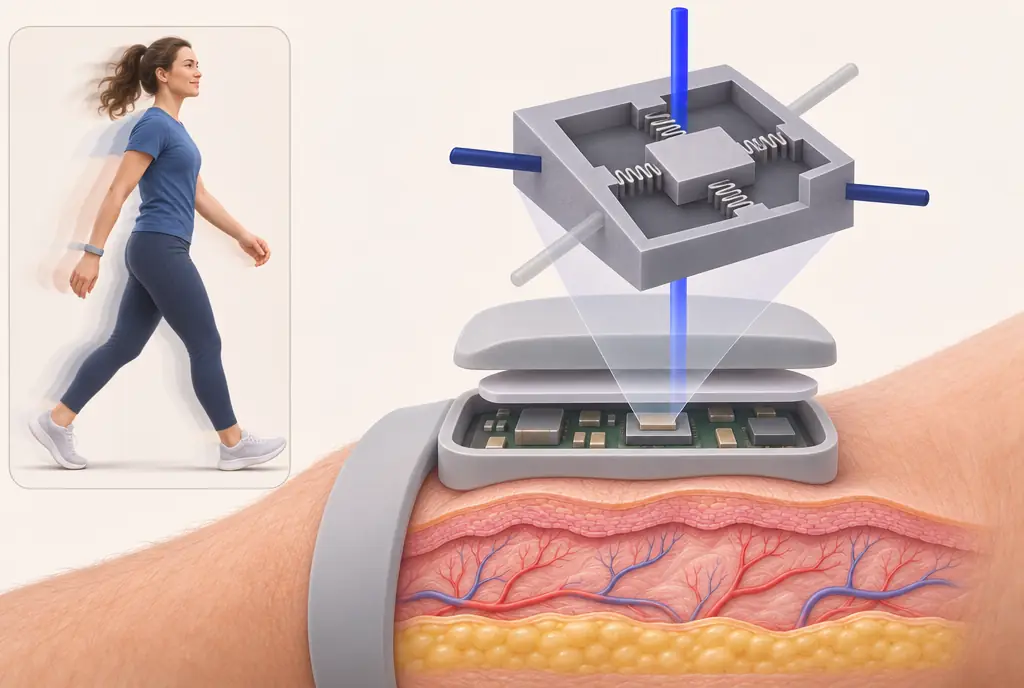
xzy
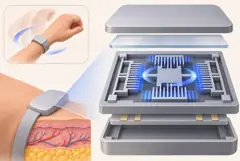
An exploded view of a wristband's MEMS accelerometer: a proof mass on springs inside a silicon frame, with three axes around it.
Illustration. An exploded view of a wristband's MEMS accelerometer: a proof mass on springs inside a silicon frame, with three axes around it. Generic device, not a real product; not to scale.

Accelerometer and actigraphy

In consumer wearablesCleared (e.g. Actiwatch, K983533)
Measures
Movement, steps, activity and sleep-wake estimates
How
A tiny proof mass measures acceleration on three axes many times a second
Can't do
Match polysomnography for sleep stages; know why you are still
Depth
Whole-limb motion
Band
Inertial (mechanical)
Worn on
Wrist
FDA
Mini-Mitter's Actiwatch was cleared on 23 Mar 1999. Step and activity counts in consumer devices are wellness features. (K983533)
Devices
Actiwatch: Research and clinical actigraph
Papers
Ancoli-Israel et al., 2003
Read next
Actigraphy: what the movement record means · PPG motion artifact removal
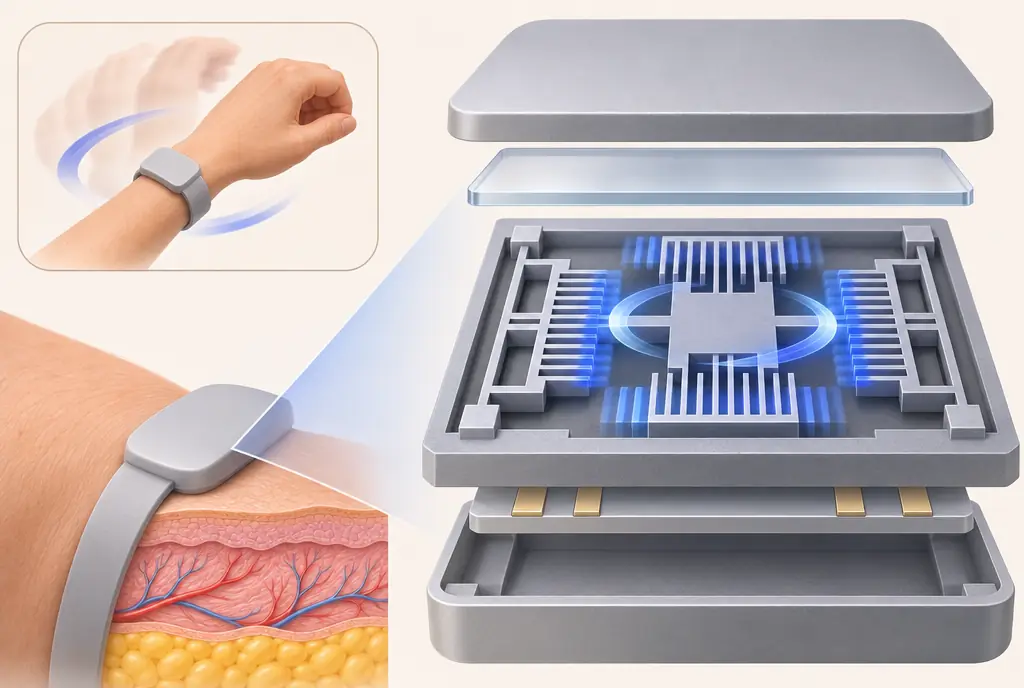
rotation rate
An exploded view of a MEMS gyroscope chip with a vibrating comb-drive structure that senses the wrist's rotation.
Illustration. An exploded view of a MEMS gyroscope chip with a vibrating comb-drive structure that senses the wrist's rotation. Generic device, not a real product; not to scale.

Gyroscope

In consumer wearablesNot verified
Measures
Rotation rate and, with the accelerometer, orientation and gait
How
A vibrating micro-structure senses rotation through the Coriolis effect
Can't do
Measure physiology directly; it describes movement
Depth
Limb or body rotation
Band
Inertial (mechanical)
Worn on
Wrist
FDA
Not verified
Read next
Detecting motion artifacts in PPG
chest sensorrecoil
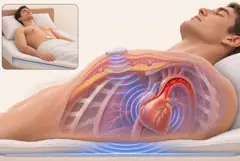
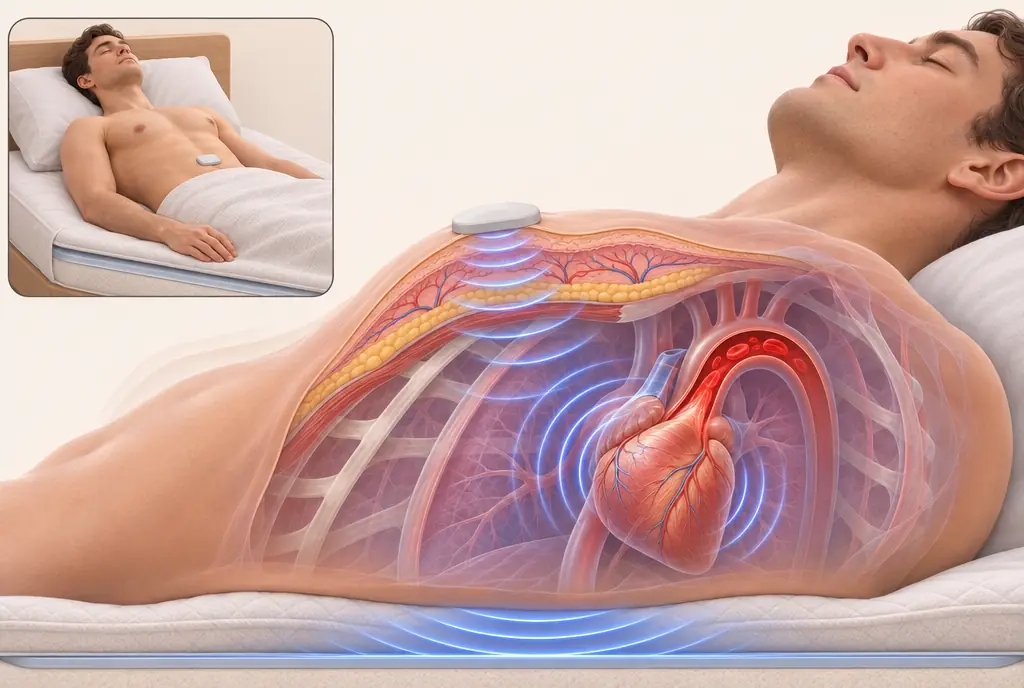
A person lying in bed with a patch on the lower sternum and a sensor sheet under the mattress; vibrations from each heartbeat spread to both sensors.
Illustration. A person lying in bed with a patch on the lower sternum and a sensor sheet under the mattress; vibrations from each heartbeat spread to both sensors. Generic device, not a real product; not to scale.

Ballistocardiography and seismocardiography (BCG, SCG)

Research prototypesNot verified
Measures
The body's recoil and chest-wall vibration with each heartbeat
How
Accelerometers on the chest (SCG) or force sensors that feel the whole body recoil (BCG) pick up the mechanical heartbeat
Can't do
Work well during movement; give standardised clinical metrics yet
Depth
Whole-body or chest-wall motion
Band
Mechanical vibration
Worn on
Chest, Contactless (room or bed)
FDA
Not verified
Papers
Inan et al., 2015
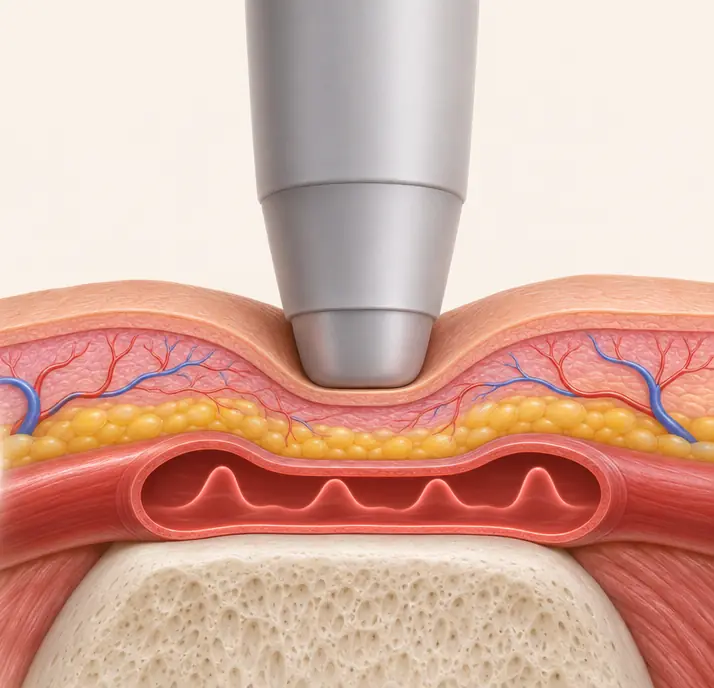
skinpressbone behind the artery
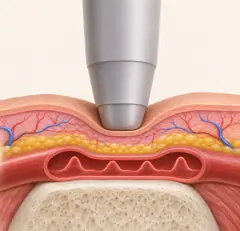
A pen-like pressure probe flattens the top of the radial artery against the bone beneath it, so the pressure pulse inside reaches the sensor.
Illustration. A pen-like pressure probe flattens the top of the radial artery against the bone beneath it, so the pressure pulse inside reaches the sensor. Generic device, not a real product; not to scale.

Arterial tonometry

Medical or specialist devicesNot verified for wearables
Measures
The arterial pressure waveform at a superficial artery
How
A sensor presses an artery against bone until its wall flattens, then records the pulse pressure
Can't do
Reach deep central arteries; hold position easily in a wearable
Depth
Superficial arteries such as the radial artery
Band
Mechanical pressure
Worn on
Wrist
FDA
Not verified for wearables
Papers
Wang et al., 2018
Read next
Pulse wave velocity · When will cuffless blood pressure be ready?

Thermal, acoustic, RF and ultrasound

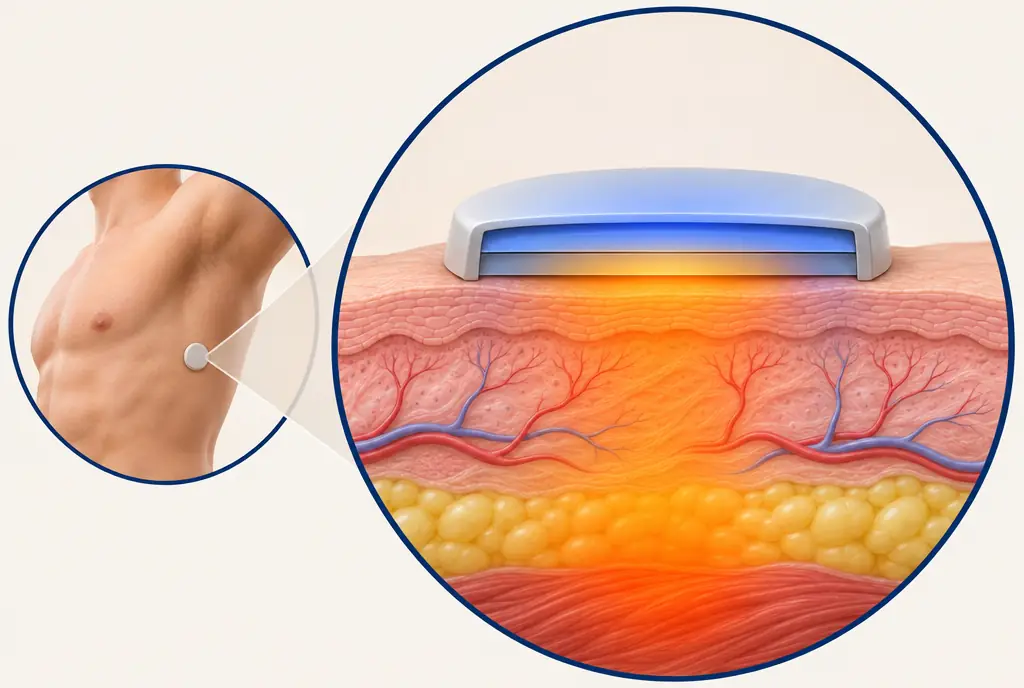
skinthermistor or heat-fluxheat leaving the body
A round patch on the side of the chest; heat flows from warmer deep tissue out through the skin into the sensor, which is cooler at its outer face.
Illustration. A round patch on the side of the chest; heat flows from warmer deep tissue out through the skin into the sensor, which is cooler at its outer face. Generic device, not a real product; not to scale.

Skin temperature and heat-flux core temperature

In consumer wearablesSome cleared (BioButton, K241101)
Measures
Skin temperature trends; estimated core temperature from heat flow
How
A thermistor reads skin temperature; a heat-flux sensor also measures heat leaving the body to estimate core temperature
Can't do
Equal core temperature from skin alone; heat-flux estimates did not validate in one heat-stress study
Depth
Skin surface
Band
Thermal (infrared emission or contact)
Worn on
Finger or hand, Wrist, Chest
FDA
BioIntelliSense's BioButton, which collects skin temperature with a thermistor along with heart and breathing rate, was cleared on 26 Sep 2024 for use by healthcare professionals. We did not verify any heat-flux core temperature sensor. (K241101)
Devices
BioButton: Chest-worn patch, healthcare use
Papers
Maijala et al., 2019; Verdel et al., 2021
Read next
How temperature affects PPG
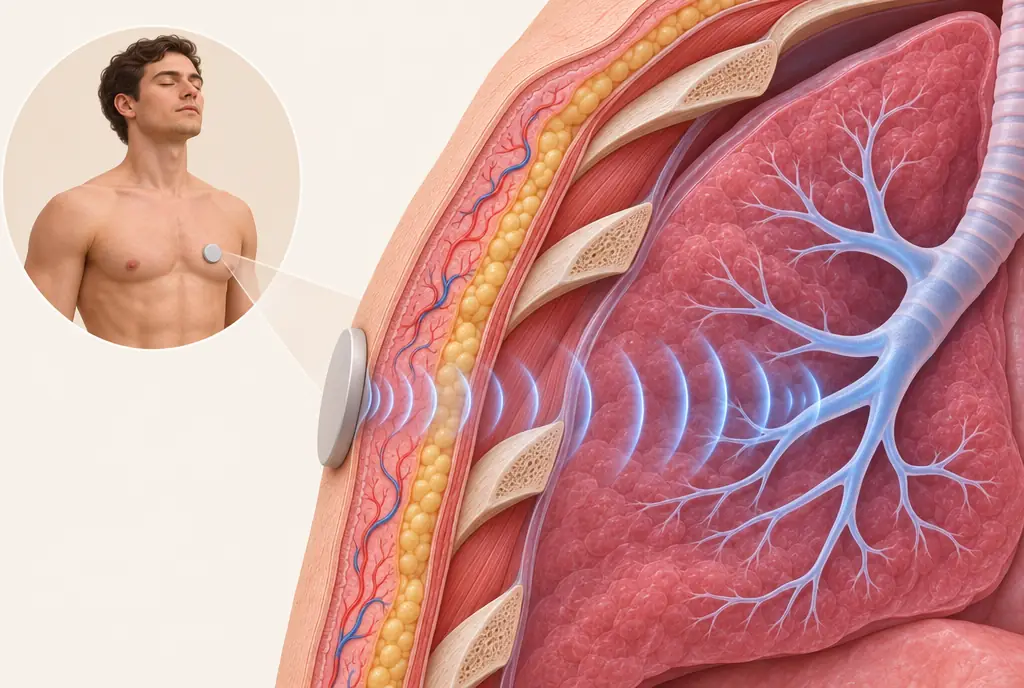
chest microphone
A disc-shaped contact microphone on the chest; sound from air moving in the airways travels through the lung and chest wall to the sensor.
Illustration. A disc-shaped contact microphone on the chest; sound from air moving in the airways travels through the lung and chest wall to the sensor. Generic device, not a real product; not to scale.

Acoustic sensing

Medical or specialist devicesCleared (Strados RESP, K201077)
Measures
Lung and heart sounds
How
Contact microphones on the chest record sounds for later review
Can't do
Interpret sounds without a clinician or validated algorithm
Depth
Chest
Band
Audible sound
Worn on
Chest
FDA
The Strados Remote Electronic Stethoscope Platform, which includes a wearable component, was cleared on 20 Dec 2020 to record lung sounds for clinician review. (K201077)
Devices
Strados RESP: Wearable lung-sound recorder
Read next
Respiratory rate from PPG
radarchest motion
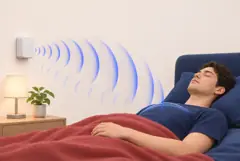
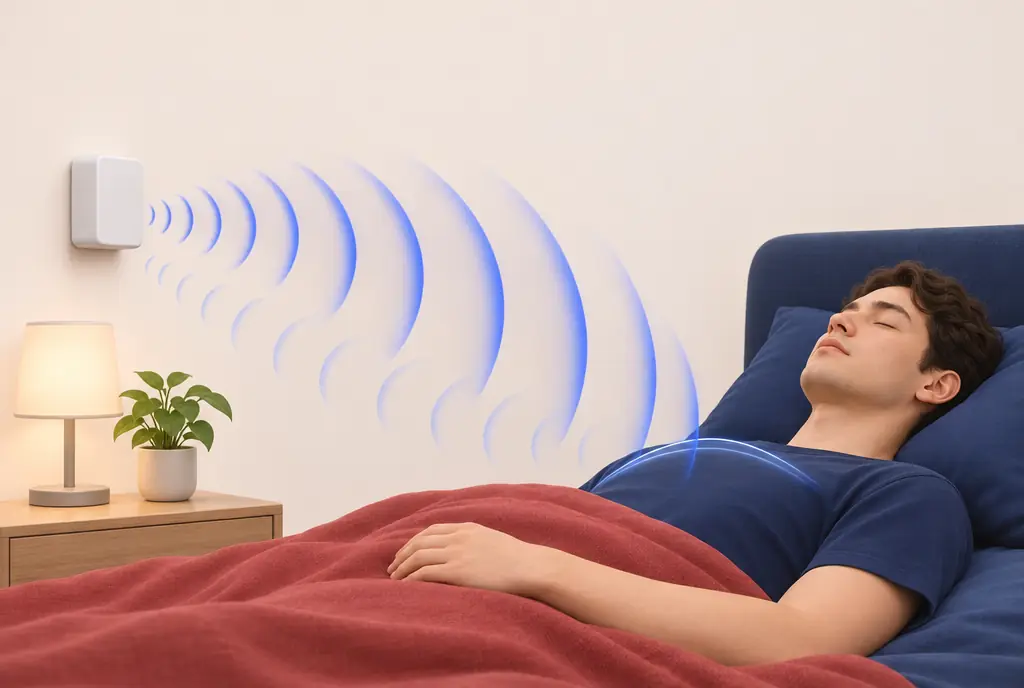
A small radar box on a bedroom wall sends faint radio waves to a sleeping person's chest and picks up the reflections, which shift as the chest rises and falls.
Illustration. A small radar box on a bedroom wall sends faint radio waves to a sleeping person's chest and picks up the reflections, which shift as the chest rises and falls. Generic device, not a real product; not to scale.

Radar and RF sensing

Medical or specialist devicesCleared (Xandar Kardian XK300, K202464)
Measures
Heart and breathing rate from tiny chest movements, without contact
How
Radio pulses bounce off the body and their timing shifts with chest motion
Can't do
Read blood glucose: we found no peer-reviewed clinical accuracy or FDA clearance for RF glucose claims
Depth
Body surface motion
Band
Radio and microwave (impulse radio ultra-wideband in the cleared example)
Worn on
Contactless (room or bed)
FDA
Xandar Kardian's XK300 uses impulse radio ultra-wideband radar to measure heart and respiration rate in adults in general care and nursing homes; cleared 26 Apr 2021. RF glucose devices: none found. (K202464)
Devices
Xandar Kardian XK300: Contactless IR-UWB radar, room-mounted
Read next
Radar-based vital signs
skintransducerecho from a deep vessel
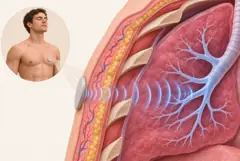
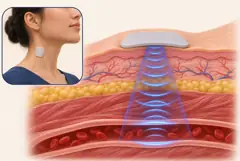
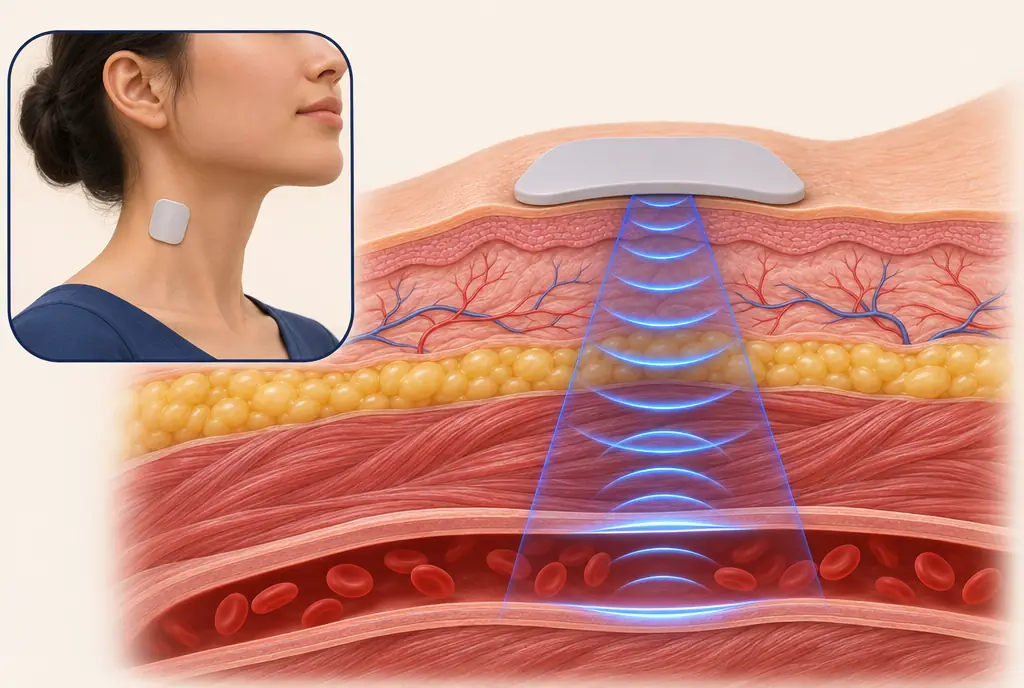
A thin patch on the side of the neck sends a narrow ultrasound beam down through skin, fat and muscle to the carotid artery and receives echoes from its walls.
Illustration. A thin patch on the side of the neck sends a narrow ultrasound beam down through skin, fat and muscle to the carotid artery and receives echoes from its walls. Generic device, not a real product; not to scale.

Wearable ultrasound

Research prototypesNot verified for wearables
Measures
Artery diameter and blood-pressure waveforms in deep vessels; tissue images
How
A thin transducer sends sound pulses and times the echoes from vessel walls
Can't do
Be called a cleared wearable yet; it is a mechanical wave, not light
Depth
Deep: centimetres, including the carotid artery
Band
Ultrasound (mechanical wave)
Worn on
Chest, Arm
FDA
Not verified for wearables
Papers
Wang et al., 2018
Read next
Blood pressure estimation methods

Biochemical

skinelectrochemical patchsweat glands
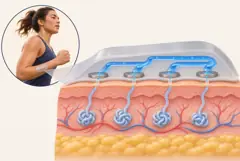
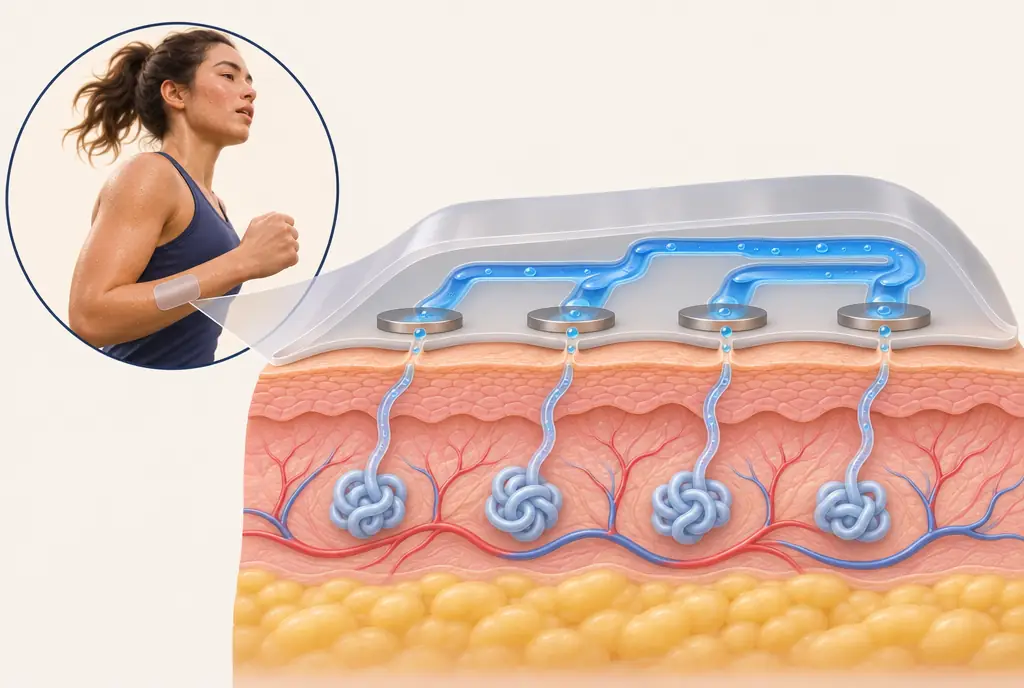
A flexible patch on the forearm of a runner; sweat rises from coiled glands into microchannels and flows over small electrode sensors.
Illustration. A flexible patch on the forearm of a runner; sweat rises from coiled glands into microchannels and flows over small electrode sensors. Generic device, not a real product; not to scale.

Sweat sensors

Research prototypesNot verified
Measures
Sweat electrolytes and metabolites such as sodium, potassium, lactate and glucose
How
Electrochemical sensors on a flexible patch react with compounds in sweat
Can't do
Stand in for blood glucose; work without enough sweat
Depth
Skin surface
Band
Electrochemical
Worn on
Skin patch
FDA
Not verified
Papers
Gao et al., 2016
Read next
Hydration monitoring
skinmicroneedle arrayouter skin, interstitial fluid
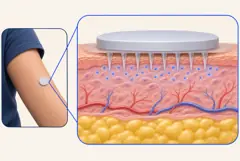
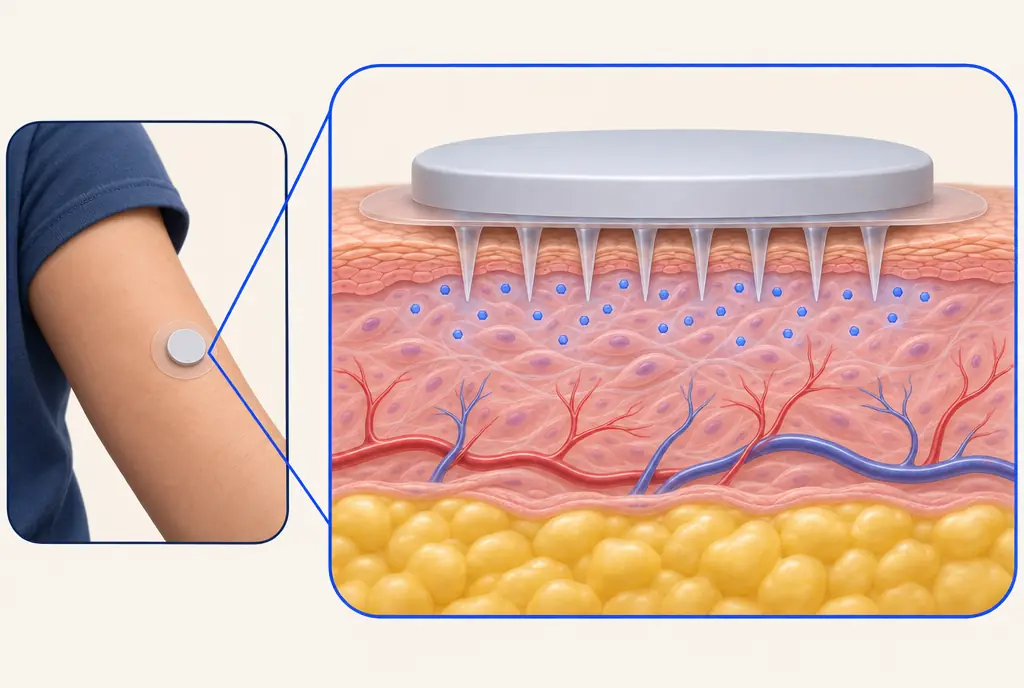
A small disc on the arm with very short microneedles reaching only the outer skin, their tips in the fluid between cells and above the blood vessels.
Illustration. A small disc on the arm with very short microneedles reaching only the outer skin, their tips in the fluid between cells and above the blood vessels. Generic device, not a real product; not to scale.

Microneedle intradermal sensors

Medical or specialist devicesAuthorized (Biolinq Shine, DEN240080)
Measures
Glucose trends in interstitial fluid, shown as a colour-changing light
How
An array of tiny electrochemical sensors sits in the outer skin and reads interstitial glucose
Can't do
Serve people on insulin under its authorization; show a number on the sensor itself
Depth
Intradermal
Band
Electrochemical
Worn on
Skin patch
FDA
Biolinq Shine was granted De Novo authorization on 23 Sep 2025 for adults 22 and older not on insulin. (DEN240080)
Devices
Biolinq Shine: Intradermal glucose range indicator
Read next
Glucose monitor watch: what works today
skinsensor puckfilament in fluid under the skin
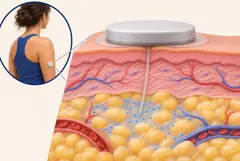
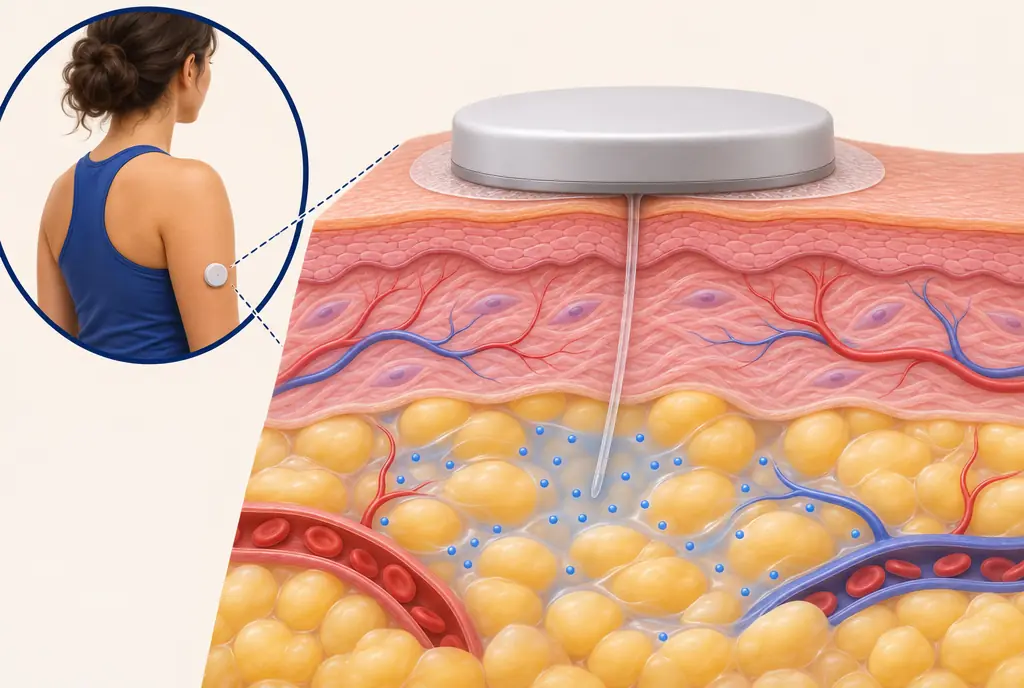
A sensor disc on the back of the upper arm with one thin filament that passes through the skin into the fluid around fat cells below.
Illustration. A sensor disc on the back of the upper arm with one thin filament that passes through the skin into the fluid around fat cells below. Generic device, not a real product; not to scale.

Continuous glucose monitors (CGM)

In consumer wearablesCleared (e.g. DEN170088, K234070)
Measures
Interstitial glucose every few minutes
How
A thin sensor filament under the skin reads glucose electrochemically
Can't do
Avoid piercing the skin; claims of an 'optical CGM' in a watch are not FDA authorized
Depth
Subcutaneous interstitial fluid
Band
Electrochemical
Worn on
Skin patch
FDA
Dexcom G6 was authorized via De Novo on 27 Mar 2018 as a factory-calibrated integrated CGM. Dexcom Stelo was cleared on 5 Mar 2024 as an over-the-counter CGM. (DEN170088, K234070)
Devices
Dexcom G6: Prescription integrated CGM; Dexcom Stelo: Over-the-counter CGM
Read next
Glucose monitor watch: what works today · Wearable hypoglycemia detection

Frequently asked questions

Which smartwatches have ECG?

ECG hardware is model-specific. In ChatPPG's manufacturer-verified inventory, current examples that officially list ECG include Apple Watch Series 12 and Ultra 4 (not SE 3), Galaxy Watch9, Pixel Watch 4, Fitbit Sense 2 and Charge 6, Garmin fēnix 8, Polar Vantage V3 and Grit X2, Withings ScanWatch 2, and WHOOP MG. WHOOP 5.0, Oura Ring 4 and 5, COROS PACE 3 and PACE Pro, Suunto Race, Amazfit T-Rex 3, Ultrahuman rings, Empatica EmbracePlus, and Sensor Bio V2 do not list ECG hardware. Features can still depend on country and software. See the ECG in smartwatches table.

What can a wearable actually sense?

Wearables sense light, electricity, motion, heat, sound, radio waves and chemistry. Light gives pulse, blood oxygen and blood flow. Electrodes give the heart's, brain's and muscles' electrical activity, skin conductance and body impedance. Motion sensors give activity and sleep estimates. Chemical sensors in or on the skin give glucose and sweat electrolytes. A typical wristband combines optical PPG, an accelerometer and sometimes ECG electrodes, skin temperature and EDA.
What are the main types of biosensors in wearables?

Grouped by physics: optical (PPG, pulse oximetry, NIRS, spectral imaging, Raman, mid-infrared, photoacoustic, fluorescence, speckle, camera rPPG), electrical (ECG, EDA, bioimpedance, EEG, EMG), mechanical (accelerometer, gyroscope, BCG and SCG, tonometry), thermal, acoustic, radar and ultrasound, and biochemical (sweat sensors, microneedles and CGMs). The explorer lists all 27.

What is the difference between NIRS and PPG?

Both shine light into tissue and read what comes back. PPG puts the LED and photodiode close together and follows the pulsing part of the signal to get heart rate and, with red and infrared light, SpO2 (Allen, 2007). NIRS spaces source and detectors further apart so light travels deeper, and it tracks changes in oxy- and deoxyhemoglobin under the sensor or in the brain's outer cortex (Scholkmann et al., 2014; Pinti et al., 2020). fNIRS uses those changes to map brain activation.

How does a pulse oximeter work?

It shines red and infrared light through or into tissue. Oxygenated and deoxygenated hemoglobin absorb those two colours differently, so comparing the pulsing part of each signal gives an estimate of arterial oxygen saturation. One FDA-cleared wrist design uses 660 nm red and 940 nm infrared light (K232512). The FDA lists skin pigmentation, poor circulation and skin temperature among factors that can affect accuracy (FDA). More in the SpO2 guide.

Can a smartwatch use Raman spectroscopy to measure glucose?

Not today. Raman devices with published glucose results are a portable box from RSP Systems (168 × 130 × 62 mm) and a compact benchtop unit from MIT and Apollon. RSP's device reached a MARD of 12.8% in 50 people with type 2 diabetes (Pors et al., 2025). MIT says a phone-sized wearable prototype is in testing and a watch-sized one is a goal (MIT News). We found no FDA clearance for any Raman glucose monitor.

Is galvanic skin response the same as EDA?

Yes. Galvanic skin response is an older name for electrodermal activity: changes in skin conductance driven by sympathetic nerve input to sweat glands (Posada-Quintero & Chon, 2020). A cleared example is Empatica's Embrace, which uses EDA and motion to flag patterns that may be associated with tonic-clonic seizures (K172935).

How accurate are BIA scales for body fat?

Bioimpedance estimates body water and fat-free mass from how a small current passes through the body. A standard review says it works in people without major fluid disturbances only when equations matched to the population and standard procedures are used (Kyle et al., 2004). Treat a scale's body-fat number as an estimate that can move with hydration.

Is any non-invasive glucose monitor FDA approved?

No. In 2024 the FDA said it has not authorized any smartwatch or smart ring that measures blood glucose on its own and told people not to use them (FDA safety communication). FDA-authorized glucose sensors pierce the skin: CGMs with a filament under the skin, and since 2025 an intradermal microneedle sensor for adults not on insulin (DEN240080).

References

  1. Allen (2007). Photoplethysmography and its application in clinical physiological measurement. Physiological Measurement. doi:10.1088/0967-3334/28/3/R01
  2. Ancoli-Israel et al. (2003). The role of actigraphy in the study of sleep and circadian rhythms. Sleep. doi:10.1093/sleep/26.3.342
  3. Arnal et al. (2020). The Dreem Headband compared to polysomnography for electroencephalographic signal acquisition and sleep staging. Sleep. doi:10.1093/sleep/zsaa097
  4. Boas & Dunn (2010). Laser speckle contrast imaging in biomedical optics. Journal of Biomedical Optics. doi:10.1117/1.3285504
  5. Bresci et al. (2026). Clinical validation on healthy humans of a portable non-invasive continuous glucose monitor based on transdermal band-pass Raman spectroscopy. Journal of Diabetes Science and Technology. doi:10.1177/19322968261445056
  6. Bumgarner et al. (2018). Smartwatch algorithm for automated detection of atrial fibrillation. Journal of the American College of Cardiology. doi:10.1016/j.jacc.2018.03.003
  7. Durduran & Yodh (2014). Diffuse correlation spectroscopy for non-invasive, micro-vascular cerebral blood flow measurement. NeuroImage. doi:10.1016/j.neuroimage.2013.06.017
  8. Gao et al. (2016). Fully integrated wearable sensor arrays for multiplexed in situ perspiration analysis. Nature. doi:10.1038/nature16521
  9. Gelbert et al. (2026). Silicon-photonics optoacoustic sensor for fully wearable blood pressure monitoring. Nature Communications. doi:10.1038/s41467-026-77580-3
  10. Ghijsen et al. (2018). Wearable speckle plethysmography (SPG) for characterizing microvascular flow and resistance. Biomedical Optics Express. doi:10.1364/BOE.9.003937
  11. Halford et al. (2017). Detection of generalized tonic-clonic seizures using surface electromyographic monitoring. Epilepsia. doi:10.1111/epi.13897
  12. Inan et al. (2015). Ballistocardiography and seismocardiography: a review of recent advances. IEEE Journal of Biomedical and Health Informatics. doi:10.1109/JBHI.2014.2361732
  13. Kyle et al. (2004). Bioelectrical impedance analysis, part I: review of principles and methods. Clinical Nutrition. doi:10.1016/j.clnu.2004.06.004
  14. Lu & Fei (2014). Medical hyperspectral imaging: a review. Journal of Biomedical Optics. doi:10.1117/1.JBO.19.1.010901
  15. Lubinski et al. (2021). Evaluation of a novel noninvasive blood glucose monitor based on mid-infrared quantum cascade laser technology and photothermal detection. Journal of Diabetes Science and Technology. doi:10.1177/1932296820936634
  16. Maas et al. (2026). Speckle-based measurement of microvascular function. Journal of Hypertension (conference abstract). doi:10.1097/01.hjh.0001197056.64038.c5
  17. Maijala et al. (2019). Nocturnal finger skin temperature in menstrual cycle tracking: ambulatory pilot study using a wearable Oura ring. BMC Women's Health. doi:10.1186/s12905-019-0844-9
  18. Meerwaldt et al. (2004). Simple non-invasive assessment of advanced glycation endproduct accumulation. Diabetologia. doi:10.1007/s00125-004-1451-2
  19. Perez et al. (2019). Large-scale assessment of a smartwatch to identify atrial fibrillation. New England Journal of Medicine. doi:10.1056/NEJMoa1901183
  20. Pinti et al. (2020). The present and future use of functional near-infrared spectroscopy (fNIRS) for cognitive neuroscience. Annals of the New York Academy of Sciences. doi:10.1111/nyas.13948
  21. Pors et al. (2025). Calibration and performance of a Raman-based device for non-invasive glucose monitoring in type 2 diabetes. Scientific Reports. doi:10.1038/s41598-025-95334-x
  22. Posada-Quintero & Chon (2020). Innovations in electrodermal activity data collection and signal processing: a systematic review. Sensors. doi:10.3390/s20020479
  23. Rothenbühler et al. (2026). A prospective pilot study demonstrating noninvasive calibration-free glucose measurement. Journal of Diabetes Science and Technology. doi:10.1177/19322968251313811
  24. Scholkmann et al. (2014). A review on continuous wave functional near-infrared spectroscopy and imaging instrumentation and methodology. NeuroImage. doi:10.1016/j.neuroimage.2013.05.004
  25. Verdel et al. (2021). Reliability and validity of the CORE sensor to assess core body temperature during cycling exercise. Sensors. doi:10.3390/s21175932
  26. Verkruysse et al. (2008). Remote plethysmographic imaging using ambient light. Optics Express. doi:10.1364/OE.16.021434
  27. Wang et al. (2018). Monitoring of the central blood pressure waveform via a conformal ultrasonic device. Nature Biomedical Engineering. doi:10.1038/s41551-018-0287-x
  28. Zhang et al. (2026). Photoacoustic noninvasive blood glucose monitoring: a review of systems and strategies for robust glucose concentration estimation, with perspectives on miniaturization and wearability. Sensors. doi:10.3390/s26061942
  29. U.S. FDA (2024). Do not use smartwatches or smart rings to measure blood glucose levels: FDA safety communication. fda.gov
  30. U.S. FDA. Pulse oximeters. fda.gov
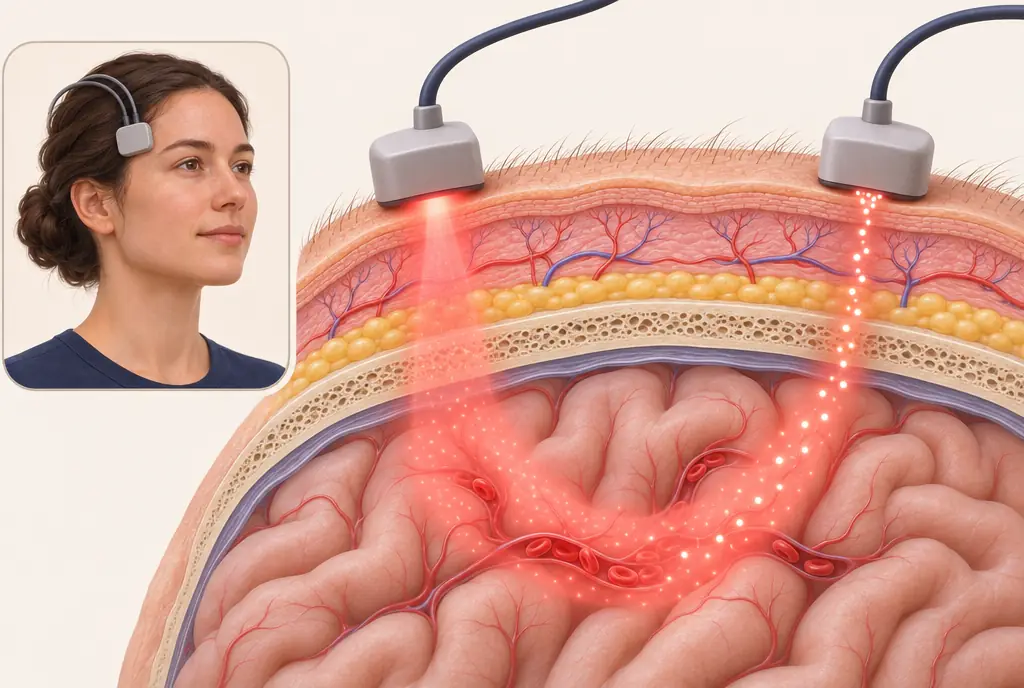
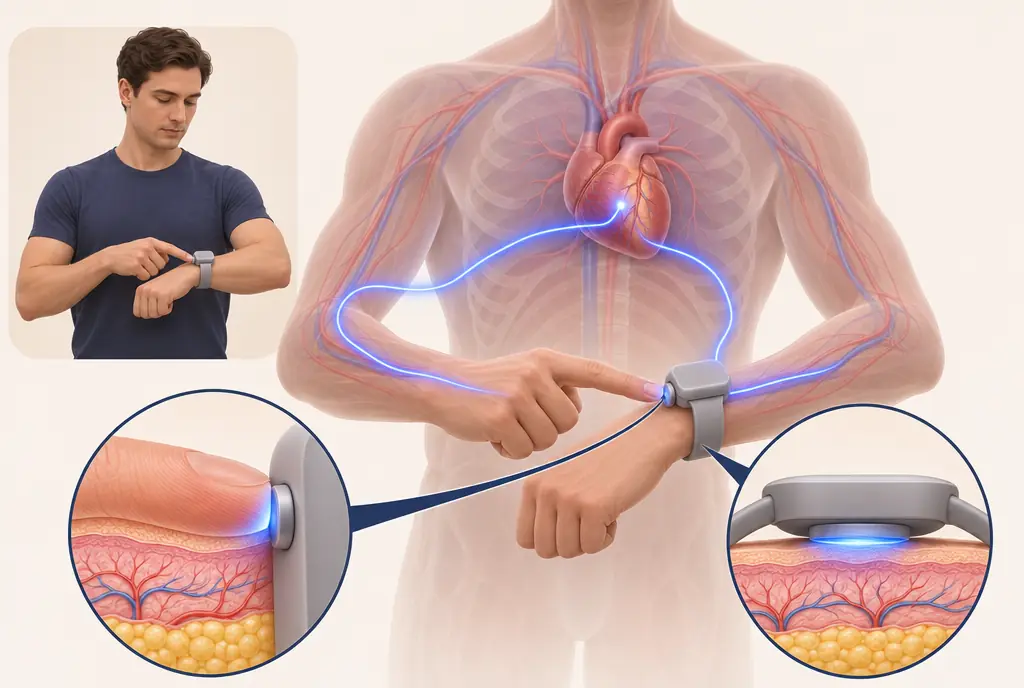
  31. Trafton A (2025). Noninvasive imaging could replace finger pricks for people with diabetes. MIT News
  32. FDA 510(k) and De Novo records cited inline were looked up in FDA's databases on 11 Nov 2026.

Educational content, not medical advice. Updated 2026-11-26.